

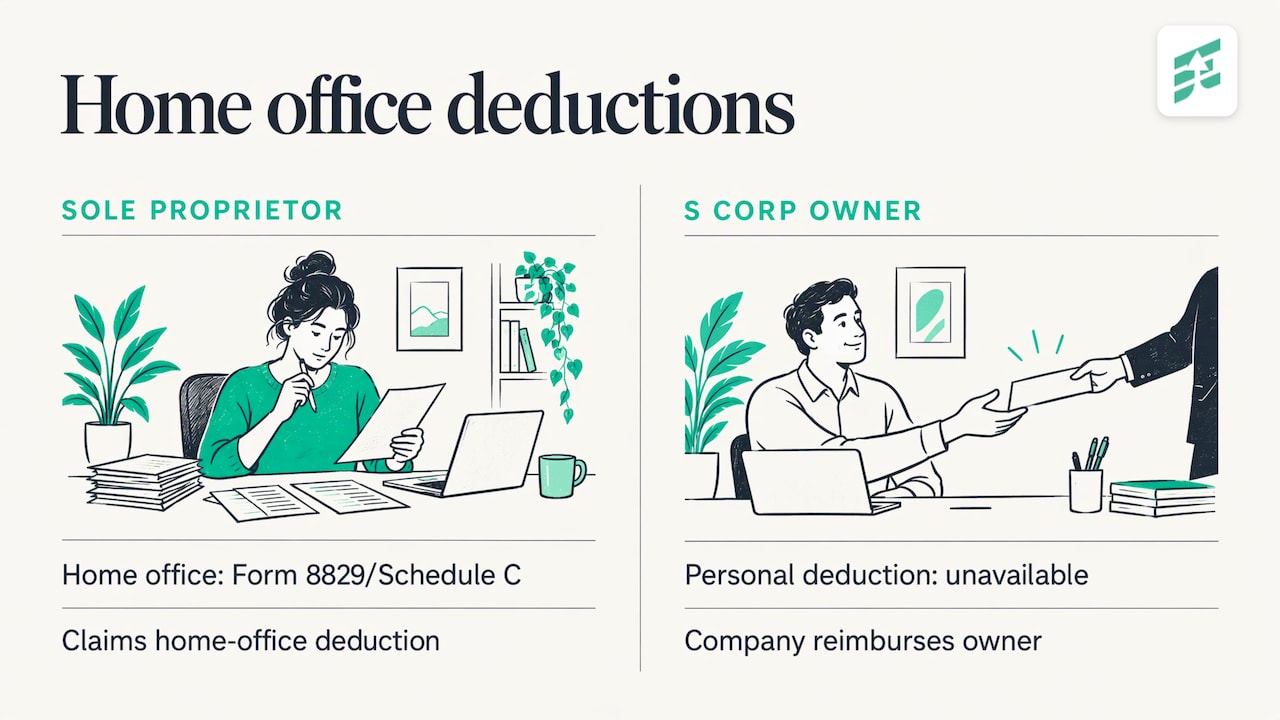
If you own an S corporation and work from home, you generally can’t claim the home office deduction on your personal return, because as a shareholder-employee you are treated as an employee of your own company. The workable route is an accountable plan: your S corp reimburses you for the business share of your home costs, deducts that reimbursement, and you receive it tax-free. Done right, you recover the same dollars the deduction was meant to capture. Done sloppily, the reimbursement turns into taxable wages.
TL;DR
- As an S corp owner who also works for the company, you are an employee, and the IRS says employees cannot deduct expenses for business use of the home on a personal return.
- An accountable plan fixes this: the corporation reimburses the business portion of your home costs, and the payment is not wages if the plan rules are met.
- The space still has to pass the IRS tests: regular and exclusive use, and it must be your principal place of business, a place to meet clients, or a separate structure.
- Keep a written plan, a square-footage calculation and monthly records. Without them, reimbursements can be recharacterized as W-2 pay.
Table of Contents
- Why the personal deduction disappears for S corp owners
- Does your workspace qualify?
- How an accountable plan works
- Which costs can be reimbursed, and how to split them
- Setting up the plan step by step
- How reimbursements show up in the books and on your returns
- Mistakes that turn reimbursements into wages
- Our perspective
- Let us set up your accountable plan
- FAQ
- Sources
Why the personal deduction disappears for S corp owners
Sole proprietors and single-member LLCs taxed as sole proprietors claim the home office deduction on Form 8829 or Schedule C. An S corporation changes the picture. Once you elect S status, the company is a separate taxpayer, and you are normally on its payroll as an officer who performs services. In IRS terms, that makes you an employee.
Publication 587 is clear that an employee cannot deduct expenses for business use of the home on a personal return. The 2017 Tax Cuts and Jobs Act had already blocked employees from deducting unreimbursed business expenses on Schedule A, which is why the old workaround of itemizing those costs stopped working for most people. Whatever the current status of that suspension when you read this, the cleaner and more reliable method is for the company to reimburse you.
That is the shift in thinking. The deduction does not move to your 1040. It moves to the corporation, through reimbursement.
If you are still deciding whether an S election makes sense at all, our guides on S corporation election requirements and LLC versus S corporation taxes cover the trade-offs, including the extra payroll and compliance work that comes with it.
Does your workspace qualify?
Before any reimbursement, the space must meet the same tests the IRS applies to everyone. Under Publication 587, the area must be used regularly and exclusively for business, and it must be one of the following:
- Your principal place of business
- A place where you meet clients or customers
- A separate, unattached structure such as a detached studio or garage
Incidental use does not count. The spare bedroom that holds your desk and also the guest bed fails the exclusivity test. The IRS notes that exclusive use does not require a permanent partition, so a clearly defined corner of a room can qualify if nothing personal happens there.
Principal place of business is judged by where your most important business activities happen and where you spend the most time. If you run your S corp from a home office and do the management, billing, planning and bookkeeping there, that usually supports the claim, even if you also work at job sites or client locations.
The convenience-of-the-employer wrinkle
Because you are an employee of your own company, the IRS also asks that your home use be for the convenience of your employer. For an owner whose company has no other office, that is usually straightforward. If the corporation leases an office you could use and you work from home by preference, the position gets weaker. Document why working from home is necessary: no company office, client calls at odd hours, equipment or records kept there.
What if you also hold a W-2 job?
Many owners keep a day job while building the S corp. Using the same room for both is where the exclusive-use test breaks, because the day-job work is personal use as far as your company is concerned. If you hold both, set aside a space used only for the S corp, or accept that the space will not qualify.
How an accountable plan works
An accountable plan is a written arrangement under which the company repays employees for business expenses. The IRS rules ask for three things, as laid out in IRS guidance on accountable plans:
- Business connection. Reimbursements cover only deductible business expenses you paid or incurred while performing services for the company.
- Substantiation. You account for each expense within a reasonable period, giving enough information for the company to identify the nature of the expense and tie it to the business.
- Return of excess. Any advance or allowance beyond what you substantiate is returned within a reasonable period.
If the arrangement meets all three, qualifying reimbursements are excluded from your gross income, are not reported as W-2 wages, and are exempt from withholding and employment taxes. The Form 2106 instructions say the same thing in plain terms: employer reimbursements are generally excluded from W-2 wages when you account for expenses on time and return any amount you did not spend on the business.
If the arrangement fails any one of the three, the payment is treated as wages reported on Form W-2 and subject to withholding and employment taxes. That is the risk of informal “I’ll just pay myself $400 a month for the office” arrangements.
Which costs can be reimbursed, and how to split them
The standard approach is to reimburse the business-use percentage of your home costs. You find the percentage by dividing the square footage of the office by the total square footage of the home. According to Intuit’s accountant guidance, the business portion of these costs is eligible:
- Mortgage interest or rent
- Property taxes
- Utilities
- Homeowners or renters insurance
- Repairs and maintenance
Costs that benefit only the office, such as painting that room or a dedicated phone line, are typically treated as fully business, not just a percentage. Confirm treatment of specific items with your CPA before you reimburse them.
A worked example
Say your home is 2,000 square feet and your dedicated office is 200 square feet. That is a 10% business-use share. These figures are illustrative, not typical for any particular home.
| Annual home cost | Total | 10% business share |
|---|---|---|
| Mortgage interest | $14,400 | $1,440 |
| Property taxes | $4,800 | $480 |
| Utilities | $3,600 | $360 |
| Homeowners insurance | $1,800 | $180 |
| Repairs and maintenance | $600 | $60 |
| Total | $25,200 | $2,520 |
The S corp reimburses you $2,520 for the year, or $210 a month, against your documented calculation. The company deducts $2,520 as a business expense. You report $0 of income from it. Without the plan, you would deduct nothing personally.
What about the simplified method?
The IRS simplified method allows $5 per square foot, capped at 300 square feet. It is an alternative to actual expenses, not an addition to them. In the example above, 200 square feet at $5 is $1,000, well under the $2,520 actual-cost figure. The simplified method is written for the individual deduction, so for an S corp owner the actual-cost method under an accountable plan generally captures more and ties to real records. Your CPA can confirm which method fits your situation.
Depreciation and what happens when you sell
If you own the home, a share of its depreciation can be part of the reimbursement. The catch: depreciation allowed or allowable on the office is recaptured as ordinary income when you sell the house. That is a planning decision, not a reason to skip the plan. Run the numbers with your CPA before you include it, especially if you expect to sell within a few years.
Setting up the plan step by step
- Confirm the space qualifies. Regular and exclusive use, plus a qualifying purpose. Take dated photos and measure the room.
- Adopt a written plan. A short document, approved in your corporate records, stating that the company reimburses business expenses that are substantiated within a reasonable time and that excess advances are returned.
- Calculate the business-use percentage. Office square footage divided by total square footage. Keep the floor plan or measurements.
- Gather annual home costs. Mortgage statements, property tax bills, utility bills, insurance declarations.
- Submit a reimbursement request. Monthly or quarterly works well. A one-page expense report listing each cost, the percentage and the amount, with statements attached.
- Pay from the corporate account. Reimburse by check or transfer, and record it in your books as an expense reimbursement, not payroll.
- Reconcile at year end. True up for actual costs, and return any excess you were paid.
The IRS standard on records is that you give the company enough information to identify the nature of each expense and connect it to the business. A spreadsheet plus the underlying bills satisfies that for most owners. Clean books make this nearly automatic, which is one reason we push owners toward regular bookkeeping instead of a once-a-year scramble.
How reimbursements show up in the books and on your returns
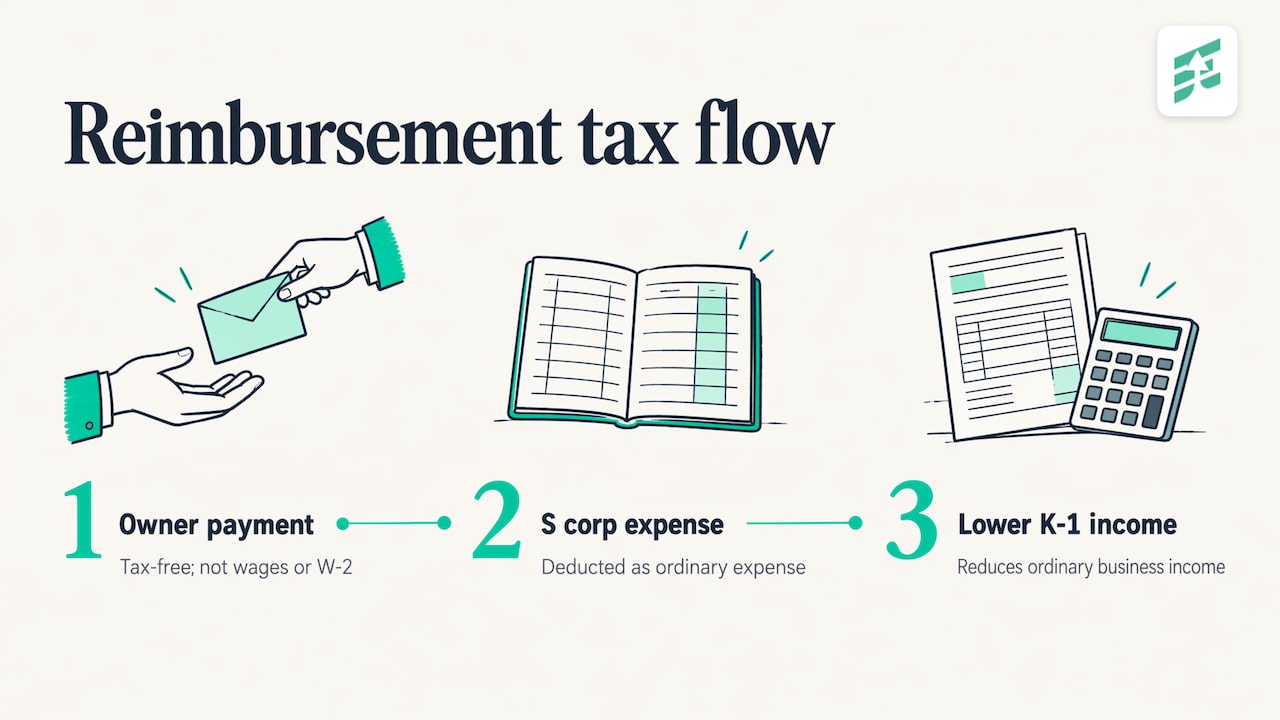
When the plan is followed, the S corporation deducts the reimbursement as an ordinary business expense, and you receive it tax-free with no W-2 reporting. Because the deduction lowers the corporation’s income, it flows through to your K-1 as lower ordinary business income. The reimbursement also does not count as wages, so it does not distort your reasonable salary.
That last point matters. Reimbursements are separate from your pay, and they never replace it. If you are unsure how to set your pay, our owner compensation guide walks through the thinking, and our piece on how to lower self-employment taxes legally shows where reimbursements fit alongside the other levers.
Mistakes that turn reimbursements into wages
- No written plan. Paying yourself a flat monthly “office allowance” with no substantiation is the classic way to fail the test.
- Estimating instead of documenting. Round-number reimbursements that do not tie to bills invite questions.
- Mixed-use space. A room that doubles as a guest room or gym fails exclusivity, and so does a room shared with a W-2 job.
- Skipping the return of excess. If you are advanced more than you substantiate, the surplus must come back within a reasonable time.
- Paying personal costs through the plan. Only the business share counts. Groceries, the family cell plan and the whole mortgage do not belong.
- Forgetting the sale. Depreciation included in reimbursements has a recapture cost at sale.
Our perspective
Most S corp owners we meet either skip the home office entirely because they heard “it doesn’t apply to S corps,” or reimburse themselves casually and hope no one asks. Both leave money on the table or create risk.
We treat the accountable plan as a year-round habit, not a tax-season fix. We write the plan, set the square-footage calculation, build the monthly reimbursement into your books, and review it each quarter alongside your salary, estimates and entity structure. That is how a small deduction stays a defensible one.
The same discipline helps in real estate, startups and cannabis businesses, where owners often work from home and the paperwork is tougher. Connecting your tax planning, bookkeeping and payroll in one place is what keeps these small wins from slipping through.
Justin Ash, CPA
Let us set up your accountable plan
Elevate Business Consulting is a CPA firm in Medford, Oregon, that works with small businesses, real estate investors, startups and cannabis operators on tax, accounting, payroll and advisory work. We can draft your accountable plan, calculate your business-use percentage, and make sure reimbursements flow correctly through your books and payroll. See our tax planning and preparation services or read how we approach year-round tax planning.
If your books are not ready to support the plan, our QuickBooks consulting and payroll processing teams can get the foundation in place first. Pricing is quoted per engagement, so reach out through the site to book a conversation.
FAQ
Can an S corp owner deduct a home office on Form 1040?
Generally no. As an employee of your own S corporation, you cannot deduct business use of the home on a personal return, as Publication 587 explains. The alternative is an accountable plan, where the company reimburses you for the business share of your home costs. The corporation takes the deduction instead.
Do I need a written accountable plan?
We strongly recommend one. The IRS tests are business connection, timely substantiation and return of excess, and a written plan plus a consistent reimbursement routine is the easiest way to show you met them. Without that, payments risk being treated as wages.
Is the reimbursement taxable to me?
Not if the plan is followed. Qualifying reimbursements are excluded from gross income and are not reported on your W-2 or subject to withholding and employment taxes. If the plan fails, the amount becomes taxable wages.
Can I use the $5 per square foot simplified method through my S corp?
The simplified method is $5 per square foot up to 300 square feet, and it replaces actual expenses rather than adding to them. For S corp owners, we usually calculate actual costs under the accountable plan, because it ties to your records. Ask your CPA which approach fits your home.
Does the space have to be a separate room?
No permanent partition is required, but the area must be used only for business and used regularly. The IRS says exclusive use means no personal use of that space. A defined corner that holds only your work setup can qualify, while a shared guest room does not.
Sources
- IRS Publication 587, Business Use of Your Home
- IRS FAQs: Simplified method for home office deduction
- IRS Information Letter 2008-0032 on accountable plans
- IRS guidance on additional compensation and accountable plans
- IRS Instructions for Form 2106
- Intuit: S corp home office deduction and accountable plan guide