
Financial statements are three reports that answer three different questions. The balance sheet shows what your business owns and owes today. The income statement shows whether you made a profit over a period. The cash flow statement shows where your cash came from and where it went. Read together, they tell you far more than your bank balance or your tax return can.
This guide walks through each statement with one small example, shows how they connect, and points out the mistakes we see owners make most often.
TL;DR
- The balance sheet is a snapshot on one date: assets = liabilities + equity.
- The income statement covers a period (a month, quarter or year) and ends in net income.
- The cash flow statement explains the change in your cash, and it can disagree sharply with your profit.
- The three statements are linked, so an error in your books usually shows up in all of them.
- They look backward. Their value comes from using them to plan taxes, cash and growth ahead of time.
Table of Contents
- What financial statements are, and who reads them
- The balance sheet: a snapshot of where you stand
- The income statement: did you make money?
- The cash flow statement: where the cash actually went
- Balance sheet vs. income statement: the quick comparison
- How the three statements connect
- How to read your statements in 15 minutes
- Mistakes that make statements misleading
- Our perspective: statements are for steering, not filing
- Setting up books that produce statements you can trust
- Want statements that actually guide decisions?
- FAQ
- Sources
What financial statements are, and who reads them
Financial statements summarize your bookkeeping in a standard format. The SEC’s beginners’ guide to financial statements describes the three core reports as the balance sheet, the income statement and the statement of cash flows. Public companies add a fourth, the statement of shareholders’ equity. A small business usually works with the first three.
Who reads them in a small business?
- You, to see whether the business is healthy and where the money goes.
- Lenders, who typically ask for them with a loan or line of credit application.
- Your CPA, who uses them to plan taxes before the year ends instead of after.
- Buyers or investors, if you ever sell or raise money.
The statements are only as reliable as the records behind them. The IRS says you may use any recordkeeping system suited to your business that clearly shows income and expenses, and it advises keeping supporting documents such as receipts and invoices organized. If your books are a mess, your statements will be too.
The balance sheet: a snapshot of where you stand
The balance sheet is dated a single day, such as December 31. It follows one equation, which the SEC guide also lays out: assets equal liabilities plus equity.
- Assets are what the business owns: cash, money customers owe you (accounts receivable), inventory, equipment, vehicles, a building.
- Liabilities are what it owes: credit cards, loans, unpaid bills (accounts payable), payroll taxes due, sales tax collected but not yet remitted.
- Equity is what is left for the owners: money you put in, profits kept in the business, minus what you took out.
A simple example
The numbers below are invented for illustration. Say a small landscaping company ends the year with:
| Assets | Amount | Liabilities and equity | Amount |
|---|---|---|---|
| Cash | $18,000 | Credit card | $4,000 |
| Accounts receivable | $12,000 | Equipment loan | $20,000 |
| Equipment | $40,000 | Accounts payable | $6,000 |
| Owner’s equity | $40,000 | ||
| Total assets | $70,000 | Total liabilities and equity | $70,000 |
Both sides total $70,000. If they do not match, something is wrong in the books. That is the first thing a CPA checks.
What to look for
- Cash against near-term bills. Can you cover the next 30 to 60 days of payables and payroll?
- Receivables that keep growing. Money owed to you is not money you can spend.
- Debt against equity. A thin equity cushion makes lenders nervous.
- Owner draws and personal expenses. If personal spending runs through the business account, the balance sheet gets distorted.
The income statement: did you make money?
The income statement, also called the profit and loss statement or P&L, covers a period of time. It starts with revenue and subtracts expenses to reach net income. The SEC guide describes it as showing how much money a company made and spent over a period.
A typical small business layout runs in this order:
- Revenue: what you billed or sold.
- Cost of goods sold (COGS): direct costs of delivering the product or service, such as materials and subcontractors.
- Gross profit: revenue minus COGS.
- Operating expenses: rent, software, insurance, wages, marketing, vehicle costs.
- Net income: what is left before or after income tax, depending on the entity.
Continuing the example, the landscaping company reports:
| Line | Amount |
|---|---|
| Revenue | $150,000 |
| COGS (materials, seasonal labor) | $60,000 |
| Gross profit | $90,000 |
| Operating expenses | $65,000 |
| Net income | $25,000 |
The gross margin is 60% ($90,000 divided by $150,000) and net margin is about 16.7%. Compare those percentages month to month and year to year. A slipping gross margin often means pricing or material costs have changed. Rising operating expenses can point to creeping overhead.
Why your accounting method changes this statement
The income statement depends on whether you use the cash or accrual method. Under the cash method you record income when you receive it and expenses when you pay them. Under accrual you record income when you earn it and expenses when you incur them. IRS Publication 583 explains both, notes that businesses with inventories generally must use accrual for purchases and sales, and says you must use the same method for your tax filings and your books. Changing an established method usually requires IRS approval.
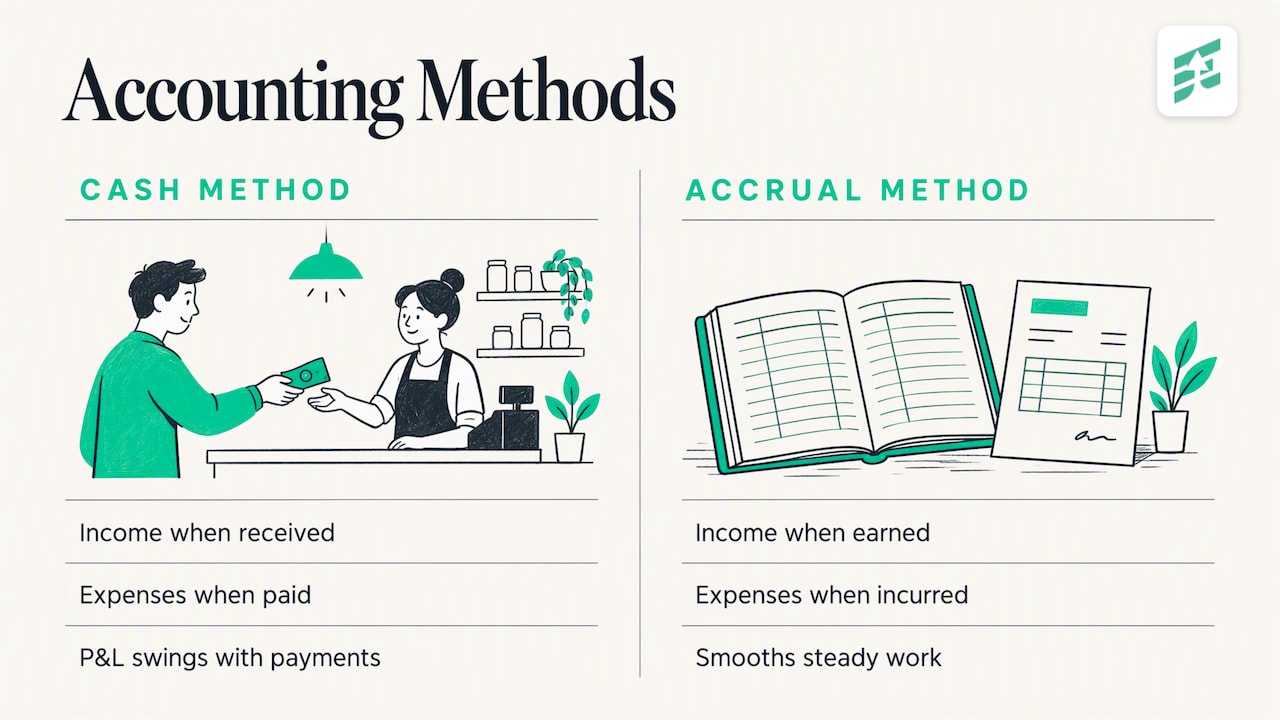
In practice, a cash-basis P&L can look great in a month when a big customer paid, and terrible in the month after, even though the work was steady. Accrual smooths that out, which is why many lenders prefer it.
The cash flow statement: where the cash actually went
The cash flow statement reconciles your beginning cash with your ending cash. It sorts the movement into three buckets:
- Operating activities: cash from running the business, such as customer payments in and supplier, payroll and rent payments out.
- Investing activities: buying or selling equipment, vehicles or property.
- Financing activities: loans received or repaid, owner contributions, owner draws.
Our landscaping company’s net income was $25,000, but suppose its cash rose by only $3,000. The statement might show:
| Cash flow item | Amount |
|---|---|
| Net income | $25,000 |
| Increase in receivables (customers owe more) | -$8,000 |
| Operating cash flow | $17,000 |
| New mower purchased | -$14,000 |
| Loan payments (principal) | -$6,000 |
| Owner draws | -$4,000 |
| Net change in cash | -$7,000 |
In this version, cash fell even though the business was profitable. That is not a bookkeeping error. It is exactly what the statement exists to reveal. The SEC guide makes the same point: an income statement tells you whether a company made a profit, while a cash flow statement tells you whether it generated cash.
This matters most for payroll and debt. A profitable business that runs out of cash on a Friday still cannot make payroll. If that worries you, our guide to cash flow forecasting for small businesses shows how to look ahead instead of only back.
Balance sheet vs. income statement: the quick comparison
| Balance sheet | Income statement | Cash flow statement | |
|---|---|---|---|
| Time frame | One date | A period | A period |
| Main question | What do we own and owe? | Did we profit? | Where did cash go? |
| Key result | Equity | Net income | Change in cash |
| Method sensitive? | Somewhat | Heavily | Less so |
| Best for | Borrowing capacity, solvency | Pricing, margins, taxes | Liquidity, payroll safety |
A useful shortcut: the balance sheet is a photograph, and the other two are videos of what happened between two photographs.
How the three statements connect
The statements are not independent. A few links to remember:
- Net income flows into equity. Profit kept in the business increases owner’s equity on the balance sheet. Owner draws reduce it.
- Net income starts the cash flow statement. It is then adjusted for non-cash items and changes in receivables, payables and inventory.
- The ending cash figure on the cash flow statement must equal the cash line on the balance sheet. If it does not, the books have an error.
That last check is a powerful, simple test. When someone hands you statements, confirm that cash matches across them and that the balance sheet balances. If either fails, do not trust the rest yet.
How to read your statements in 15 minutes
- Start with the balance sheet cash line. Compare it to your bank statement at the same date. They should reconcile.
- Scan the income statement for surprises. Look at the biggest expense lines and any category that is oddly large or oddly empty.
- Compare against last year and last month. One number alone means little. Trends mean a lot.
- Check receivables and payables. Are customers paying slower? Are you stretching vendors?
- Read the cash flow statement last. Ask why cash moved differently from profit.
- Look for personal items. Mixed personal and business spending is among the most common causes of confusing statements.
- Write down two questions for your CPA. Review is much more useful when it is specific.
Do not skip the notes
Larger companies attach notes to their statements explaining accounting policies, estimates and contingencies. Annual reports filed with the SEC, such as this example from a public company, show how the notes sit alongside the main statements to explain what the numbers alone cannot. Small businesses rarely produce formal notes, but the habit carries over: keep a short written record of unusual transactions, loans, and decisions about how you recorded them.
Mistakes that make statements misleading
- Mixing personal and business money. Your business checking account should be the primary source for your books. Everything else gets messy if it is not.
- Not reconciling accounts monthly. Unreconciled books produce statements that look official but are wrong.
- Miscategorizing owner draws or loan payments as expenses. This understates profit and overstates cost, and it throws off your tax picture.
- Switching methods casually. See the cash versus accrual note above.
- Ignoring weak controls. Statements depend on approvals, documentation and separation of duties. Our piece on accounting controls for small businesses covers practical ones.
- Only looking at them at tax time. By then, most planning options have closed.
Our perspective: statements are for steering, not filing
Most owners meet their financial statements once a year, when a tax preparer asks for them. We think that is the wrong rhythm. Financial statements are historical by nature: they describe how the business already operated. Their real value is what you do next with that history.
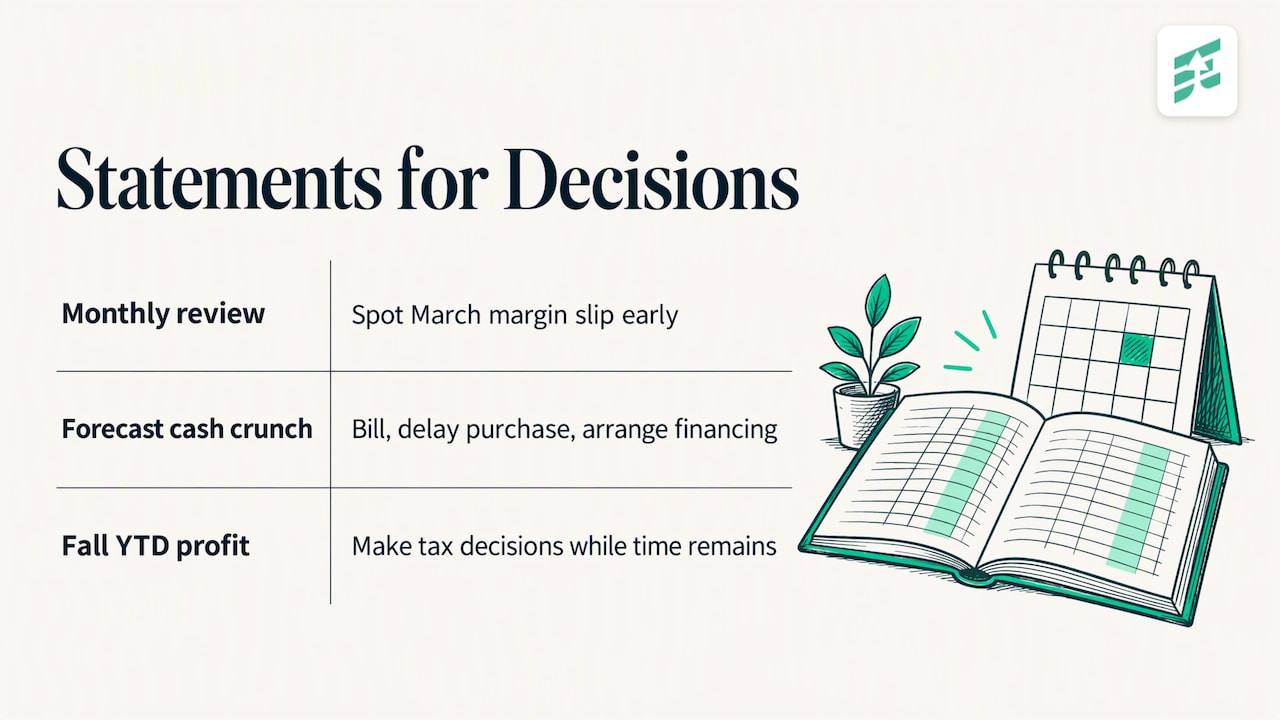
At Elevate, we work with small businesses, startups, real estate investors and cannabis operators, and the pattern repeats. The owner who reviews monthly statements notices a margin slipping in March, not in the following February. The owner who sees a cash crunch coming in the forecast can adjust billing, delay a purchase, or arrange financing before the crunch arrives. And the owner who looks at year-to-date profit in the fall can make informed tax decisions while there is still time to act.
That is why we connect the statements to tax planning, bookkeeping, payroll and advisory rather than treating them as separate chores. Clean books make accurate statements. Accurate statements make good planning possible. Good planning is how a business keeps more of what it earns and grows on purpose. For a deeper look, see our overview of financial reporting for business owners.
— Justin Ash, CPA
Setting up books that produce statements you can trust
If your statements feel unreliable, the fix usually starts upstream. A few foundations help:
- A clean chart of accounts with categories that match how you actually run the business. Startups can follow our approach to startup accounting system setup.
- Accounting software configured correctly. Many owners use QuickBooks but never set it up properly. Our QuickBooks consulting is aimed at that gap.
- A monthly close routine: reconcile bank and credit card accounts, review receivables and payables, then run the three statements.
- Clear roles. Know whether you need a bookkeeper, an accountant, or both. We explain the difference in bookkeeper vs. accountant.
- Organized records by year and category, as the IRS recommends in its guidance on business records.
Industry matters too. Real estate investors need property-level tracking, and cannabis businesses face unusual tax and compliance rules that shape how statements should be built. Our pages on real estate accounting and cannabis accounting cover those.
Want statements that actually guide decisions?
Elevate Business Consulting is a CPA firm in Medford, Oregon, offering tax planning and preparation, accounting and bookkeeping, payroll, and business consulting for small businesses. If you would like monthly statements prepared and explained in plain English, and tied to a year-round tax strategy, you can talk with us about your business. If you are comparing what a local firm should do for you, start with what a Medford CPA should do for your business.
FAQ
What are the three main financial statements?
They are the balance sheet, the income statement and the statement of cash flows. The balance sheet shows financial position on one date, while the other two cover a period of time. Public companies also present a statement of shareholders’ equity, as the SEC beginners’ guide notes.
Can a business be profitable and still run out of cash?
Yes. Profit counts income when earned and expenses when incurred under accrual accounting, but cash only moves when money is received or paid. Unpaid customer invoices, equipment purchases, loan principal and owner draws can all drain cash while the income statement shows a profit. That is why the cash flow statement matters.
Which financial statements do I need for a small business?
At minimum, a monthly balance sheet and income statement, plus a cash flow statement or forecast. Lenders usually ask for all three. Your CPA also needs them to plan taxes, and your accounting method (cash or accrual) should match what you use for your tax return.
How often should I review my financial statements?
Monthly is a good rhythm for most small businesses, once your accounts are reconciled. A quarterly review with your CPA is a sensible minimum, and it lines up with estimated tax planning. Reviewing only at year-end leaves little room to change the outcome.
Do I need a CPA to prepare financial statements?
Not legally for most small businesses, since software can generate them. But the output is only as good as the underlying entries and categories. A CPA reviews the books, explains what the numbers mean, and connects them to tax decisions.
Sources
- SEC: Beginners’ Guide to Financial Statements
- IRS Publication 583: Starting a Business and Keeping Records
- IRS: What kind of records should I keep
- SEC filing: Consolidated financial statements and notes example