

An S corp and a C corp are both corporations. The difference is how the IRS taxes them. A C corp pays its own federal income tax and its shareholders pay again on dividends. An S corp passes its income through to the owners’ personal returns. For most owner-operated small businesses that plan to stay closely held, the S corp is the usual first look. For businesses that expect to raise venture capital or bring in many kinds of investors, the C corp is usually the better fit.
This guide walks through the real differences, a worked example, the traps we see most often, and how to decide.
TL;DR
- A C corp pays a flat 21% federal corporate rate, and dividends are taxed again at the shareholder level. An S corp generally pays no federal income tax at the entity level.
- An S corp is limited to 100 shareholders, one class of stock, and eligible owners who are U.S. citizens or residents. A C corp has none of those limits.
- S corp owners who work in the business must take a reasonable salary before taking distributions.
- S corp is a tax election, not a separate type of company. An existing LLC can often make it without re-forming.
- Plan for how you will grow and exit before you pick. Tax savings now can cost you flexibility later.
Table of Contents
- What actually separates an S corp from a C corp
- The eligibility rules that rule S corps in or out
- How the tax math works for a small business
- When a C corp is the better answer
- When an S corp is the better answer
- You may not need to form a new company at all
- Deadlines: electing S status on time
- Don’t forget state tax
- Our perspective
- A simple way to decide
- Common mistakes to avoid
- How we can help
- FAQ
- Sources
What actually separates an S corp from a C corp
Both start the same way: you form a corporation (or an LLC that elects to be taxed as one) under state law. Both give owners liability protection. The split happens on the tax return.
A regular C corporation is taxed once at the corporate level. The Congressional Research Service describes this in its overview of business types and their tax treatment. Since the Tax Cuts and Jobs Act, the federal rate has been a flat 21%. When the corporation then pays out profit as dividends, shareholders pay tax a second time on their own returns. That is the double taxation people talk about.
An S corporation works differently. As the IRS explains, income, losses, deductions and credits flow through to shareholders, who report them on their individual returns and pay at their personal rates. The corporation files Form 1120-S, an informational return, rather than paying income tax itself. You can see the form on the IRS 1120-S page.
Here is the comparison at a glance:
| Factor | S corp | C corp |
|---|---|---|
| Federal income tax on profit | Passed through to owners | 21% at the corporate level |
| Dividend tax | No second layer | Shareholders taxed again |
| Shareholders | Up to 100, eligible individuals, certain trusts and estates | No limit on number or type |
| Citizenship | All shareholders U.S. citizens or residents | No restriction |
| Stock classes | One | Multiple allowed |
| Typical fit | Closely held, owner-operated | Venture-backed or large-scale growth |
| Owner pay | Reasonable salary required | Salary and dividends, taxed separately |
The eligibility rules that rule S corps in or out
The IRS lists the requirements in Publication 509. To be an S corp you must be a domestic corporation with no more than 100 shareholders and only one class of stock. Shareholders are limited to individuals, certain trusts and estates, and all must be U.S. citizens or residents.
These rules matter more than most owners expect. A foreign co-founder, a venture fund, or a second class of preferred stock for investors each breaks S status. If any of those are on your roadmap, the S corp may be a short-lived choice. We cover the filing mechanics in more detail in our guide to S corporation election requirements.
How the tax math works for a small business
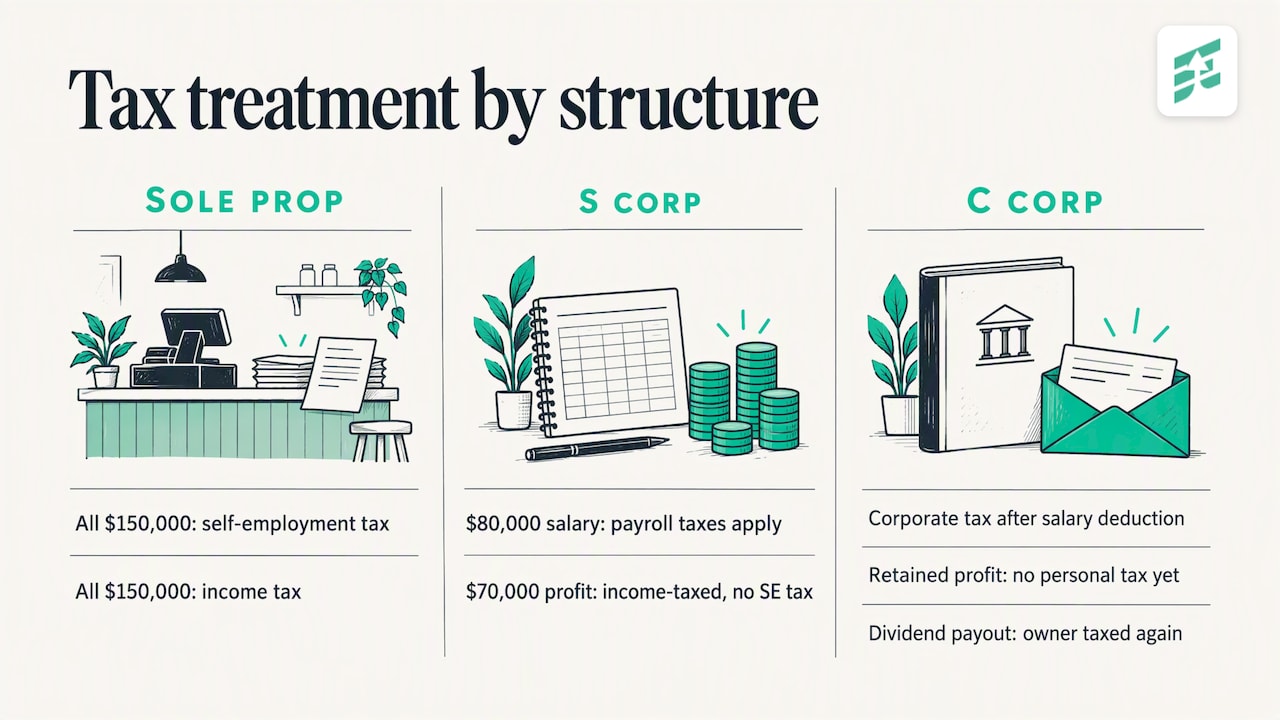
Take a hypothetical owner-operator whose business nets $150,000 before owner pay. These figures are for illustration only, not a forecast of your result.
As a sole proprietor or default LLC. The entire $150,000 is subject to self-employment tax plus income tax.
As an S corp. The owner pays herself a reasonable salary, say $80,000, through payroll. Payroll taxes apply to that salary. The remaining $70,000 flows through as profit, taxed for income tax but not subject to self-employment tax. That gap is where the potential savings come from.
As a C corp. The corporation pays tax on profit after the salary it deducts. If it keeps the profit for growth, the owner does not pay personal tax on it yet. If it pays that profit out as a dividend, the owner is taxed on it as well.
The self-employment savings in the S corp scenario are real, but they are not free. You take on payroll processing, a separate corporate return, and the compliance work that comes with both. Our article on how to lower self-employment taxes legally shows where an S election fits among other options.
Reasonable compensation is the hard line
The IRS is clear that shareholder-employees who provide more than minor services must be paid wages. Its page on S corporation employees, shareholders and corporate officers warns against taking everything as distributions to avoid payroll tax. The salary should reflect what the services are worth in the market, not what keeps payroll cheapest.
Practical ways to stay on the right side:
- Look at what comparable businesses pay someone to do your job.
- Document how you arrived at the number each year.
- Run salary through real payroll, with withholding and quarterly filings.
- Revisit the number when your role or revenue changes.
We go deeper on setting the number in our small business guide to owner compensation.
When a C corp is the better answer
The S corp gets most of the attention in small business circles, but the C corp is not the loser here. It has real strengths.
- Outside investment. Startups seeking institutional venture capital typically need a C corp to accommodate multiple stock classes, foreign investors and institutional owners, none of which S corp rules permit. The Congressional Research Service overview notes that the C corp lacks limits on the number or type of shareholders.
- Retaining earnings. If you plan to reinvest most profit in the company, the 21% corporate rate can be attractive compared with passing everything through to a high personal bracket. Whether it is better depends on your numbers and on your exit plans.
- Flexibility on ownership. Entities, nonresident owners and complex cap tables work in a C corp.
NerdWallet makes a similar point in its S corp vs. C corp comparison: weigh your long-term goals, such as keeping the business closely held, passing it to family, or pursuing a high-growth exit, against the pull of immediate tax savings.
When an S corp is the better answer
An S corp tends to suit a business that:
- is owned by a handful of U.S. individuals who work in it,
- is profitable enough that salary plus distributions makes sense,
- does not plan to take venture capital,
- wants to avoid the second layer of tax on profit paid to owners.
A real estate investor with a few partners, a service business with steady profit, or an owner-operated shop often falls here. Real estate has its own wrinkles, though, since some property-holding structures do not mix well with an S corp. If that is you, talk to a CPA before filing anything. Our team handles real estate accounting for investors and can look at the structure with you.
You may not need to form a new company at all
Many owners assume choosing an S corp means starting over. It does not. Practitioners point out that S corp status is a tax election, not a separate state-level entity. An existing LLC can often elect S corp tax treatment with the IRS without changing its state registration, as described in the NerdWallet guide above. The IRS explains in the Form 2553 instructions that a corporation, or an entity eligible to be treated as one, uses that form to make the election.
That is why the question “LLC or S corp?” confuses so many people. They are not on the same axis. An LLC is a legal structure, and an S corp is a tax status it can choose. Our explainer on LLC versus S corporation taxes untangles it, and LLC tax questions every owner should ask covers what to check first.
Deadlines: electing S status on time
The election on Form 2553 is generally due within 2 months and 15 days of the start of the tax year it should take effect, according to Publication 509. You can also file it at any point during the preceding tax year.
For a calendar-year business, that means mid-March for the same year. Today is October 22, 2026, so a business that wants S status for 2027 can file the election now, before the year begins. That is often cleaner than trying to catch the March window.
If you miss the deadline, relief may be available when you can show reasonable cause. The Form 2553 instructions describe the process under Rev. Proc. 2013-30, which includes a specific annotation on the form and, in many cases, proof that everyone has reported income as if the election were in effect. Late relief is a fix, not a plan, so start early.
Don’t forget state tax
Federal tax is only part of the picture. Our firm is based in Medford, so we see Oregon rules often. Oregon taxes corporations doing business in the state, and the Oregon Department of Revenue states that an S corporation doing business there must pay a $150 minimum excise tax, which does not flow through to shareholders. Other states handle S corps differently, so check yours before you assume that pass-through at the federal level means no tax at the state level.
Our perspective
We work with small businesses, startups, real estate investors and cannabis operators, and the S corp versus C corp question comes up in nearly every first conversation. Our view is that this is rarely a one-time decision. It is a planning decision that should be revisited as the business changes.
Three things we tell owners:
- Start with where the business is going, not just this year’s tax bill. A structure that saves money for three years and then blocks a fundraising round is expensive.
- Treat the S corp as a system, not a switch. It only works well with clean books, real payroll and a documented salary. Sloppy bookkeeping erases the savings.
- Plan all year. Salary level, estimated payments and distributions are easier to set in the spring than to repair in March. Our quarter-by-quarter guide to year-round tax planning lays out the rhythm we follow.
We also think owners benefit when their CPA connects the tax choice to payroll, accounting and advisory, so each piece supports the others rather than being handled by separate people who never talk.
— Justin Ash, CPA
A simple way to decide
Work through these questions in order.
- Will you take venture capital or institutional money? If yes, lean toward a C corp.
- Will any owner be a nonresident, an entity, or hold a different class of stock? If yes, S corp is off the table.
- Does the business make a steady profit above what you would pay yourself in salary? If yes, an S corp may cut self-employment tax.
- Do you plan to reinvest most profits? Compare the 21% corporate rate against your personal bracket with real numbers.
- Can you run payroll and file a separate return every year? If not, budget for help first.
To see how this fits with the other entity types, read how to choose a business entity structure.
Once the structure is set, you will also be choosing how the company spends and tracks money. A comparison of business cards and spend tools can help you think about controls at the stage where growth and investor expectations start to shape the books.
Common mistakes to avoid
- Paying no salary. Distribution-only compensation is the classic S corp pitfall and one the IRS has challenged successfully.
- Electing too late. Missing the 2 months and 15 days window creates paperwork you could have avoided.
- Ignoring eligibility. One ineligible shareholder can end S status.
- Choosing on taxes alone. Financial advisors cited by NerdWallet recommend weighing the long-term goal along with the immediate tax savings.
- Mixing personal and business money. It weakens liability protection and makes reasonable compensation harder to support.
How we can help
If you are weighing an S election, a new corporation, or a change of structure, we can model the options with your actual numbers and then handle the follow-through: business formation, payroll, bookkeeping and tax planning. See our tax planning and preparation services or the full list on our services page, and book a conversation about your business.
FAQ
Can an LLC be taxed as an S corp?
Yes, in many cases. S corp is a tax election rather than a separate legal entity, so an eligible LLC can file Form 2553 with the IRS and keep its state registration. It must still meet the S corp requirements, including the shareholder and stock rules.
Is an S corp better than a C corp for a small business?
Not always. An S corp often suits closely held, profitable businesses because income passes through without a second layer of tax. A C corp can be the better choice when you plan to raise outside capital or have owners an S corp does not allow.
Do S corp owners have to pay themselves a salary?
Yes, if they perform more than minor services for the corporation. The IRS expects wages that reflect fair market value for the work, run through payroll. Taking only distributions to dodge payroll tax invites challenge.
What happens if I miss the S corp election deadline?
You may still qualify for late-election relief if you can show reasonable cause. The process involves filing Form 2553 with a specific annotation under Rev. Proc. 2013-30 and, often, showing that you reported income consistently with an S election. A CPA can tell you whether your facts fit.
Can a C corp switch to an S corp later?
It can, if it meets the eligibility rules at the time of election. Switching has tax consequences that depend on the company’s history, so model it with a CPA before you file.
Sources
- A Brief Overview of Business Types and Their Tax Treatment, Congress.gov
- S corporations, Internal Revenue Service
- Publication 509 (2026), Tax Calendars, IRS
- S corporation employees, shareholders and corporate officers, IRS
- Instructions for Form 2553, IRS
- 2025 Form 1120-S, IRS
- S Corp vs. C Corp, NerdWallet
- Corporation Excise and Income Tax, Oregon Department of Revenue