
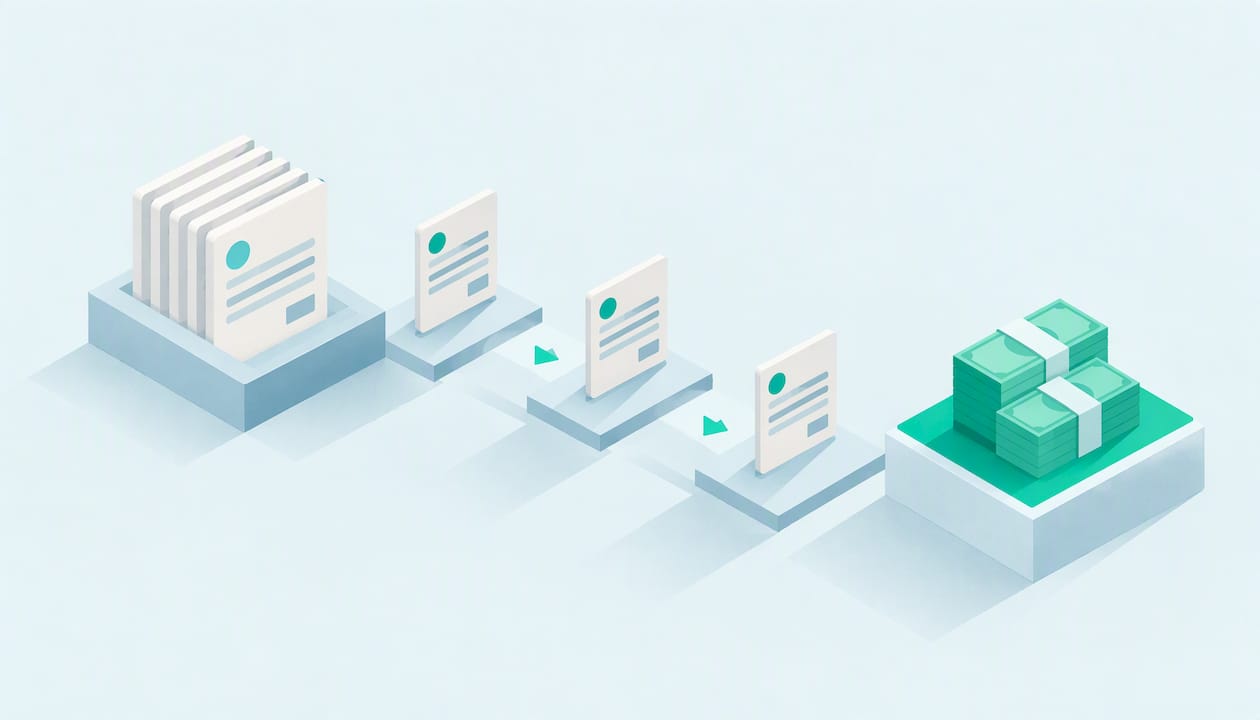
Accounts receivable collections are everything you do to turn an unpaid invoice into cash: invoicing correctly, watching due dates, following up on late payers, and recording the payment once it arrives. Done well, collections are a routine that runs on a calendar. Done badly, they are a scramble that happens only when the bank balance gets tight. This guide covers the process, the journal entry, the numbers worth tracking, and a follow-up cadence you can start using this week.
TL;DR
- Collections start before the invoice: clear terms, a credit check on larger customers, and an accurate, prompt invoice prevent most late payments.
- Follow up on a schedule, not on a feeling. Reminder before the due date, a call within the first couple of weeks past due, a firm written notice, then a payment-plan conversation.
- When a customer pays, debit Cash and credit Accounts Receivable. It does not create new revenue.
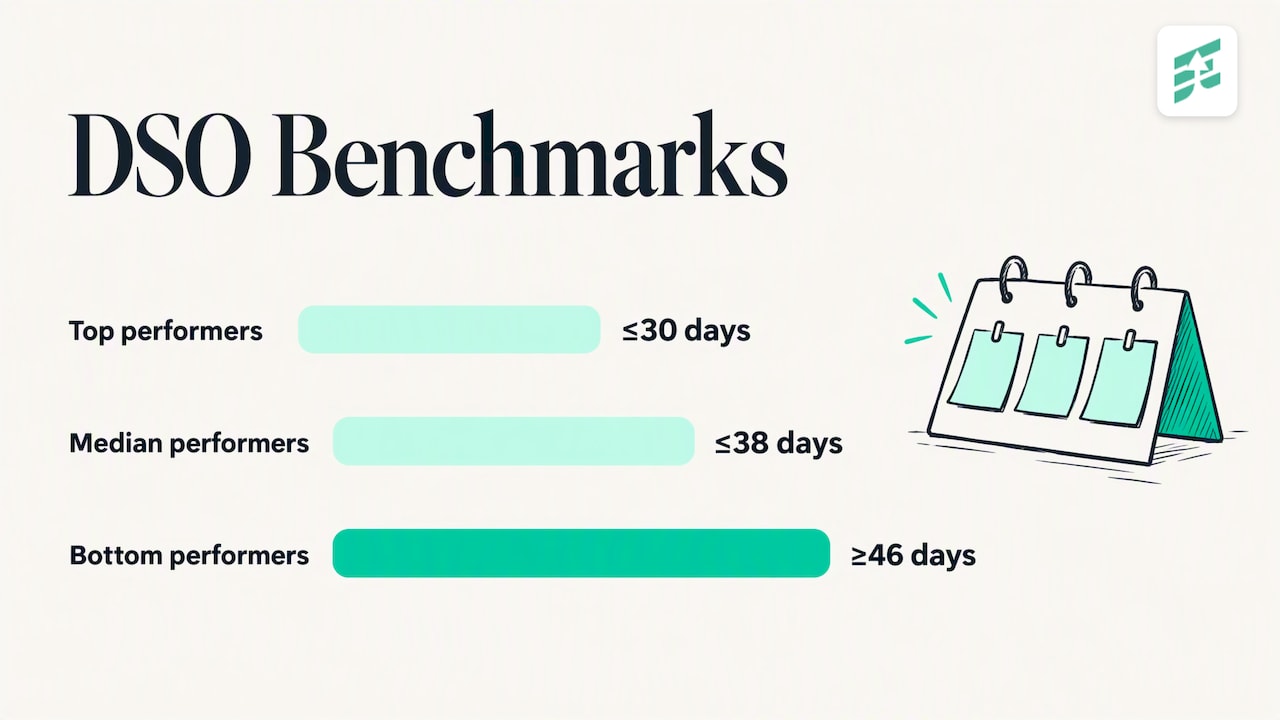
- Track days sales outstanding (DSO) and an aging report monthly. Median performers collect in 38 days or less.
- If a balance is truly uncollectible, how you write it off depends on your accounting method, so ask your CPA before you book it.
Table of Contents
- What accounts receivable collections actually are
- What happens when a customer pays
- Build the process before the first invoice goes out
- A follow-up schedule that works
- Measure it: aging reports and days sales outstanding
- When a balance will not be collected
- Why collections and cash flow forecasting go together
- Our perspective
- Get your receivables under control with a CPA
- FAQ
- Sources
What accounts receivable collections actually are
An account receivable is money a customer owes you for goods or services you already delivered on credit. Cornell’s Legal Information Institute defines it as a current asset: you record it when the work is delivered, and settlement begins when you send the invoice.
Collections is the work of getting that balance paid. It sits inside the wider credit-to-cash cycle, which Quadient describes as converting receivables into cash. For a small business, that usually means one person (often the owner) doing invoicing, reminders, phone calls and bookkeeping between other jobs. That is exactly why a written process matters: it removes the daily decision about whether to chase.
A useful distinction: accounts receivable is the balance, and collections is the activity. A growing receivables balance is not a sign of a healthy business if the cash is not coming in. You can show a profit on paper and still miss payroll.
What happens when a customer pays
When a customer pays an open invoice, the company increases cash, reduces accounts receivable and reconciles the ledger against the payment received. Three practical points follow.
- Match the payment to the right invoice. Partial payments and single payments covering several invoices are where books go wrong. Billtrust notes that each payment must be applied to the matching invoice, then the customer account and payment records updated and reconciled.
- Collection is not income. Under accrual accounting, collecting a receivable does not affect net income, because the revenue was recognized when you provided the goods or services.
- Deposit what you applied. The bank deposit and the invoice payment should tie to the same amount. When they do not, you have an unapplied payment or a fee that needs its own line.
The journal entry
For a normal collection, the standard entry is a debit to Cash and a credit to Accounts Receivable for the same amount.
| Event | Debit | Credit |
|---|---|---|
| You invoice $4,000 for work completed | Accounts Receivable $4,000 | Revenue $4,000 |
| The customer pays the $4,000 invoice | Cash $4,000 | Accounts Receivable $4,000 |
The first line recognizes revenue. The second only moves value from one asset (a promise to pay) to another (cash). In QuickBooks, you get this entry by using Receive Payment against the open invoice rather than recording a plain deposit. A plain deposit leaves the invoice open and books the money as revenue a second time. If your receivables balance never seems to match what customers say they owe, this is the first place we look. Our walkthrough on reconciling QuickBooks monthly shows how to catch it.
Build the process before the first invoice goes out
Most late payments trace back to something that happened before the due date. Citi’s small business guide lays out a typical receivables workflow: credit sale or service delivery, invoice, recording the receivable, tracking, follow-up, settlement, and an allowance or write-off for debt that will not be collected. J.P. Morgan’s guidance adds credit assessment up front, plus timely, detailed invoicing, aging-based monitoring, cash application and reconciliation.
Turned into a small-business checklist:
- Agree terms in writing. Due date, accepted payment methods, late-fee terms and what happens if the account goes to collections should be in the contract or proposal, and repeated on the invoice.
- Check credit on larger or repeat-credit customers. For a $500 job, a deposit does the same work. For a $25,000 job, ask for references or a deposit before you start.
- Invoice fast and accurately. Quadient’s process-cycle view is that accurate, timely invoicing prevents disputes and delays downstream. A wrong PO number or missing line item gives a customer a legitimate reason to wait.
- Make paying easy. Offer card and ACH links on the invoice itself. CFO.com, reporting APQC research, lists electronic payments, automated invoicing and a reminder about 10 days after invoicing among the practices that reduce DSO.
- Record it the same day. Receivables that live in a spreadsheet or an email folder cannot be aged or reconciled.
If you sell subscriptions, memberships or courses, recurring payment setups remove much of the chasing, because the customer pays on a schedule without waiting for an invoice.
Terms that change behavior
- Deposits on larger jobs convert part of the sale to cash on day one.
- Shorter payment windows, such as due on receipt or net 15 for small invoices, shorten the whole cycle. Net 30 is a habit, not a rule.
- Late-payment penalties and early-payment discounts. The same CFO.com piece names penalties, early-payment incentives, credit restrictions and deposits as levers on DSO. A 2% discount for paying in 10 days is expensive, so use it only if the faster cash is worth more to you than the margin.
- Credit holds for repeat late payers. No new work until the old invoice is paid is a reasonable policy if it is in your terms.
A follow-up schedule that works
The most common collections failure is not aggression or softness. It is inconsistency: one invoice gets chased at day 3, another is ignored until day 75 because the owner was busy. A fixed cadence also keeps the tone professional, because every customer gets the same treatment.
No official standard sets these intervals, so treat the following as a starting template and adjust for your industry and invoice size. It is built on the escalation stages Quadient lists: verify the past-due amount, send written reminders, contact the customer, negotiate arrangements, monitor installments, refer to an agency, consider legal action, and write off what stays uncollectible.
| Timing | Action | Tone |
|---|---|---|
| 5 to 8 business days before due date | Courtesy reminder with invoice copy and payment link | Helpful |
| Due date + 1 day | Short email: “Did this reach you?” | Friendly |
| Due date + 7 days | Phone call; confirm there is no dispute | Direct, curious |
| Due date + 14 days | Formal written notice citing terms and any late fee | Firm |
| Due date + 30 days | Call to ask what is holding payment up; offer a written payment plan | Problem-solving |
| Due date + 60 days | Pause new work; decide on agency, attorney or write-off | Final |
The first call matters most. Many “late” invoices are really lost emails, a missing purchase order, or an approver who is on vacation. Ask a question instead of making an accusation, and write down the promised date. When a customer gives you a date, follow up the day after it passes.
Handling disputes
A disputed invoice is a different problem from a late one, and it should not sit in the same queue. Quadient’s guidance is to investigate quickly and keep the people who handle receivables, sales and the customer talking to each other. In a small shop that means: whoever did the work reviews the complaint within two business days, you issue a credit memo for any amount you agree was wrong, and you collect the undisputed part immediately. Customers who dispute 10% of an invoice often hold all of it.
Payment plans
A payment plan is usually better than a lawsuit. Put it in writing, set specific dates and amounts, and state that missing one payment makes the full balance due. Then monitor it as you would any other receivable: a plan that nobody tracks fails quietly.
Measure it: aging reports and days sales outstanding
Two reports tell you most of what you need.
The A/R aging report sorts open invoices into buckets: current, 1 to 30 days past due, 31 to 60, 61 to 90, and over 90. Review it weekly. The money in the over-60 buckets is the money you are least likely to see, and the report also shows concentration: one customer making up 40% of your receivables is a risk even when they pay on time.
Days sales outstanding is the average number of days it takes to collect payment. CFO.com, citing APQC, defines it that way and says unbilled receivables should be excluded. The standard calculation is:
DSO = (accounts receivable at period end ÷ credit sales in the period) × days in the period
A worked example with made-up numbers: you have $60,000 in open receivables at the end of a 90-day quarter and invoiced $180,000 on credit during it. DSO = ($60,000 ÷ $180,000) × 90 = 30 days. If your terms are net 30, that is excellent. If your terms are net 15, you are paying for the gap.
What a good number looks like
APQC’s cross-industry benchmarks, reported by CFO.com, put top performers at 30 days or less, median performers at 38 days or less, and bottom performers at 46 days or longer. Those are broad averages. A contractor billing milestones and a dental practice billing insurers will sit in very different places, so the most useful comparison is your own DSO trending over twelve months.
To reduce DSO, work the sequence in this guide: invoice sooner, shorten terms, make payment easier, remind earlier and escalate on schedule. Often the cheapest improvement is the first one. An invoice sent on day 10 after the work instead of day 1 adds nine days to DSO before the customer has even seen it.
Set a written policy with real targets
Dun & Bradstreet’s collections eBook says a written policy should define attainable goals such as a maximum DSO, lower bad debt and fewer accounts handed to third parties. For a small business that can fit on one page: your terms, your reminder schedule, who calls, the dollar threshold that triggers a credit hold, and who approves a write-off.
When a balance will not be collected
Some invoices will never be paid. Plan for that instead of being surprised by it.
- Know your options in order. Written demand, payment plan, collection agency (which typically takes a share of what it recovers), small-claims or civil action, then write-off. The right stopping point depends on the amount and the cost of pursuit.
- Check the paperwork before you escalate. A signed agreement, a clear invoice and a record of your follow-up make every later option stronger.
- Write-offs have tax rules. The IRS explains in Publication 535 that a business bad debt deduction is only available if the amount owed was previously included in your gross income. That means a cash-basis business that never received the money generally has nothing to deduct, because it never counted the sale as income. An accrual-basis business has already counted the revenue, so the write-off matters. Which one you are, and how to document worthlessness, is a conversation for your CPA before year-end. Our guide to year-round tax planning shows where it fits in the calendar.
- Reserve for it. Under accrual accounting, an allowance for uncollectible accounts spreads the expected loss across the period the sales were made, rather than letting one big write-off distort a single month.
Why collections and cash flow forecasting go together
Collections are not only a bookkeeping task. They decide when you can make payroll, pay estimated taxes and buy inventory. If your forecast assumes every invoice is paid on its due date and customers actually pay 20 days late, the forecast is wrong by 20 days of cash. Use your aging report and real customer payment habits as inputs. Our piece on cash flow forecasting for small businesses walks through that, and quarterly estimated tax payments are the cash call most often missed when receivables run slow.
It also changes who should do the work. Once you are sending more than a few dozen invoices a month, a bookkeeper rather than a one-time accountant usually pays for the time: they apply payments, age the ledger and flag trouble before you see it in your bank balance.
Our perspective
We see the same pattern with small business clients in Southern Oregon and beyond. The owner thinks they have a collections problem, but the books show an invoicing problem and a records problem. Invoices go out late, payments are booked as deposits instead of applied to invoices, and the receivables balance on the books drifts away from what customers actually owe. Nobody can chase accurately from a ledger like that.
Our approach is to treat collections as part of the year-round financial picture, not a separate chore. Tax planning depends on knowing what income you have really earned. Payroll depends on cash arriving on time. Advisory decisions about hiring or buying equipment depend on a forecast built from real payment behavior. So we fix the foundation first (clean books, applied payments, a monthly aging review) and then build the follow-up routine around it. It is also the part clients tend to notice first: fewer surprises, and a number they can trust when they ask how much they are owed.
The best collections policy is the one that is short enough that you actually use it.
— Justin Ash, CPA
Get your receivables under control with a CPA
If your aging report is out of date, your payments are not applied to invoices, or you cannot say what your DSO is, the books are the first thing to fix. Elevate Business Consulting, LLC is a CPA firm in Medford, Oregon, that handles accounting, bookkeeping, payroll, tax planning and business advisory for small businesses, startups, real estate investors and cannabis operators. We can set up your receivables workflow in QuickBooks, keep it reconciled monthly and connect it to your tax and cash planning. Our prices are quoted per engagement, so contact us through our main site to talk through what you need, or see our bookkeeping services.
If your system needs repair first, start with our QuickBooks consulting services or the QuickBooks cleanup checklist.
FAQ
What is the journal entry for an accounts receivable collection?
Debit Cash and credit Accounts Receivable for the amount received. The credit removes the collected balance from your receivables, and it does not create new revenue because the sale was recorded when you invoiced. If the customer pays only part, credit receivables for the part paid and leave the rest open.
What is the average collection period for accounts receivable?
APQC data reported by CFO.com shows median performers collect in 38 days or less, with top performers at 30 days or less. Your industry and payment terms shift that range, so compare your DSO with your own terms and your own history first.
How do I improve my AR collections quickly?
Invoice the day the work is done, put the due date and payment link on the invoice, and send a reminder before it is due. Then call at about a week past due instead of sending a third email. Those three habits typically move cash faster than any software change.
When should I send an account to a collection agency?
There is no fixed rule, but many businesses decide around 60 days past due, after written notices and a payment-plan offer have failed. Weigh the balance against the cost of pursuit, and talk to your CPA about the tax treatment before you write anything off.
Sources
- Account receivable, Cornell Law School Legal Information Institute
- What Are Accounts Receivable Collections? Quadient
- What is the accounts receivable process cycle? Quadient
- What Is Accounts Receivable? SAP
- Accounts receivable journal entry instructional resource, Illinois State Board of Education
- Does collecting a customer’s accounts receivable affect net income? AccountingCoach
- What happens when a company collects cash from AR? Billtrust
- Accounts Receivable Management, Citi
- Accounts Receivable Management, J.P. Morgan
- Days sales outstanding: A critical lever for managing cash flow, CFO.com
- Strategies for More Effective Collections of Aging Accounts Receivable, Dun & Bradstreet