

A sole proprietorship is the simplest way to run a business: you and the business are legally the same, there is nothing to file to create it, and your income goes on your personal tax return. An LLC is a separate legal entity formed under state law, and it generally shields your personal assets from the business’s debts. For federal income tax, though, a one-owner LLC is taxed the same way as a sole proprietorship unless you elect otherwise. So the real choice is mostly about liability, credibility and paperwork. It is less about a lower tax rate than most people expect.
This guide walks through each difference, shows where tax planning actually comes in, and gives you a way to decide.
TL;DR
- A sole proprietorship needs no formation filing, but you are personally liable for the business’s debts and claims. An LLC generally separates the two.
- A single-member LLC is, by default, a “disregarded entity.” You still file Schedule C and pay self-employment tax as you would as a sole proprietor.
- The tax savings people attribute to an LLC usually come from a later election, such as S corporation status, and only make sense once profit is steady.
- An LLC costs more to set up and maintain, and state rules differ, so check your own state’s fees and filings.
- Decide on risk, profit level and growth plans, and revisit the choice every year, not once.
Table of Contents
- What a sole proprietorship is
- What an LLC is
- Sole proprietorship vs. LLC: side by side
- How each one is taxed
- How you pay yourself
- Do you need an EIN?
- What each structure costs you
- Our perspective: the entity is a tool, not a tax strategy
- Which one fits you? A decision checklist
- Switching from sole proprietor to LLC
- Where proactive tax planning fits in
- Work with a CPA on the decision
- FAQ
- Sources
What a sole proprietorship is
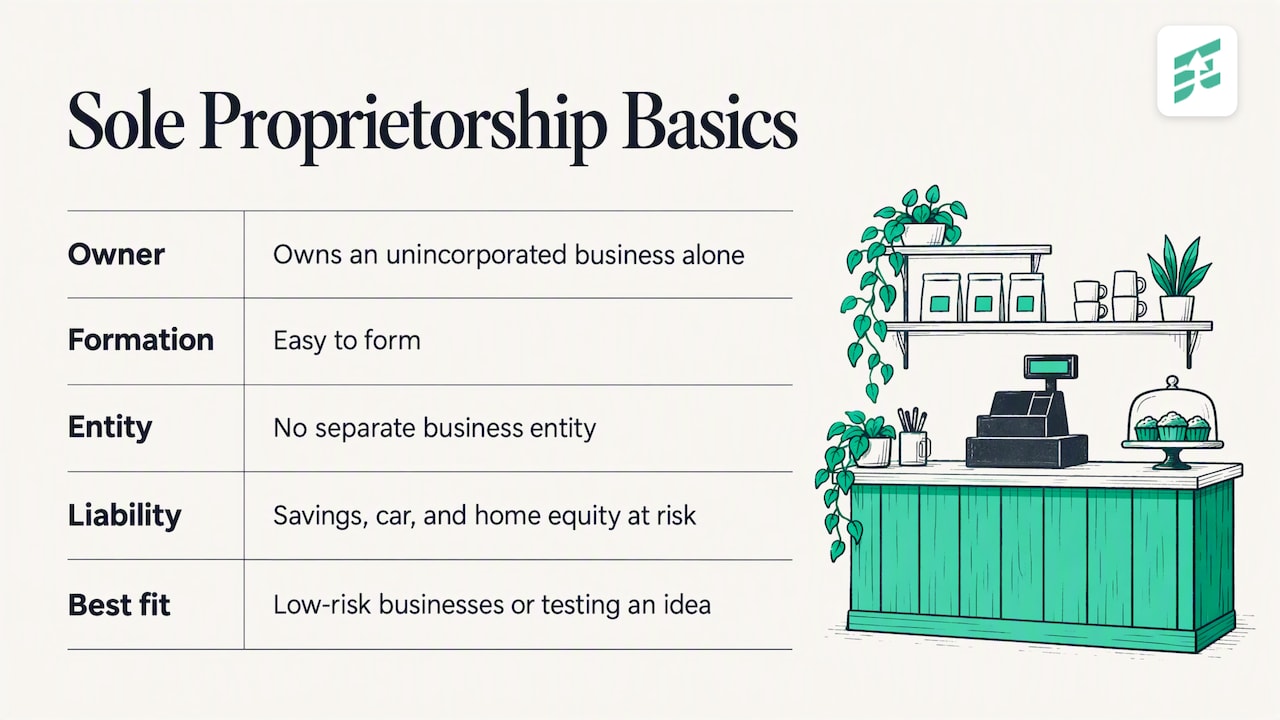
The IRS describes a sole proprietor as someone who owns an unincorporated business by themselves. If you start selling a product or service and have not formed anything, you are very likely a sole proprietor already (IRS Publication 334).
The SBA lists the main traits: it is easy to form, there is no separate business entity, and the owner is personally liable. That last point is the one that matters. If a customer sues, or the business cannot pay a supplier, your savings, car and home equity can be reached, because the law sees no wall between you and the business.
The SBA says this structure can suit low-risk businesses or owners who are testing an idea. A freelance writer, a part-time bookkeeper or a weekend vendor may fit that description. A contractor working on customers’ homes or a landlord with tenants usually does not.
What an LLC is
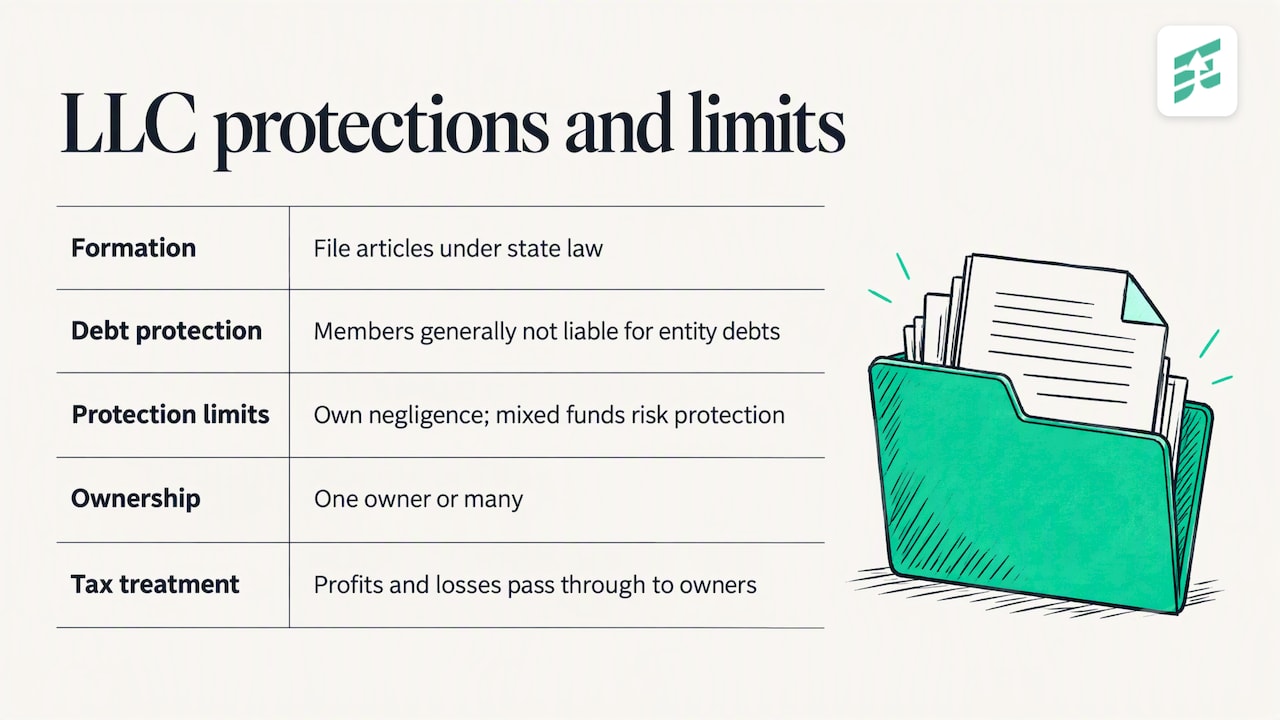
A limited liability company is formed under state law by filing articles of organization. The IRS says its members are generally not personally liable for the entity’s debts (IRS, Entities 3). The SBA adds that an LLC can have one owner or many, and that its profits and losses can pass through to the owners’ personal returns without a separate corporate tax.
Two cautions belong here, because most comparison pages skip them.
Limited liability is not total. It covers the entity’s contracts and debts. It does not excuse you from your own negligence, and a court can set the protection aside if you mix personal and business money. Insurance still matters. Ask your insurance agent or an attorney what your specific risks are.
Ownership changes can matter. The SBA notes that in some states an LLC can have a limited life, and that a change in membership may force dissolution and re-formation unless your operating agreement addresses buying, selling or transferring ownership. If you plan to bring in partners, write that agreement properly.
Sole proprietorship vs. LLC: side by side
| Sole proprietorship | Single-member LLC | Multi-member LLC | |
|---|---|---|---|
| Legal separation from owner | None | Yes, under state law | Yes, under state law |
| Personal liability for business debts | Yes | Generally no | Generally no |
| State filing to create it | None with the Secretary of State in the example below | Articles of organization | Articles of organization |
| Default federal tax treatment | Schedule C on Form 1040 | Disregarded entity, Schedule C on Form 1040 | Partnership, Form 1065 and K-1s |
| Self-employment tax | Yes | Yes, by default | Yes, for members generally |
| Can elect S corporation status | No | Yes, if eligible | Yes, if eligible |
| Operating agreement | Not applicable | Recommended, required in some states | Strongly recommended |
The California Secretary of State shows the formation contrast clearly: a sole proprietorship needs no filing with that office, while an LLC must file formation documents and maintain an operating agreement (California Secretary of State). California is an example, not a rule for every state, so look up your own state’s filing office, fees and annual report requirements before you decide.
How each one is taxed
This is the part that search results blur together, so here is the plain version.
Sole proprietors
Per IRS Topic 407, a sole proprietor reports business income and expenses on Schedule C and net business earnings on Form 1040. Net Schedule C earnings of $400 or more generally require Schedule SE, which calculates self-employment tax. The IRS also lists Form 1040-ES, the estimated tax form, among the forms sole proprietors may need (IRS, Sole proprietorships). Nobody withholds tax from your business income, so you pay it in quarterly installments.
Single-member LLCs
Here is the point that surprises many owners. The IRS says a domestic single-member LLC is generally a disregarded entity for federal income tax unless it files Form 8832 to elect corporate treatment (IRS, Single member LLCs). An individual owner generally reports the activity on Schedule C, E or F of Form 1040, depending on the activity. Publication 334 says the sole member of a domestic LLC is treated as a sole proprietor for federal income-tax purposes unless the LLC elects corporate treatment.
In practice, forming a one-person LLC does not change your federal income tax bill by itself. The same profit, the same Schedule C, the same self-employment tax.
Multi-member LLCs
A multi-owner LLC is generally treated as a partnership unless it elects corporate treatment. The partnership files Form 1065, and owners report their distributive shares from Schedule K-1 (IRS Topic 407). The SBA says LLC members are generally self-employed and pay Social Security and Medicare contributions through self-employment tax.
The elections that change the math
An LLC can elect corporation treatment with Form 8832, or S corporation treatment with Form 2553 if it qualifies (IRS, Entities 3). That is where real tax planning begins. Under S corporation treatment, an owner who works in the business becomes an employee and must be paid reasonable wages, which the IRS says should generally be commensurate with the officer’s duties (IRS, Paying yourself). The wage/distribution split can reduce self-employment tax, but it adds payroll, a separate return and a reasonable-compensation question you must be able to defend.
Three of our guides cover this ground in detail: LLC versus S corporation taxes, S corporation election requirements and how to lower self-employment taxes legally.
How you pay yourself
The way you take money out differs by structure, and getting it wrong creates cleanup work at tax time.
- Sole proprietor or single-member LLC (default): you take an owner’s draw. It is not wages, it is not deductible, and you are taxed on the profit whether or not you withdraw it.
- Partnership-taxed LLC: the IRS says partners are not employees and generally should not receive a W-2 for distributions or guaranteed payments. Those amounts go through partnership reporting and Schedule K-1 (IRS, Paying yourself).
- LLC taxed as an S corporation: you run payroll for yourself, and any distributions come on top of reasonable wages.
Our guide to owner compensation shows how these options look in practice.
Do you need an EIN?
A sole proprietor with no employees can often use a Social Security number for the business. An LLC with employees, one taxed as a partnership or corporation, or one that opens certain business accounts will need an EIN. Many owners get one anyway, so they do not hand out their SSN to clients and banks. Confirm your situation with the IRS instructions for Form SS-4 or with your CPA.
What each structure costs you
A sole proprietorship has almost no formation cost. You may still need a local business license, a trade-name registration (a “DBA”) if you operate under a name other than your own, and any permits your industry requires.
An LLC adds:
- A state filing fee for formation, which varies by state.
- In many states, an annual or biennial report and fee.
- An operating agreement.
- Stricter separation of finances. A dedicated business bank account and clean books are the evidence that protects your liability shield.
We do not quote a single fee here because the amounts are state-specific and change. Look at your state’s Secretary of State or corporation division website for the current figure. In Oregon, where we are based, that is the Secretary of State’s Business Registry.
Our perspective: the entity is a tool, not a tax strategy
We meet owners who formed an LLC because someone told them it would save taxes, and owners who stayed sole proprietors for years because forming one seemed like a hassle. Both have usually skipped the same step: matching the structure to the numbers and the risk.
Here is how we think about it.
- Start with risk, not tax. If a mistake in your work or a slip on your premises could cost more than you can absorb, you want a legal wall between you and the business. Real estate investors and cannabis operators often sit in this group, because they hold property and face heavy regulation.
- Then look at profit. At low profit, the cost and paperwork of an S corporation election usually exceed the savings. As profit becomes consistent, the conversation changes. This is a calculation to run with your actual figures, not a rule of thumb.
- Plan across the year. The entity choice matters far less than what you do in March, June, September and December: estimated payments, equipment purchases, retirement contributions, payroll set-up and year-end bookkeeping. That is why we work year-round rather than once a year. Our quarter-by-quarter tax planning guide lays out the rhythm.
- Review it annually. The right structure at $30,000 of profit is often not the right one at $150,000.
Our goal is to connect tax, accounting, payroll and business decisions, so the entity you choose supports the business you are building, not just last year’s return.
— Justin Ash, CPA
Which one fits you? A decision checklist
A sole proprietorship is usually enough when:
- You are testing an idea or earning side income.
- Your work carries low risk of claims, you have no employees and you carry appropriate insurance.
- You value simplicity and minimal paperwork above all.
- You are not yet profitable enough for entity-level planning to matter.
An LLC usually makes sense when:
- You hire employees or subcontractors, sign leases or contracts, or work on customers’ property.
- You own rental property or other assets that attract claims.
- You want a credible business identity with banks, vendors and clients.
- You expect to add partners or want the option of an S corporation election later.
- You want a legal wall between business debts and personal assets.
The SBA’s framing is similar: sole proprietorships for lower-risk businesses or owners testing an idea, and LLCs for medium- or higher-risk businesses or owners who want their personal assets protected (SBA).
For a longer framework that includes corporations, see how to choose a business entity structure.
Switching from sole proprietor to LLC
Most owners start as sole proprietors and convert later. If you are planning the move, work through this list first.
- File the LLC with your state and write an operating agreement.
- Get an EIN if your situation requires one, and update it with banks, payment processors and the state.
- Open a separate business bank account and stop paying business expenses from personal accounts.
- Transfer contracts, licenses and permits. Some do not transfer automatically, so check with each issuer.
- Update insurance so the policy names the LLC.
- Keep the same tax treatment, unless you deliberately elect otherwise. A one-owner LLC continues on Schedule C by default.
- Revisit your bookkeeping. New entity, new chart of accounts, clean cut-over date.
If you have already earned income this year as a sole proprietor, ask your CPA how to handle the transition year, especially around estimated payments and payroll if you elect S corporation status. Our guide to LLC tax questions every owner should ask is a good starting list.
Where proactive tax planning fits in
Whichever structure you pick, the biggest savings tend to come from decisions made before year-end rather than from the return itself. A few areas to plan for:
- Estimated taxes. Sole proprietors and most LLC owners pay as they go. Underpaying creates penalties and a cash-flow shock in April. See our explanation of quarterly estimated tax payments.
- Self-employment tax. It applies to most owners by default, so planning how you take income matters.
- Deductions and records. Good bookkeeping is what lets you claim legitimate expenses with confidence. Landlords, for instance, should know which costs to track, which we cover in top tax deductions landlords should track.
- Timing. Equipment purchases, retirement contributions and owner pay all have timing windows. The right moves depend on your profit and your state.
For a wider view, read tax planning that helps small businesses keep more.
Work with a CPA on the decision
Choosing an entity is a one-time paperwork task with long-term consequences, which is why it is worth an hour with a CPA before you file anything. At Elevate Business Consulting, we help small businesses, startups, real estate investors and cannabis operators compare structures against their actual numbers, set up the entity, and then keep the books, payroll and tax planning running year-round. Our LLC formation and document preparation services cover the filing side, and our business formation guidance explains how we approach it. We do not publish prices, so contact us to talk about your situation and get a quote for your engagement.
FAQ
Is an LLC better than a sole proprietorship for taxes?
Not by default. A single-member LLC is taxed like a sole proprietorship unless it elects another treatment, so you still report on Schedule C and pay self-employment tax. Tax savings come from an election such as S corporation status, and only when profit and payroll make it worthwhile.
Do sole proprietors need an EIN?
Often not, if there are no employees and no other filing that requires one, because you can use your Social Security number. An LLC that has employees or is taxed as a partnership or corporation generally needs one. Many owners get an EIN anyway to keep their SSN private.
What happens if my LLC makes no money?
You still owe your state’s required filings and any annual fee, even in a year with no income. For federal taxes, a default single-member LLC reports its activity, including any loss, on your personal return. Whether a loss is deductible depends on the rules for your activity, so ask your CPA.
What is a one-person LLC called?
It is a single-member LLC. The IRS generally treats it as a disregarded entity for federal income tax, meaning the business is not taxed separately from you unless the LLC elects corporate treatment.
Can I switch from a sole proprietorship to an LLC later?
Yes, and many owners do once revenue grows or risk increases. You file formation documents with your state, set up a separate bank account and update contracts, licenses and insurance. Review the tax side first so the transition year goes smoothly.
Sources
- Launch your business, U.S. Small Business Administration
- Topic no. 407, Business income, IRS
- Paying yourself, IRS
- Entities 3, IRS
- Single member limited liability companies, IRS
- Publication 334, Tax Guide for Small Business, IRS
- Sole proprietorships, IRS
- Starting a Business: Entity Types, California Secretary of State