

Most small businesses pay a CPA somewhere between a few hundred dollars a year for a simple return and several thousand a month for ongoing advisory work. Where you land depends on how messy your books are, how many entities and states you file in, and whether you want someone to prepare a return once a year or help you make decisions all year. Below are the real ranges, how firms structure their fees, what pushes your price up or down, and how to tell when a CPA is worth the money.
TL;DR
- Hourly CPA rates commonly run $150 to $400, and tax or audit work can reach $500 an hour.
- Business tax returns most often cost $1,000 to $1,499 as a flat fee; monthly bookkeeping most often costs $250 to $499.
- Year-round advisory and CFO-level support are priced as monthly retainers, and the cost climbs with scope.
- Clean records, a simple structure and a clear scope are the cheapest ways to lower your bill.
- Software covers simple, single-state businesses. A CPA earns their fee once you add entities, states, payroll, real estate or a need for tax strategy.
Table of Contents
- What CPAs charge small businesses
- How CPA fees are structured
- What makes your price go up or down
- Three realistic scenarios
- Do you need a CPA, or is software enough?
- When to hire a CPA
- How we price and what you get from Elevate
- Our perspective: pay for decisions, not for forms
- How to check a CPA before you hire
- Ways to keep your CPA costs down
- FAQ
- Sources
What CPAs charge small businesses
There is no single price, because “hiring a CPA” covers very different jobs. A sole proprietor who needs one return is buying a different product than an LLC with employees that wants monthly books, payroll and quarterly tax planning. Here are the ranges published by the pricing surveys and guides we see most often. Treat them as national benchmarks, not quotes.
| Service | Typical range | Source |
|---|---|---|
| General CPA work, hourly | $150 to $400 per hour | SmartAsset |
| Tax or audit work, hourly | $200 to $500 per hour | budgeting guide |
| Sole proprietor tax prep (revenue under $250,000) | $450 to $750 | 2025 survey cited by SmartAsset |
| C corporation tax prep ($1 to $2 million revenue) | $3,700 to $5,600 | 2025 survey cited by SmartAsset |
| Business tax return, flat fee | $1,000 to $1,499 (the most common band) | 2025 pricing benchmark |
| Monthly bookkeeping and accounting | $250 to $499 most common | 2025 pricing benchmark |
| Monthly bookkeeping, wider budgeting range | $250 to $1,200 | budgeting guide |
| Tax planning and advisory | Most often above $2,000 a year | 2025 pricing benchmark |
| CFO or controller services | Most often above $2,500 a month | 2025 pricing benchmark |
Two things stand out. First, the gap between a sole proprietor and a mid-sized corporation is large, which is why a single “average” is misleading. Second, the work that costs the most is rarely the return itself. It is the monthly bookkeeping and the planning that surround it.
The budgeting guide above states that its ranges are common quotes rather than survey data, so use it to sanity check a proposal, not to negotiate down to a number.
How CPA fees are structured
The same $3,000 of annual work can be billed three different ways. Knowing which one you are being offered tells you what you are actually buying.
Hourly billing
You pay for time. It suits one-off questions, cleanup projects and situations where nobody can predict the scope, such as responding to an IRS notice. The downside is that the meter runs while you think, so owners often hold back questions they should ask. Hourly billing is also fading: a 2024 AICPA and CPA.com survey found that only 10% of client advisory practices use it as their main pricing model.
Flat fees
Flat fees are now the most common model for tax returns. You know the number before work starts, and the firm agrees to a defined scope. Ask what is excluded, such as amended returns, extra state filings or responding to notices. The pricing benchmark also notes that billing tax preparation upfront can give firms predictable cash flow, so some firms ask for payment when you engage them.
Monthly retainers
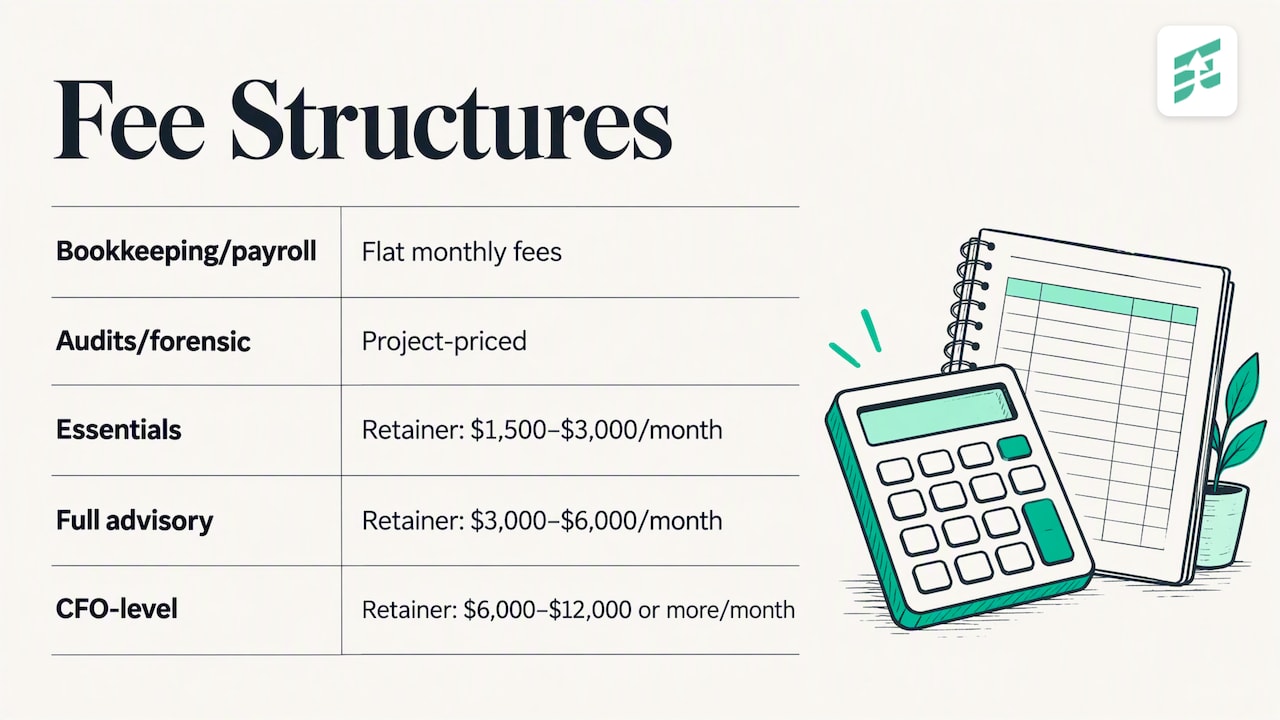
Routine bookkeeping and payroll are usually priced as flat monthly fees, while audits and forensic work are typically project-priced. For advisory, 2026 guidance on client advisory services describes fixed retainers of $1,500 to $3,000 a month for essentials, $3,000 to $6,000 for full advisory, and $6,000 to $12,000 or more for CFO-level support. Those figures describe firms serving larger clients with complex needs. Most very small businesses will land well below that tier, at the bookkeeping-plus-planning level.
The AICPA recommends that firms consider subscription and value billing to stabilize cash flow and clarify service scope. For you, a retainer means predictable costs and a CPA who is allowed to pick up the phone.
What makes your price go up or down
Across the fee guides, the same drivers show up again and again. SmartAsset lists business complexity, bookkeeping quality, time to file, location and the CPA’s expertise. In practice that translates to a handful of questions:
- Entity type. A single-member LLC taxed as a sole proprietor is simpler than an S corporation, partnership or C corporation with payroll and shareholder items.
- Number of states. Each additional state filing adds work and risk.
- State of your books. Records that are reconciled, categorized and ready on day one cost less than a shoebox of receipts. If a CPA has to rebuild twelve months of transactions, you pay for the rebuild.
- Volume. Hundreds of monthly transactions, inventory, or many rental units mean more hours.
- Payroll. Employees add filings, deposits and year-end forms.
- Industry. Regulated or tax-unusual industries, such as cannabis, need a CPA who knows the rules, and that expertise is priced accordingly.
- Scope. A return alone costs less than a return plus quarterly planning, bookkeeping review and a call whenever you need one.
- Market. Firms are raising prices. The 2025 benchmark found that 80% of firms plan to raise prices by 5 to 10% in 2026, and nearly half pointed to rising costs as the main reason.
That last point is worth planning around. If you have not renewed an engagement in two years, expect the number to be higher, and ask what is included for the increase.
Three realistic scenarios
These are illustrations built from the benchmark ranges above. They are not Elevate quotes, and your own proposal will differ.
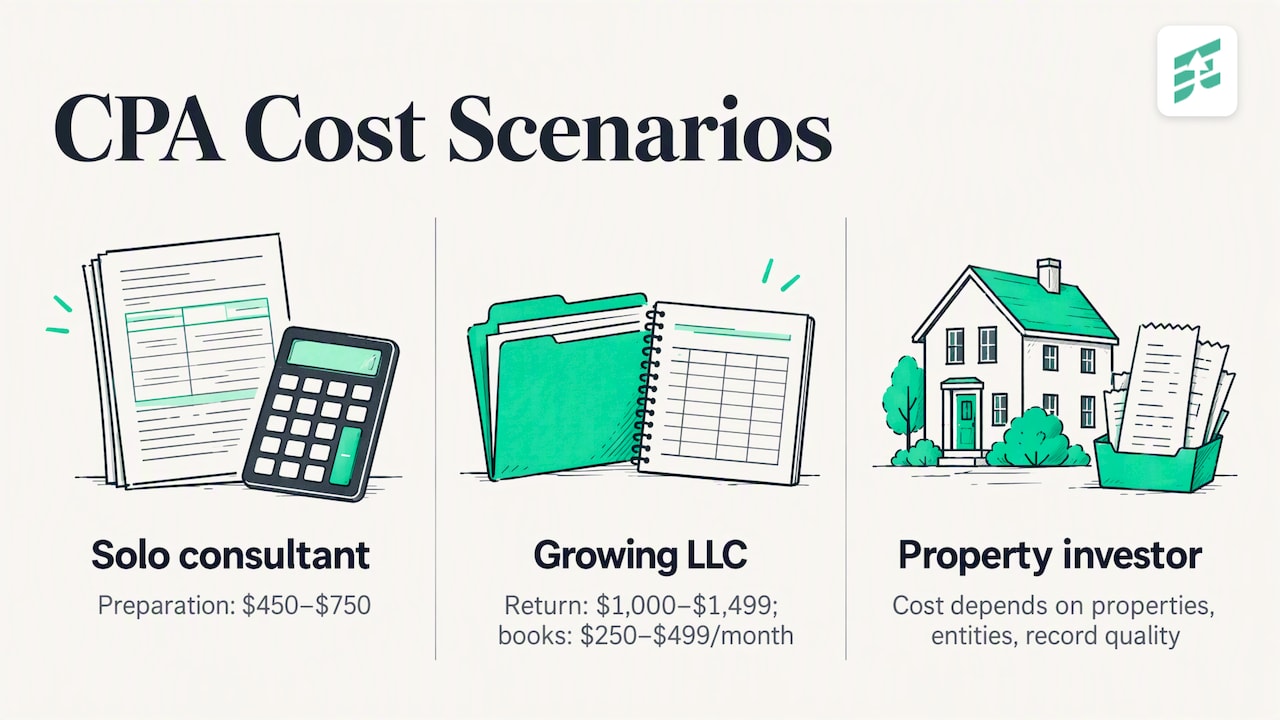
The solo consultant. One owner, one state, no employees, organized books in accounting software. This owner sits near the sole-proprietor band in the survey: $450 to $750 for preparation. If they add a planning conversation before year end, they move toward a flat business-return fee.
The growing LLC with a few employees. An S corporation with payroll, monthly books and quarterly estimated taxes. The business return alone often falls in the $1,000 to $1,499 flat-fee band. Add monthly bookkeeping at $250 to $499 and planning above $2,000 a year, and the annual total is meaningfully higher, but so is the work that is being done for you.
The real estate investor. Several properties, depreciation schedules, possibly multiple entities. Cost depends mostly on the number of properties and entities and on how clean the rental records are. Investors who track expenses by property all year spend less cleaning up in March. Our list of top deductions landlords should track is a good place to start.
Do you need a CPA, or is software enough?
Software handles a lot. For routine, repetitive transactions in a single-entity, single-state business, accounting software is generally sufficient. Human expertise matters most when you hit multi-state filings, audits, entity changes, IRS representation, tax strategy and forward-looking planning.
A practical test: you probably need a CPA if any of these is true.
- You are choosing or changing an entity type, such as moving from an LLC taxed as a sole proprietor to an S corporation.
- You have employees, contractors or sales across state lines.
- You own rental property or are buying your next one.
- You are paying estimated taxes and guessing at the amounts. Our guide to quarterly estimated tax payments explains why guessing gets expensive.
- You received an IRS notice or fear one is coming.
- You make money but cannot explain where the cash goes.
If none of these apply, a bookkeeping tool and a once-a-year preparer may be all you need. That is a perfectly good answer, and it is better to hear it before you pay for a retainer.
When to hire a CPA
The best time is earlier than most owners think, and almost never in March. A CPA hired in April can file your return. A CPA hired in October can still change your result for that year.
Startups
The first year sets habits. Choosing the entity, setting up a chart of accounts and separating personal and business spending are cheap to do at the start and expensive to fix later. Our guides to what to set up and when in startup bookkeeping and a startup accounting system that scales walk through the order. If you are also forming a company, business formation is a natural time to bring a CPA in, because the entity choice drives your tax bill.
After formation, lenders and vendors start looking at your credibility. Clean books support everything else, including building business credit for an LLC, which goes more smoothly when your financial records are current.
Real estate investors
The moment you own a second property, or hold property in an entity, the bookkeeping stops being simple. Depreciation, repairs versus improvements and passive loss rules all benefit from a CPA who sees them as they happen. See how we handle real estate accounting.
Businesses with payroll or regulated products
Payroll mistakes create penalties quickly, and some industries have unusual tax rules. If you run either, a CPA who works in your sector is worth more than a cheaper generalist.
How we price and what you get from Elevate
We do not publish fixed prices, because the right scope for a landlord with three rentals is not the right scope for a startup with a team. What we do is look at your records, your entity, your goals and your timeline, and propose a scope before you commit to anything.
Elevate Business Consulting is a CPA firm in Medford, Oregon, built around tax, accounting, payroll and advisory for small businesses, startups, real estate investors and cannabis operators. Our approach is proactive and year-round: tax planning, bookkeeping and payroll are connected, so decisions made in June show up as savings in April. You can see how that works across tax planning for small businesses and our year-round planning guide.
If you want a number for your situation, start with a conversation at Elevate. Bring last year’s return and your current books, and we will tell you what we would do and what it would take.
The relevant services, depending on what you need, are bookkeeping, payroll processing and QuickBooks consulting.
Our perspective: pay for decisions, not for forms
The most common mistake we see is treating a CPA as a once-a-year expense. Owners look at the cost of preparing a return and decide it is a number to minimize. But preparation records what already happened. The money is in what you do before the year ends: how you compensate yourself, when you buy equipment, how you track rental expenses, whether your estimated payments match reality.
That is why we work year-round and connect the bookkeeping, payroll and tax sides of the business. When one team sees all of it, we can flag a problem in the third quarter instead of explaining it in the spring. It also makes our fees easier to judge. The question is not whether we charge more than a seasonal preparer. The question is whether you are keeping more of what you earn and sleeping better about the numbers.
A good CPA should also be willing to tell you when you do not need one yet. If your business is simple, we will say so.
— Justin Ash, CPA
How to check a CPA before you hire
Price is only one filter. Before you sign:
- Verify credentials. The IRS says anyone with a PTIN can be a paid preparer, so a PTIN alone is not the same as a CPA license. Use the IRS guidance on choosing a tax professional and its directory to check, and confirm a CPA license with your state board of accountancy.
- Avoid fees based on refunds. The IRS warns that a preparer who bases fees on a percentage of your refund is a red flag.
- Get the scope in writing. Ask what is included: amended returns, notices, extra states, payroll filings, calls between busy seasons.
- Ask who does the work. Is it the CPA, a staff accountant or an offshore team, and who reviews it?
- Ask about experience in your situation. A firm that handles rentals or cannabis every week will spot issues a generalist misses.
- Ask about timing. The IRS advises small businesses to work with a tax professional year-round, keep adequate records and verify credentials. A firm that only responds in tax season is not doing that.
Ways to keep your CPA costs down
You cannot negotiate away complexity, but you can stop paying for avoidable work.
- Close your books monthly. Reconciled accounts are the single biggest cost lever. Our chart of accounts setup guide helps you categorize correctly from the start.
- Separate personal and business money. Mixed accounts mean hours of sorting.
- Put controls in place. Simple accounting controls cut errors and rework.
- Send documents once, organized. Missing items trigger back-and-forth that firms often bill for.
- Ask for a flat fee and a written scope. It removes the fear of the meter.
- Bundle related work. Bookkeeping, payroll and tax under one roof avoids paying two firms to reconcile the same numbers.
- Plan before year end. An hour of planning in the fall can save more than the return costs to prepare.
FAQ
How much does a CPA cost for a small business?
Expect roughly $150 to $400 an hour for general work, a flat fee of about $1,000 to $1,499 for many business tax returns, and $250 to $499 a month for routine bookkeeping. Simpler sole proprietors pay less, and larger corporations with more complexity pay more. Advisory and CFO-level support are priced on top as monthly retainers.
Do I need a CPA for my small business?
Not always. If you run a simple, single-owner, single-state business with clean books in software, a bookkeeper and an annual preparer may do. You likely need a CPA when you have multiple entities or states, payroll, rental property, an IRS notice, or a decision about entity type or tax strategy.
When should I hire a CPA?
Hire one before you form your entity, before you buy property, or before your first employee, and certainly before year end rather than at filing time. Planning moves made during the year can change what you owe, while a return filed in April can only report it.
Is a CPA better than a regular accountant or tax preparer?
A CPA holds a state license and is held to professional standards, while the IRS notes that a paid preparer only needs a PTIN. That does not make every unlicensed preparer poor, but for planning, entity decisions and representation before the IRS, a licensed CPA is a safer choice. Check any credential through the IRS directory or your state board.
Can I pay a CPA a percentage of my refund?
You should not. The IRS identifies fees based on a percentage of the refund as a warning sign of an unethical preparer. Ask for a flat or hourly fee, quoted in writing.
Sources
- How Much Does a CPA Cost for a Small Business? (SmartAsset)
- The end of hourly billing: 2025 pricing benchmark (Ignition)
- How much does an accountant cost? (QuickBooks)
- How much does an accountant cost in 2026? (Relay)
- How to Price Client Advisory Services at Your CPA Firm 2026 (Compass)
- Stop leaving money on the table (AICPA & CIMA)
- How to Hire an Accountant for Your Small Business (Ramp)
- Choosing a tax professional (IRS)
- How to Choose a Tax Return Preparer and Avoid Preparer Fraud (IRS)
- Publication 5965 (IRS)