
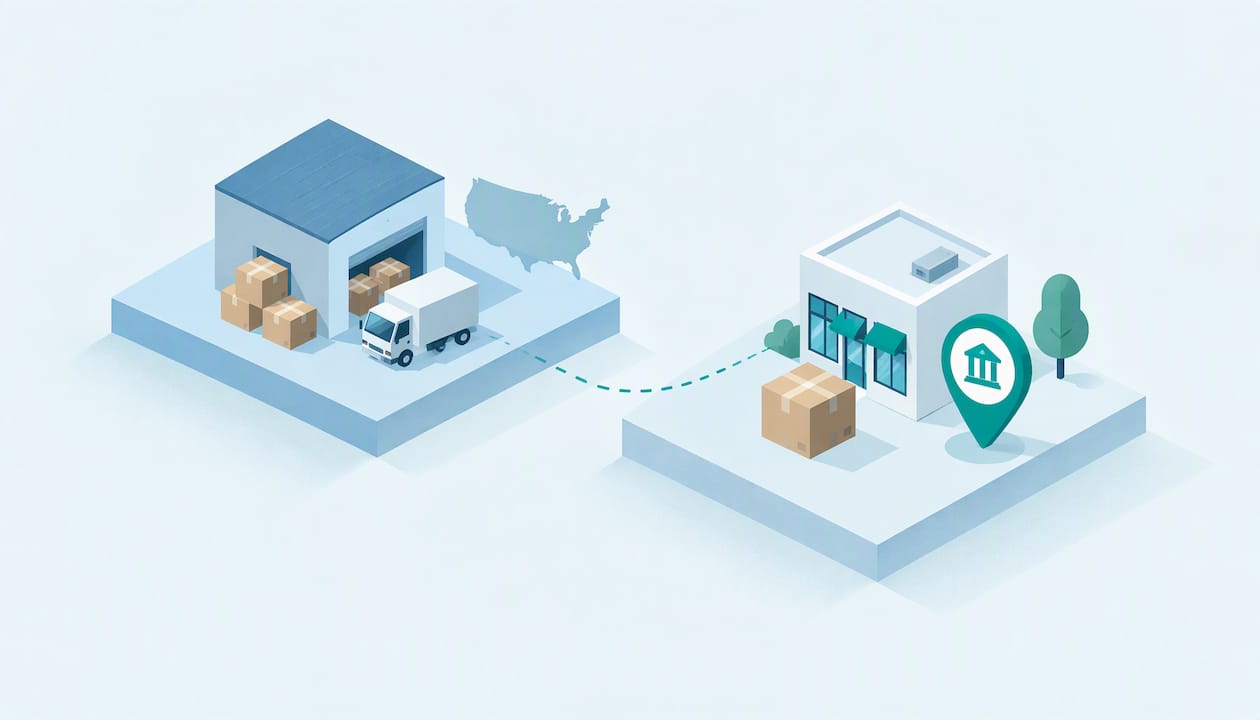
Use tax is the buyer’s side of sales tax. When you buy something taxable and the seller does not charge your state’s sales tax, you owe the tax yourself, and you report and pay it directly to the state. Most states that have a sales tax also have a use tax, and it catches a lot of small businesses off guard because nothing at checkout tells you it exists.
This guide explains what use tax is, how it differs from sales tax, which purchases trigger it, how the amount is figured, and how to build a routine so it never turns into a surprise during an audit. Rules vary by state, so we draw on state revenue departments and name the state each time.
TL;DR
- Use tax applies when you buy taxable goods or services and the seller does not collect your state’s sales tax. You pay it directly to the state.
- For any one transaction, sales tax or use tax applies, not both. Washington’s Department of Revenue says so plainly.
- Common triggers: online or out-of-state purchases without tax, items pulled from inventory for business use, and purchases made in a lower-tax locality.
- The rate generally matches the sales tax rate where you use or receive the item, and the base usually includes shipping and handling.
- Keep invoices and receipts, and ask your CPA to build use tax into your bookkeeping so it is accrued as you buy.
Table of Contents
- What use tax is
- Use tax vs. sales tax
- When a small business owes use tax
- How much use tax you owe
- How to report and pay use tax
- Records that protect you
- A simple routine to stay compliant
- Our perspective
- Get use tax handled as part of your books
- Common mistakes to avoid
- FAQ
- Sources
What use tax is
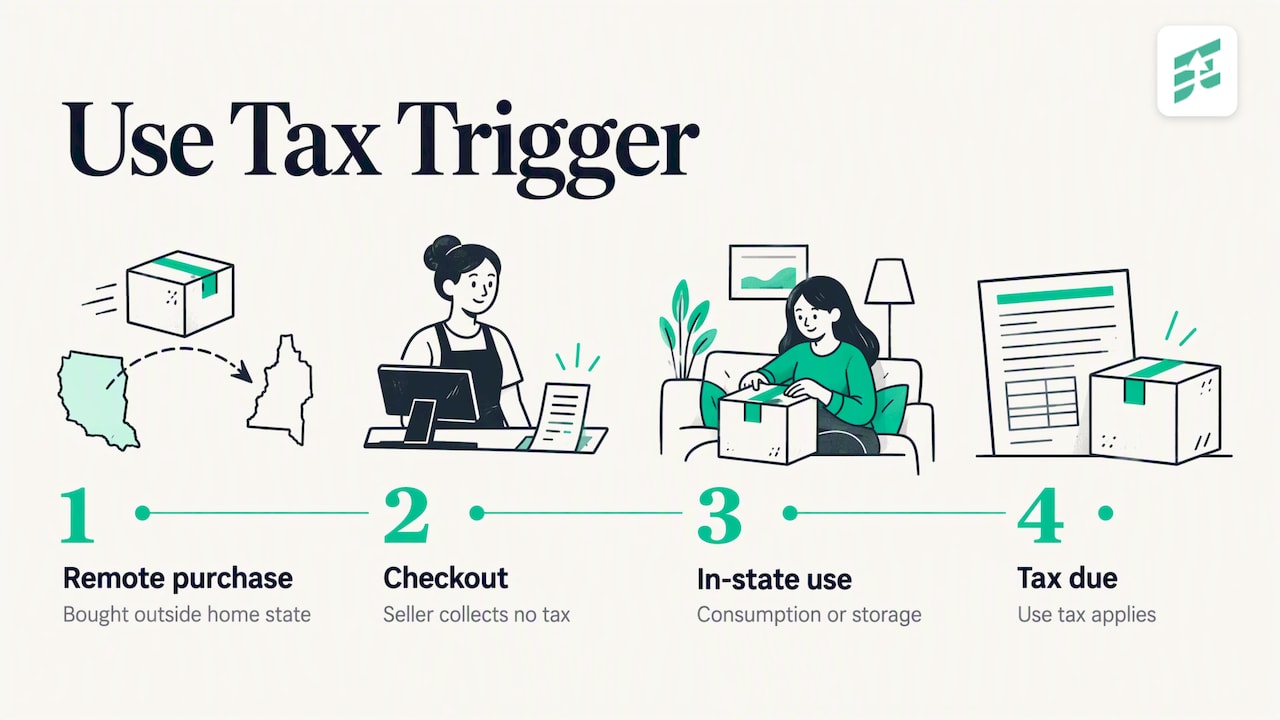
States tax the consumption of taxable goods and some services inside their borders. Normally the seller collects that tax at the register or online checkout. Use tax exists for the cases where that does not happen.
The Tax Policy Center describes general sales taxes as percentage taxes on consumer purchases of goods and services, and notes that consumers owe use tax in their home state on goods bought outside it for consumption there. Its analysis also explains the purpose: use tax keeps in-state consumption taxable when an out-of-state seller did not collect tax at checkout. Without it, buying from a remote seller would be a way around the tax, and local retailers would be at a disadvantage.
Georgia’s Department of Revenue states the same idea in statutory terms. Georgia’s sales and use tax guidance says use tax applies to nonexempt tangible personal property purchased at retail outside Georgia, on its first use, consumption, distribution, or storage in the state. Note the trigger words: use, consumption, storage. The tax attaches when the item goes to work in your state, not when you click “buy.”
Use tax vs. sales tax
The two taxes are mirror images. They tax the same kind of transaction at the same rate. The difference is who collects and who is on the hook.
| Sales tax | Use tax | |
|---|---|---|
| Who collects it | The seller, at the time of sale | Nobody collects it at checkout |
| Who is responsible | The seller remits it to the state | You, the buyer, report and pay it |
| When it applies | The seller charges your state’s tax | The seller does not charge your state’s tax |
| How it is paid | Seller’s sales tax return | Your own return, often the same one you use for sales tax or excise tax |
| Can both apply? | Not to the same transaction | Not to the same transaction |
The Washington Department of Revenue says a transaction is subject to either sales tax or use tax, not both. That is a useful rule of thumb. If your invoice already shows the correct sales tax for your location, you are done. If it does not, use tax is the question to ask.
One point that trips people up: use tax is not a penalty or an extra charge for being an out-of-state buyer. It is the same tax you would have paid at a local store, simply collected through a different door.
When a small business owes use tax
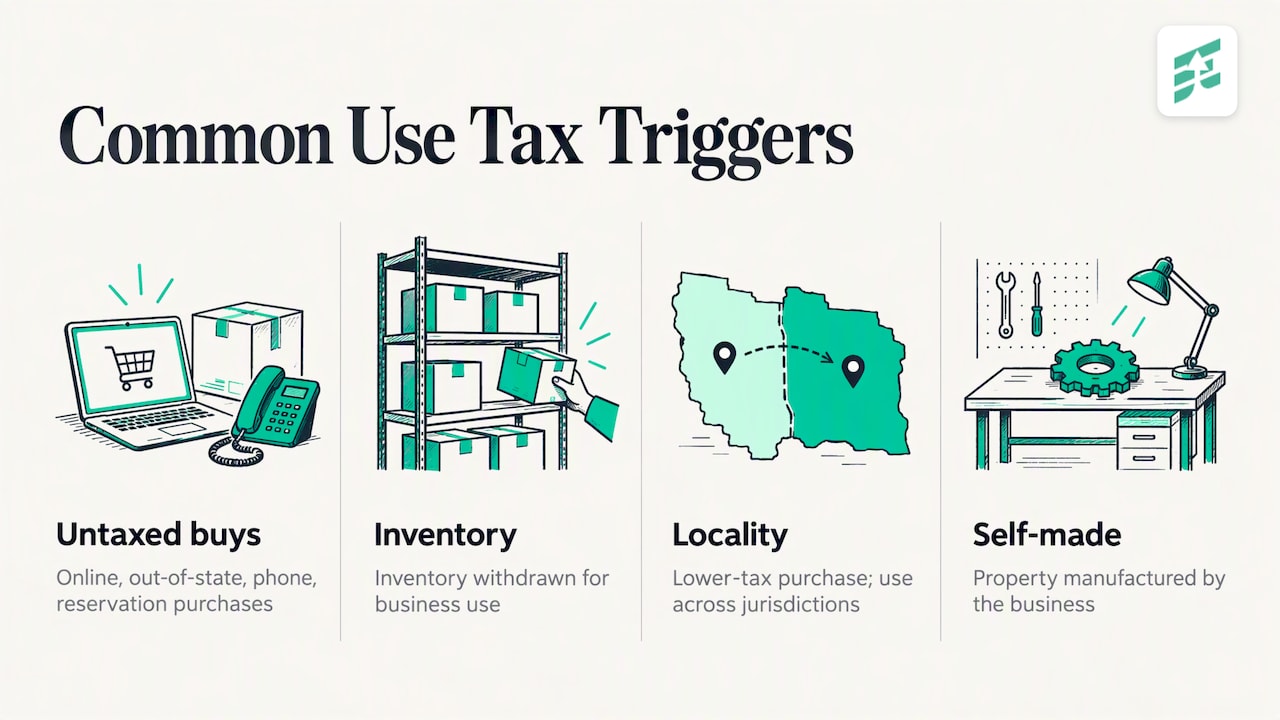
The Minnesota Department of Revenue says use tax is owed on taxable business equipment, supplies, or other items when the seller does not charge Minnesota sales tax. It lists common examples: untaxed online or out-of-state purchases, inventory withdrawn for use, and purchases made in a lower-tax locality. The New York Tax Department adds a few more, including property or services bought by phone without New York tax, purchases made on an Indian reservation, items used in a different local jurisdiction, and property the business manufactured itself.
Here is how those play out for the kinds of businesses we work with.
Online and out-of-state purchases
A contractor orders tools from a supplier in another state. The supplier has no obligation to collect your state’s tax, so the invoice shows none. The tools are taxable where you use them, so the tax is yours to report. The same goes for office furniture, computers, shop equipment, and supplies bought from a vendor that simply did not charge tax.
Inventory pulled for your own use
If you buy goods for resale without paying sales tax, you normally give the seller a resale certificate. If you later take some of that stock for your own use, the exemption no longer fits. New York and Minnesota both list withdrawing inventory for use as a use tax event. A retailer who takes product home, uses it as a store display, or gives it away as a sample should ask their CPA how their state treats it.
Items you make yourself
New York lists property manufactured by the business itself among use tax situations. If you build fixtures or equipment for your own operations, the materials may not have been taxed in a way that covers your use of the finished item.
Purchases from a lower-tax area
Some states have local taxes on top of the state rate. Buying in a locality with a lower rate and using the item in a higher-rate one can leave a gap. Minnesota lists this as a use tax situation. Texas says local use taxes, up to an additional 2 percent, depend on where the item is used, stored, or consumed.
Taxable services
Use tax is not limited to physical goods. Many states tax certain services, and the same logic applies when a provider does not charge the tax. Which services are taxable varies widely, and we cover that in our guide to sales tax on services by state.
How much use tax you owe
Two questions decide the amount: what rate applies, and what price it applies to.
The rate
In most states the use tax rate matches the sales tax rate for the place where you use the item. Idaho’s State Tax Commission says its use tax rate is the same as its sales tax rate. Texas is more specific. The Texas Comptroller states that Texas use tax is 6.25 percent, with up to an additional 2 percent in local use taxes depending on where the item is used, stored, or consumed, and it points businesses to its Sales Tax Rate Locator to find the local rate.
In New York, the Tax Department explains that the applicable rate is generally the rate where the business takes delivery or uses the item, if that rate is higher. So if you ship an item to a high-rate location, you do not get to use a lower rate from somewhere else.
The price it applies to
New York says use tax is generally calculated on the consideration paid or agreed for the property or service, including seller charges for shipping or handling. Idaho bases the tax on a recent sales price, or on fair market value when you cannot show proof of a recent purchase price. That second point is a good reason to keep invoices: without them, the state can substitute its own valuation.
A worked example
Suppose a small business in a state with a combined 7 percent rate buys a $2,000 piece of equipment from an out-of-state vendor with $100 in shipping, and the vendor charges no tax. In a state that includes shipping in the base, the taxable amount is $2,100, and the use tax is $147. This is an illustration with a made-up rate, not any state’s actual rate. Your state’s base and rate decide the real number, and some states exempt certain equipment or have thresholds, so check the state’s guidance or ask us.
How to report and pay use tax
There is no universal form. The method depends on whether you are registered for sales tax or similar accounts, and on your state.
- Pennsylvania. The Department of Revenue says a business must directly report and remit use tax when it buys taxable property or services and the seller does not collect Pennsylvania sales tax.
- Georgia. The Department of Revenue states that a taxpayer who purchases taxable goods or services without tax must accrue and remit it under O.C.G.A. § 48-8-30(g).
- Washington. The Department of Revenue encourages businesses to report and pay use tax on business purchases on their excise tax return for the period when the goods are first used in Washington.
- Florida. According to the state’s Business Owner’s Guide for the Major Florida Taxes (2025), registered dealers report use tax on Form DR-15. Returns and payments are due on the first day of the month following the reporting period and are late after the twentieth day, with stated weekend and holiday rules. The guide also requires a return for each reporting period even if no sales or rental activity occurred, with electronic filing or telefiling options for zero-tax periods.
The pattern across states: you accrue the tax when you buy or first use the item, and you remit it on a periodic return, often the same one used for sales tax. Businesses without a sales tax account may have another way to report, such as a separate use tax form. Your state’s revenue department site will name the exact form and due date, and those can change, so confirm them there each year.
If you operate in several states, each state has its own rules, and the same purchase can raise different questions in each. That is a good moment to get a CPA involved.
Records that protect you
Use tax is a self-assessed tax, so your paperwork is your defense. The IRS’s Publication 583 says every business should keep records supporting income, expenses, and credits, and lists supporting documents such as sales slips, paid bills, invoices, receipts, deposit slips, and canceled checks. It also says you may keep paper or electronic records, but an electronic system must index, preserve, retrieve, and reproduce complete and accurate records in a legible form the IRS can access.
That is federal guidance, and states set their own retention periods. Idaho’s State Tax Commission, for example, says businesses with a use tax permit must keep records at least four years, while businesses without a permit must keep them at least seven. The longer period for unregistered businesses is worth noticing: the less formally you are set up, the longer the state expects you to hold the evidence.
For use tax specifically, hold on to:
- The vendor invoice showing the price, shipping, and whether tax was charged.
- The delivery address or location where the item was first used.
- Any resale or exemption certificate tied to the purchase.
- A record of the use tax you accrued and the return you paid it on.
A simple routine to stay compliant
Most use tax problems come from having no process, not from bad intent. A light routine fixes that.
- Flag untaxed purchases as they happen. When you enter a bill in your accounting software, check whether tax was charged. If a taxable item shows none, mark it.
- Set up a use tax account. Track accrued use tax in its own line so it is visible at period end and does not get buried in the expense it came from.
- Review inventory withdrawals. Decide how items taken for business use are recorded and taxed.
- Report on your normal schedule. Include accrued use tax on the return your state expects.
- Review at year-end. A quick look at the year’s larger purchases catches what slipped through, and fits naturally into year-round tax planning.
If your books run on QuickBooks, much of this can be automated with the right setup, which is the kind of work our QuickBooks consulting covers.
Our perspective
Use tax is a perfect example of why we think tax work should happen all year, not in March. It does not show up on a tax return you file once. It shows up in the dozens of ordinary purchases a business makes: a laptop, a piece of equipment, a shipment of supplies. If nobody is watching those entries as they are recorded, the tax goes unaccrued and the exposure quietly grows.
We approach it the way we approach most things for small business owners. Connect the accounting, the tax rules, and the day-to-day decisions so they work together. When your bookkeeping flags untaxed purchases as they happen, use tax becomes a few minutes of routine instead of a stressful cleanup. That matters most for the clients we serve in real estate, startups, and cannabis, where large purchases and fast growth are common.
Our goal is accuracy first, then savings and cash flow. Knowing what you owe, and when, lets you plan for it instead of reacting to a notice.
Justin Ash, CPA
Get use tax handled as part of your books
At Elevate Business Consulting, we are a CPA firm in Medford focused on tax, accounting, payroll, and business advisory for small businesses. We can help you decide how your state treats your purchases, set up your accounting so untaxed items are caught as you enter them, and keep the records you would need if the state ever asked. You can see what we offer on our main site, or read about our bookkeeping services if clean, current books are the first step.
If you own rental property or operate in a specialized industry, our real estate accounting and cannabis accounting pages explain how we support those businesses.
Common mistakes to avoid
- Assuming no tax at checkout means no tax. The absence of a charge is the very condition that creates use tax.
- Forgetting shipping. In states like New York, shipping and handling charged by the seller are part of the taxable amount.
- Using the wrong location’s rate. The rate generally follows where you take delivery or use the item, not where the seller sits.
- Skipping zero returns. Florida, for one, requires a return for each reporting period even when nothing is reported.
- Throwing out invoices. Without proof of price, a state may value the item itself, as Idaho does with fair market value.
- Treating it as an owner-only issue. Entity choice affects other taxes, but use tax follows the purchase. If you are still deciding how to set up your business, see our comparison of sole proprietorship vs. LLC.
FAQ
What is use tax in simple terms?
Use tax is the tax you owe on a taxable purchase when the seller did not charge your state’s sales tax. It is generally the same rate you would have paid at a local store. You report it and pay it to the state yourself, usually on a periodic return.
Is use tax the same as sales tax?
No, though they are paired. Sales tax is collected by the seller at the time of sale. Use tax is the buyer’s responsibility when sales tax was not paid. A single transaction is subject to one or the other, not both, according to the Washington Department of Revenue.
Do small businesses really have to pay use tax?
Yes, when they buy taxable items without paying sales tax. States such as Minnesota, New York, and Pennsylvania specifically address business purchases, including untaxed online purchases and inventory withdrawn for use. Whether a given item is taxable depends on your state, so ask your CPA or check your revenue department’s guidance.
How do I find the right use tax rate?
Start with your state revenue department. Many states match the use tax rate to the sales tax rate where you use the item. Texas, for example, offers a Sales Tax Rate Locator for local rates. If you buy for use in more than one location, track each location separately.
How long should I keep use tax records?
It depends on your state. Idaho requires at least four years for businesses with a use tax permit and at least seven for those without one. The IRS also expects businesses to keep supporting documents such as invoices and receipts. Ask your CPA to confirm the period for your state.
Sources
- Georgia Department of Revenue: What is Subject to Sales and Use Tax?
- Minnesota Department of Revenue: Use Tax
- New York Tax Department: Use Tax for Businesses
- Washington Department of Revenue: Use tax
- Tax Policy Center: How do state and local general sales and gross receipts taxes work?
- Texas Comptroller: Use Tax
- Idaho State Tax Commission: Use Tax Basics Guide
- Pennsylvania Department of Revenue: Use Tax for Businesses
- Florida Department of Revenue: Business Owner’s Guide for the Major Florida Taxes
- IRS Publication 583