

Backup withholding is a flat 24% of certain payments that a payer must hold back and send to the IRS when the payee has not given a correct taxpayer identification number (TIN), or when the IRS says the payee underreported interest or dividends. If you pay contractors, vendors or investors, the rules decide what you must withhold and what paperwork protects you. If you are the one being paid, a correct Form W-9 on file is how you keep the full amount.
This guide covers the triggers, the rate, the payments covered, the notices the IRS sends, and the steps to stop or avoid it.
TL;DR
- The current backup withholding rate is 24%, applied to reportable payments when the payee’s TIN is missing or wrong, or when the IRS directs it for underreporting.
- A signed Form W-9 collected before the first payment is the simplest way to keep backup withholding from starting.
- A CP2100 or CP2100A notice is a deadline-driven task: compare the listing to your records and, for mismatches, send a First B-Notice within 15 business days.
- Withheld amounts are deposited electronically and reported on Form 945 and the payee’s 1099.
- If you are the payee, fix the cause (a correct TIN, filed returns, balances paid) and the withholding can stop.
Table of Contents
- What backup withholding is and why it exists
- The rate and the payments it covers
- What triggers backup withholding
- Form W-9: your first line of defense
- If you receive a CP2100 or CP2100A notice
- Depositing and reporting what you withhold
- How to stop or prevent backup withholding
- Perspective: build the process before the notice arrives
- Common mistakes small businesses make
- Get help setting this up
- FAQ
- Sources
What backup withholding is and why it exists
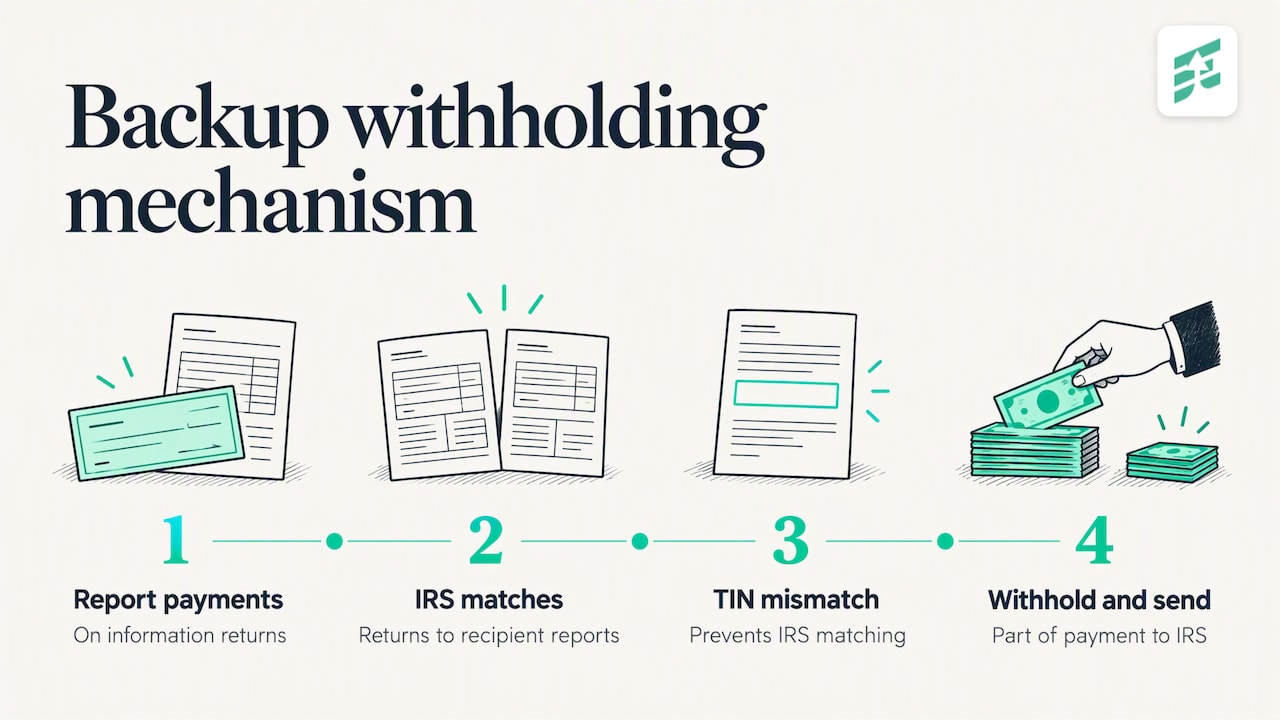
The U.S. tax system depends on payers reporting what they pay on information returns such as Form 1099. The IRS matches those returns to what recipients report. When a payee’s TIN is missing or does not match, the IRS cannot do that matching. Backup withholding is the safety net: the payer keeps part of the payment and sends it to the IRS on the payee’s behalf, so some tax is collected up front.
It is not a penalty on the payee and it is not an extra tax. The amount withheld is credited to the payee when they file their return, the same way tax withheld from a paycheck is. It is also different from wage withholding: it applies to payments to people who are not employees, such as independent contractors and investment account holders.
The payer carries the legal duty. Under the Instructions for the Requester of Form W-9, a payer who fails to withhold when required can become liable for the uncollected amount. That is why small businesses should treat the process as a routine part of vendor onboarding, not as a year-end scramble.
The rate and the payments it covers
The IRS lists the current rate as 24%. It applies to the gross amount of the payment, not to profit and not after expenses.
The payments that can be subject to backup withholding include:
- Interest and dividends
- Rents and royalties
- Commissions
- Nonemployee compensation reported on Form 1099-NEC
- Gross proceeds paid to attorneys
Some transactions sit outside the rules. IRS Publication 1281 says real estate transactions, foreclosures, cancelled debts and distributions from retirement accounts are excluded from backup withholding. If you handle property deals, that distinction matters, though the reporting rules around them are their own topic.
Reporting thresholds for information returns have been adjusted by recent legislation, and they differ by form. Check the current Form 1099 instructions for your tax year before you decide that a small payment needs no paperwork. Collecting a W-9 from every new vendor regardless of size removes the guesswork.
What triggers backup withholding
Per the IRS, backup withholding may apply when a payee does any of the following:
- Fails to provide a correct TIN. This covers a missing TIN and one that does not match IRS records.
- Underreports interest or dividend income. The IRS finds the gap and tells the payer to start withholding.
- Fails to certify that they are not subject to backup withholding for that underreporting, where certification is required.
These are the same three reasons the IRS backup withholding page gives. In practice, small businesses meet the first one most often: a contractor who never returned a W-9, a typo in a Social Security number or EIN, or a name that does not match the number.
Missing or obviously incorrect TINs
The IRS treats a TIN as obviously incorrect when it has more or fewer than nine digits or contains characters other than numbers, according to Publication 7950. A number like 12-345678 with a stray letter, or an eight-digit entry, is the kind of error you can catch before filing anything.
For a missing or obviously incorrect TIN, the IRS describes a solicitation process on its B program page. A payer makes up to three requests (the initial, the first annual and the second annual) to avoid the penalty for leaving a TIN off an information return. Keep a dated record of every request you send.
Notices about underreported income
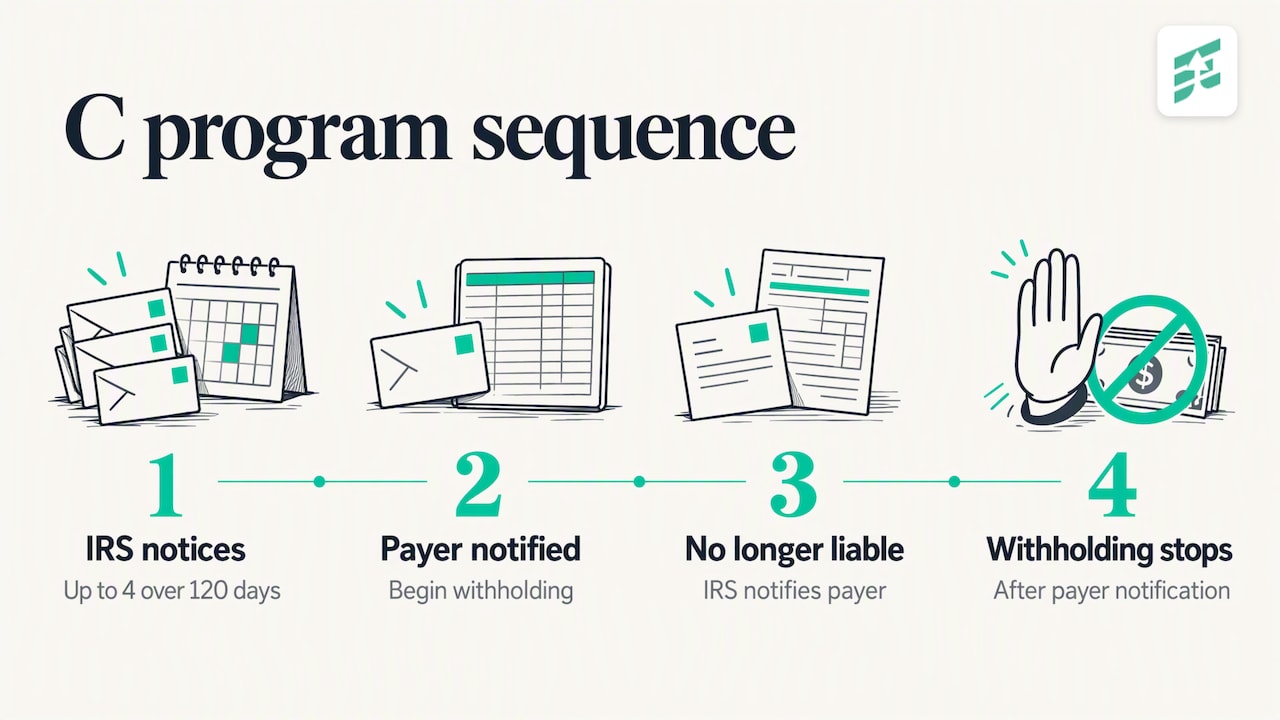
Underreporting cases follow what the IRS calls the C program. Under it, the IRS issues up to four notices to the taxpayer over 120 days before telling a payer to begin withholding. When the IRS notifies the payer that the taxpayer is no longer liable, withholding stops.
Form W-9: your first line of defense
When a payee opens an account, makes an investment, or starts receiving payments reportable on Form 1099, they must give their TIN in writing and certify under penalties of perjury that it is correct. The IRS notes that in some cases Form W-9 or a similar form is used for this.
A clean onboarding routine looks like this:
- Send a blank Form W-9 to every new contractor or vendor before the first invoice is paid.
- Check that the name, TIN type and number are filled in and the form is signed and dated.
- Scan the digits against the obvious-error test above: nine numeric characters, nothing else.
- Store the form securely in your records. Per IRS manual guidance, payers should not send a payee’s signed W-9 to the IRS.
- Enter the details in your accounting system so the 1099 is ready at year end.
The payer keeps the form. It is a record that supports your 1099 filing and your defense if a TIN is later flagged.
If the payee will not return a W-9, hold 24% from the payment and treat it as backup withholding. That is far less painful than discovering the problem when a notice arrives.
If you receive a CP2100 or CP2100A notice
The IRS sends these notices to payers when information returns they filed contain TINs that are missing or do not match. The notice lists the payees concerned. It is not an accusation, but it does start a clock.
The IRS B program guidance gives this sequence:
- Compare the listing to your records. Look up each name and number against the W-9 you collected.
- Missing or obviously incorrect TIN: start backup withholding if you have not already.
- Incorrect TIN that matches what you have on file: send the appropriate B-Notice.
- Listing does not match your records: correct or update your records. A data entry slip on your side needs a fix, not a B-Notice.
Timing matters. IRS manual guidance says a payer should send the payee a First B-Notice and a copy of Form W-9 within 15 business days of receiving the CP2100 or CP2100A notice. Put the date you received the notice on your calendar the day it arrives.
If you wrongly withhold from an exempt organization that was flagged by mistake, the IRS manual says only those specific amounts may be returned to the payee by the payer. Keep clear records so you can identify them.
Depositing and reporting what you withhold
Backup withholding is not yours to hold. The Form 945 instructions say to deposit nonpayroll withheld federal income tax, including backup withholding, by electronic funds transfer through EFTPS, IRS Direct Pay or your IRS business tax account. They also tell you to combine all Form 945 taxes for deposit purposes, and your deposit schedule is monthly or semiweekly depending on your liability.
You then:
- Report the total on Form 945, the annual return for nonpayroll withholding.
- Show the amount withheld from each payee on the payee’s Form 1099 (for nonemployee compensation, in box 4).
- Give the payee a copy so they can claim the credit on their own return.
Keep payroll and backup withholding separate in your books. Wage withholding belongs on Form 941, and mixing the two causes reconciliation problems later. If you use accounting software, set up a liability account for backup withholding so each deduction and each deposit is traceable. Our QuickBooks cleanup checklist shows how to keep liability accounts tidy.
How to stop or prevent backup withholding
If you are the payee, the cure follows the cause. The IRS says to correct the reason the withholding started:
- Give the payer a correct TIN, in writing, certified under penalties of perjury, using Form W-9 where appropriate.
- If the cause is underreported income, resolve it and pay the amount owed.
- File any missing returns.
For C-program withholding, the payer stops when the IRS tells them you are no longer liable. Until then, the payer cannot stop on your say-so.
The withheld money is not lost. It counts as a payment toward your tax. Contractors and self-employed people should factor it into their estimates; our guide to quarterly estimated tax payments shows how credits for withholding fit alongside what you pay during the year.
Perspective: build the process before the notice arrives
Most backup withholding problems we see are not tax-law problems. They are paperwork-timing problems. A contractor is paid in March, the W-9 never comes back, and in January the 1099 goes out with a blank TIN. By the time the IRS notice arrives, the payer is tracking down people who no longer answer the phone.
Our approach is year-round. We want a W-9 on file before the first payment, a vendor list that ties to the books, and a calendar reminder for the 15-business-day window if a notice does come. That connects tax, bookkeeping and payroll decisions instead of treating them as separate chores.
If you run a contractor-heavy business, such as construction, real estate or a growing startup, the cost of a clean intake process is small compared with liability for uncollected withholding. We would rather set it up with you in the first quarter than untangle it in the last.
Justin Ash, CPA
Common mistakes small businesses make
Waiting until January to collect W-9s. The form belongs at onboarding. Chasing it at filing time is when payees disappear.
Withholding but not depositing. The amount is not business revenue. Deposit it on your schedule and file Form 945.
Mixing it with payroll. Backup withholding goes on Form 945, not the payroll return. Separate accounts prevent errors.
Ignoring a notice because the payee seems fine. The CP2100 timeline runs from receipt. If your records match the listing, the B-Notice process applies; if they do not, fix your records and document it.
Treating every payment the same. Some payments, such as real estate transactions and retirement distributions, are outside the rules per Publication 1281. Others, like contractor pay, are squarely in. Knowing which is which keeps you from over- or under-withholding.
A tidy bookkeeping process makes all of these easier. If you pay subcontractors, see our guide to bookkeeping for contractors for how to organize vendor records and tax documents.
Get help setting this up
We are a CPA firm in Medford, Oregon, working with small businesses, startups, real estate investors and cannabis operators on tax, accounting, payroll and advisory. If backup withholding has come up in your business, whether from a notice or from a growing list of contractors, we can review your vendor files, set up the right accounts in your books, and build a W-9 routine that runs without you.
See our bookkeeping services or payroll processing services, or start from our main site to book a consultation. For the bigger picture on staying ahead of tax deadlines, read our year-round tax planning guide.
FAQ
What is the backup withholding rate?
The IRS lists the current rate as 24%. It is applied to the gross reportable payment. The amount withheld is credited to the payee when they file their tax return.
How do I know if I am subject to backup withholding?
You may be subject to it if you did not give the payer a correct TIN, if the IRS told the payer you underreported interest or dividends, or if you did not provide the required certification. Your payer will usually tell you, often by sending a B-Notice and a Form W-9. A correct, signed W-9 and, where relevant, resolving the underreporting are the ways to stop it.
Do I send the signed Form W-9 to the IRS?
No. IRS manual guidance says payers should not send a payee’s signed W-9 to the IRS. The payer keeps it in its records to support the information returns it files.
How long do I have to send a B-Notice after a CP2100 notice?
IRS manual guidance says to send the payee a First B-Notice and a copy of Form W-9 within 15 business days of receiving the CP2100 or CP2100A notice. This applies when an incorrect TIN matches what is in your records. Check the notice itself and the IRS B program page for your situation.
How is backup withholding paid and reported?
The payer deposits it electronically and reports it on Form 945. It also appears on the payee’s Form 1099. The payee then claims the credit on their own return.
Sources
- Backup withholding | Internal Revenue Service
- Backup withholding “B” program | Internal Revenue Service
- Backup withholding “C” program | Internal Revenue Service
- Publication 1281 (12-2023) | Internal Revenue Service
- Publication 7950 (8-2025) | Internal Revenue Service
- 5.19.3 Backup Withholding Program | Internal Revenue Service
- Instructions for the Requester of Form W-9 | Internal Revenue Service
- Instructions for Form 945 | Internal Revenue Service