

The de minimis safe harbor lets a business deduct small purchases of tangible property in the year it pays for them, instead of capitalizing and depreciating them. The limit is $2,500 per invoice or item for a business without an applicable financial statement, and $5,000 for one with an audited financial statement. You choose it each year with a short statement attached to your timely filed federal return.
This guide covers who qualifies, what counts as one “item,” what the safe harbor cannot touch, how the election works, and how it fits with the repair-versus-improvement rules and the small taxpayer safe harbor for buildings.
TL;DR
- The limit is $2,500 per invoice or item without an applicable financial statement and $5,000 with one.
- You need an accounting procedure in place at the start of the year, and the item must be expensed on your books the same way you treat it on your return.
- The election is made annually by attaching a statement to a timely filed original return. It is not automatic.
- Inventory, land and certain spare parts are excluded, and delivery or installation on the same invoice counts toward the limit.
- The small taxpayer safe harbor is a different rule for building repairs and improvements, with its own tests.
Table of Contents
- What the de minimis safe harbor does
- The current limits: $2,500 and $5,000
- The accounting procedure requirement
- What the safe harbor does not cover
- How to make the election
- A worked example
- Repairs versus improvements
- The small taxpayer safe harbor for buildings
- Common mistakes
- Perspective
- Get it set up before the year starts
- A year-end checklist
- FAQ
- Sources
What the de minimis safe harbor does
Tax rules generally require you to capitalize the cost of tangible property you buy, such as equipment, furniture or computers. You then recover that cost through depreciation over several years. The de minimis safe harbor is an exception that lets you deduct qualifying small-dollar amounts right away, provided you also deduct them for financial accounting or books-and-records purposes and stay under the threshold.
The IRS describes it as an administrative convenience. Without it, a business would track a $400 monitor and a $900 chair as separate depreciable assets with their own recovery periods. With it, they are ordinary expenses.
For a small business, that means:
- Fewer assets on the fixed asset register to track.
- A larger deduction in the year you buy, which helps cash flow.
- Less year-end cleanup in your books.
The safe harbor is a way to avoid arguments about whether a purchase should be capitalized. If you meet its conditions, the IRS does not challenge the deduction on the grounds that it should have been capitalized.
The current limits: $2,500 and $5,000
Two thresholds apply, depending on whether you have an applicable financial statement (AFS). An AFS is, broadly, a certified audited financial statement, or certain financial statements filed with a government agency. Most small businesses do not have one.
| Your situation | Limit per invoice or item | What you need |
|---|---|---|
| No AFS | $2,500 | An accounting procedure at the start of the year to expense items under the limit |
| AFS | $5,000 | Written accounting procedures, and the item expensed on the AFS |
The IRS lists both figures in its tangible property regulations guidance. The no-AFS limit was originally $500. In 2015 the IRS raised it to $2,500 effective for 2016 onward, noting that common items such as smartphones and tablets often cost more than $500.
So what is the safe harbor rule for 2026? The same one. The $2,500 and $5,000 limits are the figures the IRS publishes today. Check the IRS tangible property page before you file, because thresholds are set by IRS guidance and can be changed by it.
You may also see searches about an “$800 de minimis.” That is a separate customs rule about low-value imports. It has nothing to do with the income tax deduction described here.
Per invoice or per item?
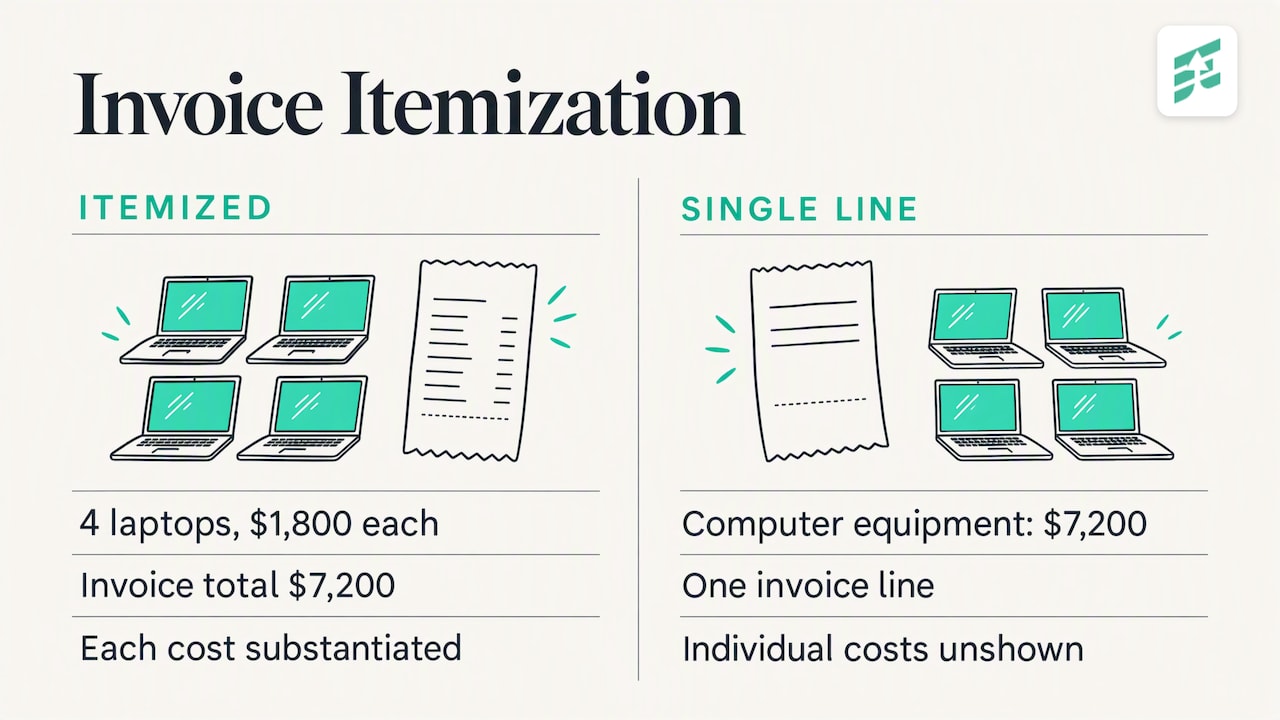
The limit applies per invoice, or per item as substantiated by the invoice. Say you buy four laptops at $1,800 each on one invoice totaling $7,200. Each laptop is an item under $2,500, so each can qualify if the invoice shows them separately. If the invoice lists one line for “computer equipment, $7,200,” you have a problem proving what each item cost. Itemized invoices matter.
What counts toward the cost
Additional costs such as delivery fees or installation must be included in the property’s cost when they appear on the same invoice. A $2,300 machine with a $300 installation charge on one invoice is a $2,600 item and falls outside the no-AFS limit. Ask vendors to bill shipping and installation on separate invoices when that is how the work is actually done.
The accounting procedure requirement
This is where small businesses most often trip. To qualify, you need accounting procedures in place at the beginning of the tax year to expense amounts paid for property that costs less than a set amount or has a useful life of 12 months or less. If you have an AFS, those procedures must be written. Even if you do not have an AFS, we recommend writing a one-page policy. It takes minutes, and it is the first thing that supports your position if anyone asks.
A simple policy might say:
- Purchases of tangible property costing $2,500 or less per invoice or item are expensed when paid or incurred.
- The policy applies to all such purchases, with the exceptions the regulations require.
- The policy takes effect at the start of the tax year and applies for the full year.
Your books must match. If your policy says you expense items under $2,500 but your bookkeeper has been capitalizing $1,200 printers, the books do not follow the procedure. Clean bookkeeping is the foundation here, which is why we cover the chart of accounts setup in its own guide.
You can also set a higher book threshold than the safe harbor amount if you can show it clearly reflects your income, per Rev. Proc. 2015-20. The safe harbor only protects amounts up to its own limit, so anything above that is judged on its facts.
What the safe harbor does not cover
The election does not apply to inventory, land, or certain rotable, temporary and standby emergency spare parts. In practice:
- Inventory: Goods you hold for sale, and materials that become part of them, follow inventory rules.
- Land: It is never depreciable and never a de minimis expense.
- Certain spare parts: Rotable, temporary and standby emergency parts have their own treatment.
The safe harbor also applies to a single election for the year. You cannot elect it for some purchases and skip it for others. If you elect, you apply it to all qualifying amounts that year, and your books follow the same rule.
Other rules still apply on top. Larger purchases above your threshold are capitalized and depreciated, or may qualify for other tax provisions such as Section 179 or bonus depreciation. Which of those fits depends on your situation and your state, so it is a planning conversation rather than a rule of thumb.
How to make the election
The election is made by attaching a statement titled “Section 1.263(a)-1(f) de minimis safe harbor election” to your timely filed original federal tax return for the year the costs are paid. The statement must include:
- Your name
- Your address
- Your taxpayer identification number
- A declaration that you are making the election
A few practical points:
- Every year. The election does not carry forward. Put it on your checklist for each return.
- Original return. It cannot be added later on an amended return, so extensions matter. File on time, including extensions, and attach the statement.
- Each entity. If you own several businesses, each filing entity makes its own election.
- Software. Some tax software handles the statement on e-filed returns and some does not. Ask your preparer how it is attached.
If you have missed the election in a prior year, do not assume it can be fixed by amending. Talk to a CPA about what options exist for your facts.
A worked example
Imagine a small Oregon contractor with no AFS. During the year it buys:
| Purchase | Cost (one invoice, itemized) | Result |
|---|---|---|
| Two tablets for field crews | $700 each | Expensed |
| Office desk | $1,150 | Expensed |
| Commercial printer | $2,400 | Expensed |
| Printer with installation on one invoice | $2,400 + $350 = $2,750 | Over the limit, capitalized |
| Pickup truck | $38,000 | Capitalized and depreciated |
The first three items are deducted immediately, assuming the contractor had the policy in place on the first day of the year and attached the election statement. The installed printer shows how a single invoice can push an item over the line. The truck was never close.
This is an illustration, not a client case. Your own results depend on your invoices, your policy and your return.
Repairs versus improvements
Many readers searching this topic also want to know how the IRS separates repairs from improvements. They are related, but the de minimis safe harbor does not decide the question. It sets a dollar line for small purchases. The repair rules decide what a cost is.
The rule of thumb in the regulations: betterments, restorations, or adaptations to a new or different use are improvements and must be capitalized. Costs not paid for an improvement generally are deductible as repairs and maintenance.
- Betterment: fixes a defect, expands the property, or makes it materially better. Adding a room is a betterment.
- Restoration: replaces a major component or returns worn-out property to working condition. A full roof replacement tends to fall here.
- Adaptation: converts the property to a use different from the one it had when you placed it in service.
- Repair: keeps the property in ordinary working order, such as patching a leak or repainting.
A useful sequence for a small invoice is to ask whether it fits under your de minimis limit first. If it does and you have elected, you can expense it without the repair-versus-improvement analysis. If it does not, you work through the repair rules.
Landlords hit this constantly. Appliances, flooring, fixtures and small contractor jobs add up across units. Our guide to tax deductions landlords should track goes through the categories that matter.
The small taxpayer safe harbor for buildings
People often confuse this with the de minimis rule, since both have “safe harbor” in the name. They address different problems. The small taxpayer safe harbor is available to businesses with average annual gross receipts of $10 million or less that own or lease building property with an unadjusted basis of $1 million or less. It allows qualifying building costs up to the lesser of 2% of that basis or $10,000 per year.
| De minimis safe harbor | Small taxpayer safe harbor | |
|---|---|---|
| Applies to | Tangible property purchases and some small costs | Repairs, maintenance and improvements to a building |
| Limit | $2,500 or $5,000 per invoice or item | Lesser of 2% of building’s unadjusted basis or $10,000 per year |
| Size test | None | $10 million average gross receipts, $1 million building basis |
| Scope | Whole business | Applied building by building |
A small landlord or a business that owns its office can use both in the same year, each for the costs it fits. Whether to elect the second one, and for which buildings, is the kind of decision worth running past your CPA before filing.
Common mistakes
- No policy at the start of the year. Adopting a procedure in December does not help for that year.
- Books and return do not match. If the ledger capitalizes an item, you cannot deduct it as de minimis.
- Lumped invoices. A single total invoice for many items makes item-level cost hard to show.
- Forgetting the statement. No statement, no election, regardless of how well your books look.
- Treating the limit as annual. The limit is per invoice or item. It is not a yearly cap on total deductions.
- Ignoring state rules. Federal rules do not automatically bind state returns. Check how your state treats depreciation and expensing.
A tidy year-end process catches most of these. Our quarter-by-quarter tax planning guide shows where to review capital purchases before the year closes.
Perspective
Most of the de minimis questions we see are not tax questions. They are bookkeeping questions. The rule is simple, but it only works when the policy exists on day one of the year, invoices are itemized, and the ledger treats a $1,200 monitor the same way the return does.
That is why we handle it as part of year-round planning rather than a line item in March. We review what the business plans to buy, decide which safe harbors make sense, and set the accounting procedure before the year starts. Real estate investors and cannabis operators, who buy equipment and repair property constantly, tend to see the biggest effect.
The goal is not just a bigger deduction. It is a cleaner set of books, fewer assets to track, and a return that is easy to defend.
Justin Ash, CPA
Get it set up before the year starts
If you are not sure whether you have the right policy, or whether to elect the safe harbor this year, we can build the process into your books and your return. Elevate Business Consulting works with small businesses, startups, real estate investors and cannabis operators on tax planning and preparation as a year-round service, from the accounting procedure to the election statement.
If you own rental property, see our real estate accounting services. If your books need cleanup first, start with our bookkeeping services.
A year-end checklist
- Confirm you had an accounting procedure in place on the first day of the year.
- Pull a list of every purchase of tangible property and check the invoices for itemization.
- Flag anything near the limit, especially with delivery or installation on the same invoice.
- Separate inventory, land and spare parts, which fall outside the election.
- Reconcile the ledger to your policy so books and return agree.
- Ask your preparer to attach the election statement to the original return.
- Decide whether the small taxpayer safe harbor applies to any buildings you own or lease.
For wider context on how these choices fit your overall tax picture, read about tax planning that helps small businesses keep more.
FAQ
Is the de minimis safe harbor automatic?
No. You must attach a statement to your timely filed original federal return each year. You also need an accounting procedure in place at the start of the year, and your books must treat qualifying items as expenses.
What is the de minimis safe harbor limit for a small business?
A business without an applicable financial statement can deduct up to $2,500 per invoice or item. A business with an AFS can deduct up to $5,000. The IRS publishes both on its tangible property regulations page.
Does the safe harbor apply to inventory or land?
No. The election excludes inventory, land and certain rotable, temporary and standby emergency spare parts. Those costs follow their own rules.
How is the small taxpayer safe harbor different?
It covers repairs and improvements to a building, not individual purchases. It requires average gross receipts of $10 million or less and a building with an unadjusted basis of $1 million or less, and caps costs at the lesser of 2% of basis or $10,000.
Can I set a higher threshold than $2,500?
You can use a higher book threshold if you can show it clearly reflects your income, as Rev. Proc. 2015-20 explains. The safe harbor itself only protects amounts up to its limit, so talk to your CPA first.
Sources
- Tangible property final regulations, Internal Revenue Service
- 26 CFR 1.263(a)-1, Electronic Code of Federal Regulations
- Notice 2015-82, Increase in De Minimis Safe Harbor Limit
- IR-2015-133, IRS news release on the tangible property threshold
- Rev. Proc. 2015-20, Internal Revenue Service