

A retainer is not income the day it lands in your bank account. If you receive one, you record it as a liability and move it to revenue as you earn it. If you pay one, you record it as a prepaid asset and expense it as you receive the service. The IRS adds its own timing rules for taxes, and they can differ from your books. This guide covers both sides, with journal entries, a worked example, and the tax traps.
TL;DR
- A retainer you receive goes in as cash plus a liability (unearned revenue), not income. It becomes revenue when you perform the work or when the contract says it is earned.
- A retainer you pay is generally a prepaid asset, expensed as the services arrive.
- For taxes, cash-method businesses generally report income when received, so a retainer can be taxable before you earn it. Accrual-method businesses have a limited deferral option.
- A “true retainer” that only buys availability is treated differently from an advance against future work, and your agreement has to say which one you have.
- Keep the agreement, invoices, and payment records together so your accountant can support the treatment.
Table of Contents
- What a retainer is, and how it differs from a deposit
- Accounting for a retainer you receive
- Accounting for a retainer you pay
- Cash basis vs. accrual basis: when the retainer counts
- What the retainer agreement and invoice should say
- Refunds and unused balances
- Why charge a retainer at all
- Setting it up in your software
- Perspective: why retainers deserve year-round attention
- Get your retainers set up right
- FAQ
- Sources
What a retainer is, and how it differs from a deposit
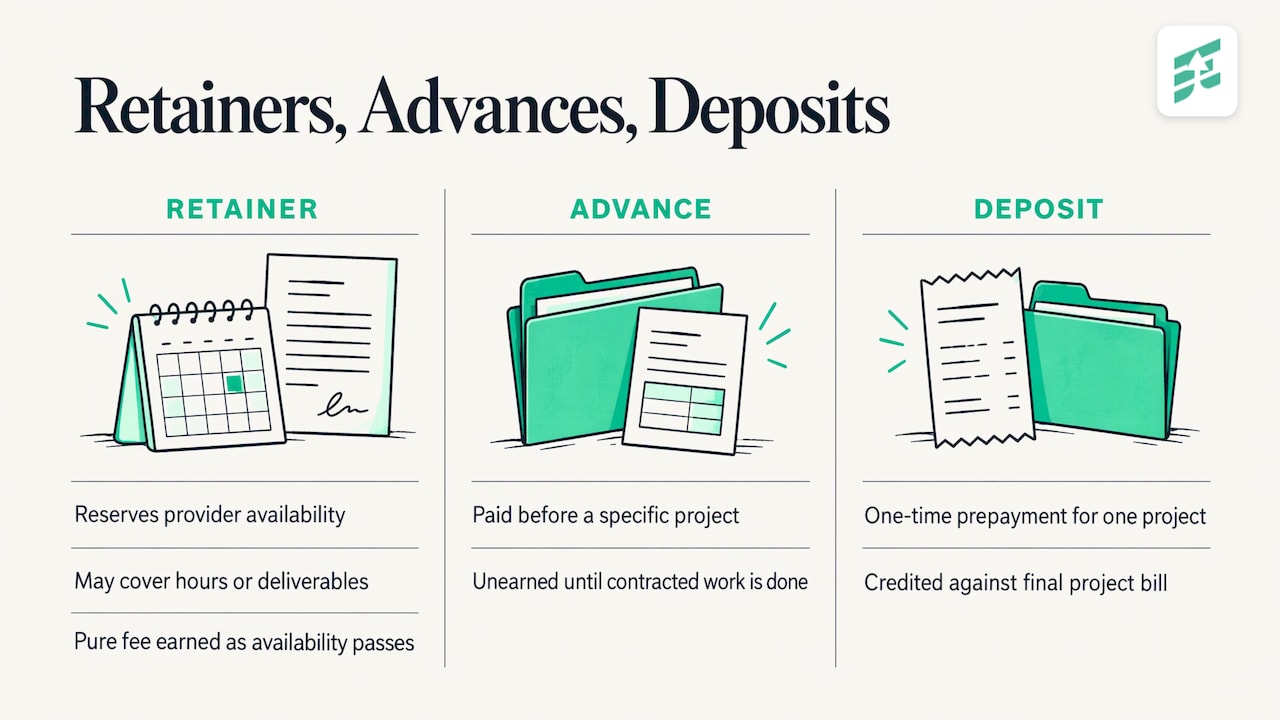
A retainer is money a client pays a provider to reserve the provider’s time or secure access to services. Xero describes it as a fee paid to reserve availability, not necessarily tied to one project, while an advance is paid before a specific project. Invoity’s guide lays out three common versions: guaranteed availability, a prepaid block of hours, or a fixed set of monthly deliverables. It also separates retainers from deposits, which are one-time prepayments credited against a single project’s final bill.
For your books, the labels matter less than the substance. Glencoyne’s guide notes that most project deposits and service retainers are handled the same way: both are client prepayments for work not yet done, and both call for unearned revenue treatment.
There is one exception worth knowing. A true retainer is a fee paid purely to guarantee availability, whether or not the client uses any services. In that case the fee can be earned when the period of availability passes, but Glencoyne says the agreement must spell this out in precise language. If your contract is vague, assume the money is an advance against work.
Accounting for a retainer you receive
If you run a service business, consultancy, agency, or professional practice, you are usually on the receiving end. The rule is simple: the money is not yours yet.
The entries, step by step
QuickBooks’ guidance says upfront deposits and retainers belong in a current-liability account because they are not income until used for services, even though the cash sits in your bank account. The same logic appears in standard accounting instruction: cash received before services are performed is a debit to Cash and a credit to Unearned Revenue, which is a liability.
- Receipt. Debit Cash (or the bank account), credit Retainer Liability (unearned revenue).
- Work performed and invoiced. Create the invoice for the services. QuickBooks says to apply the retainer as a negative line on the invoice, which reduces the liability and moves the amount to income.
- Balance due. If the invoice is larger than the retainer, the client pays the difference. If it is smaller, the remainder stays in the liability account until it is used or returned.
The first entry is where most mistakes begin. A retainer coded straight to a revenue account inflates income, throws off margins, and can push a cash-basis owner into paying tax too early. Running a periodic journal entry anomaly review is one way to catch prepayments that were booked to the wrong account before they reach your financial statements.
A worked example
This is an illustration, not a client case. Say a marketing consultant collects a $3,000 retainer on November 1 to cover work over the next three months, with $1,000 of work completed each month.
| Date | Event | Debit | Credit |
|---|---|---|---|
| Nov 1 | Retainer received | Cash $3,000 | Retainer Liability $3,000 |
| Nov 30 | $1,000 of work invoiced, retainer applied | Retainer Liability $1,000 | Service Revenue $1,000 |
| Dec 31 | $1,000 of work invoiced, retainer applied | Retainer Liability $1,000 | Service Revenue $1,000 |
| Jan 31 | Final $1,000 invoiced, retainer applied | Retainer Liability $1,000 | Service Revenue $1,000 |
On the accrual basis, the consultant reports $1,000 of revenue per month and carries a liability balance of $3,000 after the first entry, $2,000 after November, and so on until it reaches zero. Bank balance and revenue tell different stories, which is exactly why the liability account exists.
Accounting for a retainer you pay
If you are the one hiring an attorney, an accountant, or an agency, the mirror image applies. The paying business generally records the payment as a prepaid asset and recognizes expense as the services are received, according to one 2026 explainer. Tax timing then depends on your accounting method and the applicable rules.
In practice:
- Payment. Debit Prepaid Expenses (or a retainer asset account), credit Cash.
- Services received. Debit the relevant expense (legal, professional fees, marketing), credit Prepaid Expenses for the amount used.
- Unused balance returned. Debit Cash, credit Prepaid Expenses.
The common error on this side is expensing the entire retainer on the day you write the check. That overstates expenses in one period and understates them in the next. Ask your provider for a periodic statement of how much of the retainer has been applied, so your prepaid balance matches reality.
Cash basis vs. accrual basis: when the retainer counts
Your accounting method changes what the retainer does to your financial statements and your tax return.
Cash method. The IRS says in Publication 538 that cash-method taxpayers generally report income when it is actually or constructively received. A payment is constructively received when it is credited to your account or made available to you without substantial restriction, even if you have not withdrawn it. For retainers, that means the money is generally taxable in the year it arrives. SparkReceipt gives an example: a cash-basis sole proprietor collecting a $12,000 annual retainer in November 2026 would report the full $12,000 as 2026 income, even though most of the work happens in 2027.
Accrual method. Accrual-method taxpayers generally report income when it is earned, regardless of when payment arrives, per the same IRS publication. For advance payments for services, Publication 538 says they are generally income in the year received, but an accrual-method taxpayer may elect a limited deferral to the following tax year if specified conditions are met. The deferral cannot extend beyond that next year.
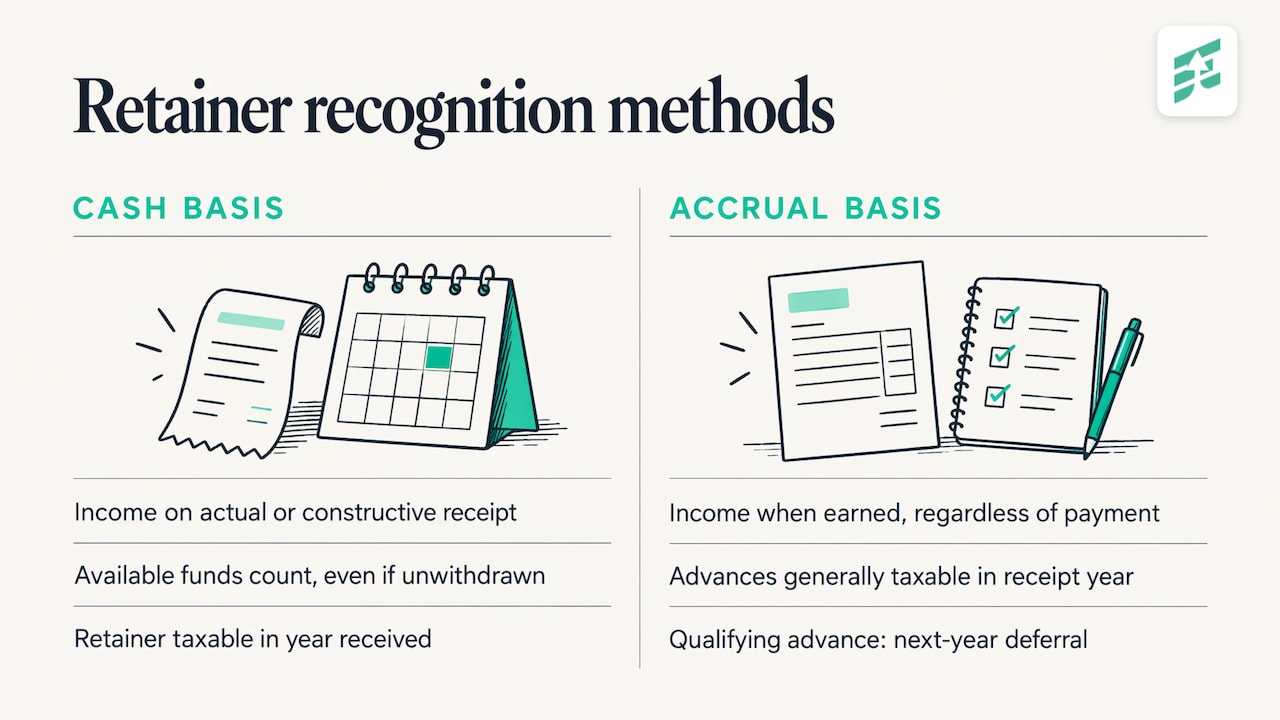
The tax code sections behind this are 451(b) and 451©, which cover timing tied to financial statements and the limited deferral of qualifying advance payments, as a Federal Bar Association tax presentation explains.
Book revenue recognition under GAAP
Books and tax returns do not have to match. Under US GAAP, ASC 606 holds that revenue is recognized when earned, not when cash arrives. FINRA’s Regulatory Notice 23-21 puts the point sharply: consideration received before the related performance obligation is satisfied is a liability, and booking non-refundable fees as revenue on receipt, without substantiating that the obligation was met, generally would not be sufficient under ASC 606.
How you recognize the revenue depends on the kind of promise you made:
- Continuous access or availability: recognize ratably over the period.
- Hours or usage-based work: recognize as the hours are delivered.
- Milestones or deliverables: recognize as each is completed.
If you prepare reviewed or audited statements for a lender or investor, your accountant will want the revenue pattern documented before year-end, not after.
What the retainer agreement and invoice should say
Many retainer headaches are drafting problems. The accounting follows the agreement, so the agreement needs to answer the questions an accountant will ask.
The Federal Bar Association’s guide says retainer terms should explain how the arrangement works, what it costs, what it covers, how it is replenished, and any unique terms, and that these should carry through to invoices. NeatInvoice recommends that a retainer invoice show:
- The service period
- The retainer model (availability, hours, or deliverables)
- Included work or hours
- The overage rate and how overages are approved
- How unused capacity is treated
- The due date, tax details, and payment instructions
- A reference to the agreement
That same guide recommends keeping the signed agreement, invoices, payment evidence, usage summaries, overage approvals, and renewal changes together, and it warns that an invoice label alone does not decide accounting treatment. Calling something “non-refundable” or “earned on receipt” on an invoice does not make it so if the contract and the work say otherwise.
Refunds and unused balances
Whether unused money goes back depends on the type of retainer and the contract. For lawyer retainers, the Federal Bar Association says the lawyer holds the funds in a trust account until earned, applies earned amounts after invoicing, and returns what remains after the work is done. Other professionals handle it by contract, which is why the refund language belongs in writing up front.
On the books, the entries follow the facts:
- Full refund, no work done: debit Deferred Revenue, credit Cash, and no revenue is recognized.
- Cancellation with no remaining obligation and a contract that makes the amount non-refundable: the remaining balance may be recognized as revenue, subject to the agreement and applicable accounting rules.
- Partial use: apply the earned portion to revenue, then refund or carry forward the rest per the agreement.
Before you recognize a forfeited balance as income, have your CPA confirm that the contract language supports it.
Why charge a retainer at all
From the provider’s side, a retainer protects cash flow. Edward Mendlowitz, writing in Accounting Today, suggests asking for about two-thirds of the estimated fee upfront on short projects and always requesting a retainer before long ones. His reasoning is that the longer the gap between doing the work and sending the bill, the less likely you are to be paid in full.
A retainer works best when your books are set up to handle it. If your unpaid invoices are already piling up, our guide to accounts receivable collections covers the follow-up side. If you are still choosing who should keep these entries, bookkeeper vs. accountant lays out the difference.
Setting it up in your software
Most small businesses get retainers wrong in the chart of accounts, not in the theory. A workable setup has three pieces:
- A current-liability account named something like “Client Retainers” or “Unearned Revenue.”
- A service item for the retainer so it does not post to income by default.
- A repeatable process for applying the retainer to each invoice, so the liability balance always equals unused client funds.
Reconcile the liability account monthly against your client list. The balance by client should add up to the account total, and any client with a balance and no recent activity deserves a conversation about refund or renewal. If you want the setup built correctly the first time, our QuickBooks consulting services cover this kind of configuration. Different industries add their own wrinkles, such as job costing for contractors or prepaid rent and deposits for rental properties.
Perspective: why retainers deserve year-round attention
Retainers look simple on the day the money arrives, and that is exactly when they get misclassified. The cash feels like revenue, so it gets booked as revenue, and the owner finds out in March that the tax bill and the real profit do not match.
We approach retainers the same way we approach everything for small businesses: connect the books, the tax return, and the business decisions before the year ends. That means deciding at signing whether the retainer is a true availability fee or an advance against work, writing that into the agreement, setting up the liability account, and checking in before December to see how the year’s retainers will land on the return.
The owners who get the most from this are the ones who plan the timing instead of discovering it. A retainer collected in November can change a cash-basis owner’s year. A short planning conversation before year-end is much cheaper than fixing it afterward.
Justin Ash, CPA
Get your retainers set up right
Elevate Business Consulting is a CPA firm in Medford, Oregon, working with small businesses, startups, real estate investors, and cannabis operators. We combine tax planning, accounting and bookkeeping, payroll, and business advisory, so a retainer is treated consistently in your books, your tax planning, and your cash forecast.

If you collect or pay retainers and want the entries, agreement language, and year-end timing reviewed, see our accounting and bookkeeping services or our bookkeeping services built to help you plan ahead, and book a consultation.
FAQ
How much does a retainer usually cost?
It depends on the provider, the scope, and the retainer model, so there is no standard figure. As a rule of thumb, one accounting columnist suggests about two-thirds of the estimated fee for short projects. Ask for the amount, what it covers, and how it is replenished in writing.
Do you get your retainer back?
Often, if the money is an advance against future work and you do not use all of it. For lawyer retainers, remaining funds are returned after the work is completed. A true availability retainer is different and may be earned even if you never call, so check the agreement.
Is a retainer income when I receive it?
In your books, usually not: it is a liability until you earn it. For taxes, it depends on your method. Under the cash method it is generally income in the year received, while accrual-method taxpayers may qualify for a limited one-year deferral under IRS Publication 538.
Is a retainer a prepaid expense for the business paying it?
Generally yes. The payer records a prepaid asset and expenses it as services are received. Tax timing depends on the payer’s accounting method, so confirm the treatment with your CPA before year-end.
What is the difference between a retainer and a deposit?
A retainer is typically recurring or open-ended and secures access to a provider, while a deposit is a one-time prepayment credited against a single project’s final bill, per Invoity. For bookkeeping, both usually start as unearned revenue.
Sources
- IRS Publication 538, Accounting Periods and Methods
- Xero: Small Business Guide to Professional Services Accounting
- Glencoyne: Project Deposits vs Retainers
- Invoity: What Is a Retainer?
- QuickBooks: Manage upfront deposits or retainers
- QuickBooks: Record a retainer or deposit
- Lumen Learning: Journalizing Revenue and Payments on Account
- LegalClarity: Is a Retainer a Prepaid Expense?
- SparkReceipt: Deferred Revenue Explained
- Federal Bar Association tax conference presentation
- FINRA Regulatory Notice 23-21
- NeatInvoice: Retainer Invoice Guide
- Federal Bar Association: Lawyer Retainers
- AccountingIQ: Unearned Revenue Refund Journal Entry
- Accounting Today: Getting paid sooner or later
- Revoxy: Journal Entry Anomaly Review