

Oregon’s Corporate Activity Tax (CAT) is a tax on a business’s Oregon sales, not on its profit. You must register once your Oregon commercial activity passes $750,000. You file a return at $1 million or more. You owe tax only on taxable commercial activity above $1 million, at $250 plus 0.57% of the excess. Below those lines you owe nothing, but you still need to track the numbers. A business that crosses a line without noticing pays penalties.
This guide walks through who is covered, how the math works with a worked example, when payments are due, and what happens if you miss a deadline.
TL;DR
- Register with the Oregon Department of Revenue (DOR) within 30 days of passing $750,000 in Oregon commercial activity. File Form OR-CAT once you reach $1 million.
- The tax is $250 plus 0.57% of taxable Oregon commercial activity over $1 million. Taxable activity is gross receipts, less exclusions, less a 35% subtraction for labor costs or cost inputs.
- It applies to every entity type: corporations, LLCs, partnerships and sole proprietorships. Unitary groups file as one taxpayer.
- Expect to owe $5,000 or more? Quarterly estimated payments are required.
- Late registration, underpayment, late payment and late filing each carry a separate penalty.
Table of Contents
- What the Corporate Activity Tax is
- The three thresholds that decide your obligations
- How Oregon CAT is calculated
- Exclusions and special rules that lower the base
- Multistate businesses and unitary groups
- Due dates and estimated payments
- Penalties and how to reduce them
- A short compliance checklist
- Our perspective
- Get help with CAT registration and filing
- FAQ
- Sources
What the Corporate Activity Tax is
The CAT is an annual tax that Oregon created in 2019 through the Student Success Act (House Bill 3427). It applies to tax years beginning on or after January 1, 2020. According to the Oregon Department of Revenue’s CAT page, it is imposed for the privilege of doing business in Oregon. It is not a transactional tax, and it is not an income tax.
The name misleads people. The tax is not limited to corporations. The DOR says any person, business or unitary group doing business in Oregon may have obligations. That includes corporations, partnerships, LLCs and sole proprietorships.
The tax is measured on commercial activity. That is the total amount a business realizes from transactions and activity in the regular course of business in Oregon, with no deduction for expenses. A business with thin margins and big revenue can owe CAT while owing little income tax. You can be unprofitable and still owe.
The Oregon Legislature’s CAT FAQ report estimated about 450,000 businesses in Oregon, with roughly 40,000 expected to have a CAT liability. Most small businesses fall under the threshold. The ones that cross it are often growing fast. Those owners are the ones most likely to be caught off guard.
Who is exempt
The DOR lists several exempt entities:
- 501©(3) nonprofits
- Tax-exempt farmers’ cooperatives
- Government entities
- Certain hospitals and long-term care facilities
- Manufactured dwelling park nonprofit cooperatives
The nonprofit exemption does not apply to income that is unrelated business taxable income under federal law. If you run a nonprofit with a revenue-generating side, ask your CPA how that activity is treated.
The three thresholds that decide your obligations
Oregon uses three dollar lines. The 2025 Form OR-CAT Instructions and the DOR page lay them out.
| Oregon commercial activity | What you must do |
|---|---|
| $750,000 or less | Nothing. You are outside the CAT requirements. |
| Over $750,000 | Register through Revenue Online within 30 days. |
| $1 million or more | File a CAT return on Form OR-CAT. |
| Taxable activity over $1 million | Pay the tax, after exclusions and the 35% subtraction. |
The third line is easy to miss. Filing starts at $1 million of commercial activity, but payment starts only when taxable commercial activity exceeds $1 million. Taxable activity is what remains after the exclusions and the 35% subtraction. So a business can file and still owe only the $250 base, or nothing, depending on how the math lands. Check the current DOR instructions each year, because thresholds and forms can change.
These tests apply to your Oregon commercial activity, not your total revenue. A business based in Washington with Oregon customers still counts its Oregon-sourced receipts.
Registration is the step people miss
Registration happens within 30 days of reaching the $750,000 mark during the year. It is done online through Revenue Online. Failing to register can bring a penalty of $100 per month, capped at $1,000 in a tax year, under ORS 317A.131 as cited in the DOR instructions.
House Bill 4202 removed the annual re-registration requirement except in certain circumstances, as noted in the 2020 Form OR-CAT Instructions. Once registered, you generally stay registered.
A practical habit: have your bookkeeper run a year-to-date Oregon sales figure each quarter. If you are approaching $750,000 by midyear, you have time to register. If you find out in December, you may already be past the 30 days. This is one reason we build year-round tax planning into our client work. Thresholds like this are far easier to manage when someone watches them during the year.
How Oregon CAT is calculated
The DOR’s How to calculate CAT liability worksheet breaks it into two steps.
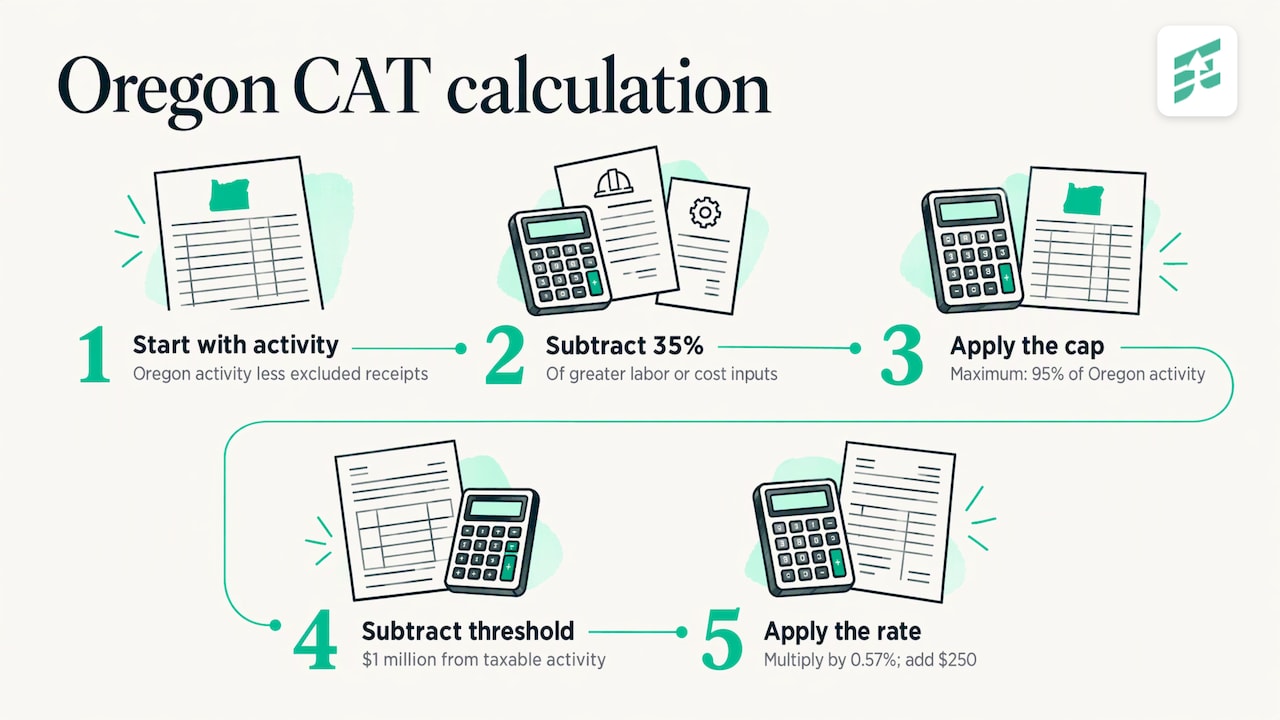
Step 1: find taxable Oregon commercial activity. Start with Oregon commercial activity. Remove any excluded receipts. Then subtract 35% of the greater of your labor costs or your cost inputs. That subtraction is limited to 95% of Oregon commercial activity.
Step 2: apply the rate. Subtract $1 million from taxable Oregon commercial activity. Multiply the result by 0.57%. Add $250.
What counts as labor costs and cost inputs
The DOR’s 2022 CAT statistics publication explains the two subtraction options:
- Cost inputs means cost of goods sold as calculated for federal taxable income. It includes factory labor, raw materials and factory overhead. It leaves out indirect costs like sales and general and administrative expenses.
- Labor costs includes most types of compensation. It excludes employees’ payroll taxes, and it excludes compensation above $500,000 paid to any single employee.
You use whichever is greater, not both. A service firm with a large payroll will usually use labor costs. A product business with heavy materials spending may do better with cost inputs. Multistate taxpayers apportion eligible costs to Oregon commercial activity.
A worked example
Say an Oregon design-build company has these figures for the year:
| Item | Amount |
|---|---|
| Oregon commercial activity | $3,000,000 |
| Eligible labor costs | $1,200,000 |
| Eligible cost inputs | $800,000 |
- The greater of labor costs or cost inputs is $1,200,000.
- 35% of $1,200,000 is $420,000. This is under the 95% cap, so it stands.
- Taxable Oregon commercial activity: $3,000,000 minus $420,000 equals $2,580,000.
- Subtract $1 million: $1,580,000.
- Multiply by 0.57%: $9,006.
- Add $250: $9,256.
This is an illustration only. Real returns involve exclusions, sourcing questions and group rules. But it shows the scale. A company with $3 million in Oregon sales owes a bit over 0.3% of that. The larger risk for most small businesses is not the tax itself. It is the penalty for missing registration or filing deadlines.
Exclusions and special rules that lower the base
The DOR page and the statistics publication list the receipts that fall outside commercial activity. The main true deductions are:
- Receipts from the sale of motor vehicle fuel
- Wholesale and retail sale of groceries
- Farmer sales to an agricultural cooperative in Oregon
- Fluid milk sales by dairy farmers who are not members of an agricultural cooperative
- Net revenue of residential care facilities or in-home care agencies for services to Medicare recipients
The DOR notes that HB 3427 listed 48 exclusions, but most simply clarify what was never part of the tax base. Only a handful work as real deductions.
Contractors and the subcontractor exclusion
General contractors who incur labor costs for single-family residential construction in Oregon may exclude 15% of the labor costs paid to a subcontractor. Per the DOR calculation document, this does not cover payments for materials, land or permits. It is not allowed for payments between subcontractors. If you run a construction business, clean job costing is what makes this exclusion usable. Our guide to bookkeeping for contractors covers how to separate labor from materials on each job.
Multistate businesses and unitary groups
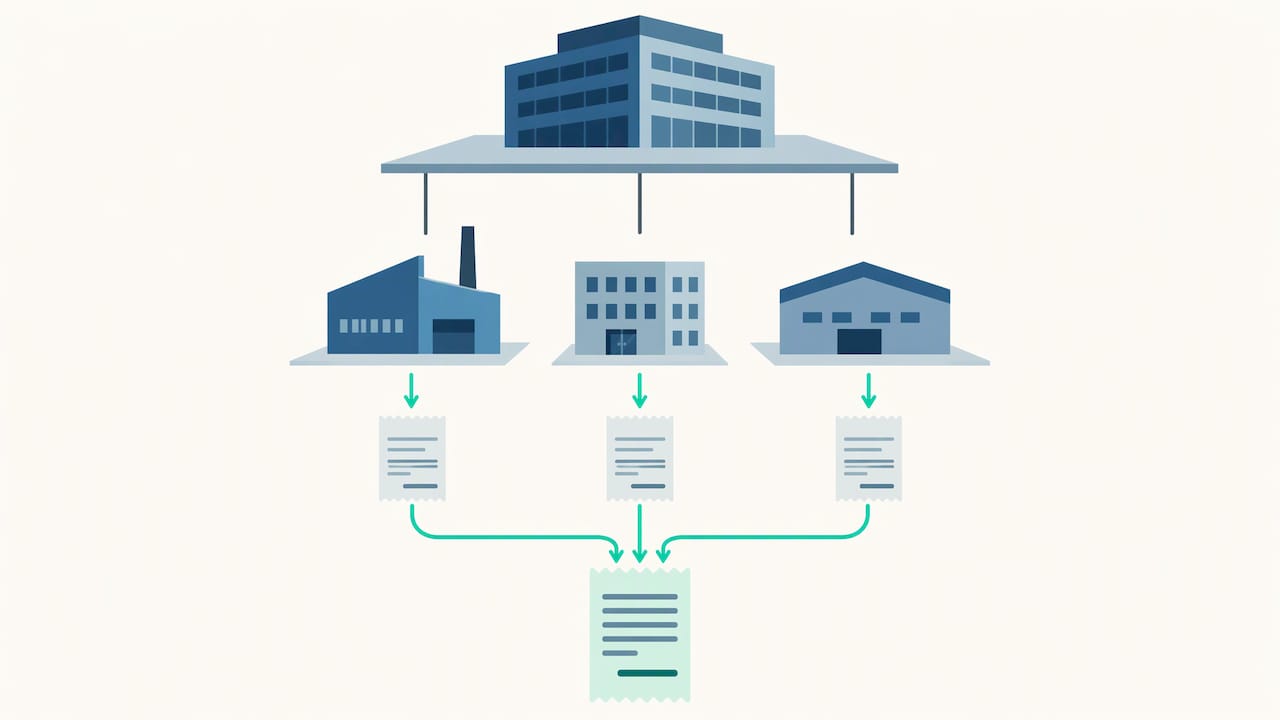
If you own more than one company, the group rules matter. The DOR defines a unitary group as persons with more than 50% common ownership that share or exchange value through centralized management, administrative services or functional integration. A unitary group registers, files and pays as a single taxpayer. Receipts between group members can be excluded. A group may elect to omit a non-U.S. member that has no Oregon commercial activity and no exclusions that would otherwise be sourced to Oregon.
For owners with several LLCs, this changes the threshold test. The $750,000 and $1 million lines apply to the group, not to each entity. Three small companies under common control, each at $400,000 in Oregon sales, can together cross the registration line. Group status depends on facts, so get it reviewed before assuming each entity stands alone. The state’s definition is in OAR 150-317-1025, and your CPA should apply it to your ownership chart.
Out-of-state sellers
The Legislature’s committee materials list examples of substantial nexus with Oregon. They include owning or using capital in Oregon, holding a Secretary of State certificate to do business in Oregon, having at least $50,000 of Oregon property or payroll, at least $750,000 of Oregon commercial activity, or 25% of total property, payroll or commercial activity in Oregon. The detail is in the committee document on the CAT. If you sell into Oregon from elsewhere, review these tests with your CPA.
Due dates and estimated payments
The annual return is due by the 15th day of the fourth month after the tax year ends. For a calendar-year business, that is April 15, moved to the next business day if it lands on a weekend or Oregon legal holiday. A federal extension for the same tax year automatically serves as an Oregon extension. More time to file is not more time to pay.
Quarterly estimated payments are required if you expect to owe $5,000 or more. For calendar-year filers, they are due April 30, July 31, October 31 and January 31. The DOR statistics publication notes that nearly all CAT payments arrive before returns are filed, because of these estimates and extensions.
The safe harbor protects you from the underpayment penalty. For tax years beginning on or after January 1, 2022, each installment must equal or exceed 25% of 90% of the tax for the year, under OAR 150-317-1310. Plan your cash for these dates. A year that closes strong can produce a CAT bill that arrives in installments you did not budget for. Our guide to quarterly estimated tax payments shows how to build them into a cash calendar alongside your federal and state income tax estimates.
Penalties and how to reduce them
The DOR page lists the following penalties:
| Situation | Penalty |
|---|---|
| Failure to register | $100 per month, up to $1,000 per tax year |
| Underpaying quarterly estimates | 5% |
| Late payment | 5% |
| Late filing (tax not paid by original due date, return filed over three months late) | 20% |
| Unpaid tax and no report within 30 days of a demand notice | 25% deficiency penalty |
| No returns filed for three consecutive years | 100% late-payment and late-filing penalty |
Total penalties cannot exceed the tax due, and interest accrues from the day after the original due date.
The DOR has a waiver process under OAR 150-305-0068. Per its tax practitioner meeting presentation, it can cover several of these penalties when the taxpayer is in compliance. If you are already late, the fastest route is to register, file and pay, then request a waiver with your CPA’s help.
A short compliance checklist
- Pull your Oregon sales total each quarter and compare it with $750,000 and $1 million.
- Register on Revenue Online within 30 days of passing $750,000.
- Review your ownership structure to see whether you are part of a unitary group.
- Separate labor costs from cost inputs in your books so you can take the larger subtraction.
- Identify any excluded receipts and tag them in your accounting system.
- If you expect $5,000 or more in tax, set up quarterly estimates.
- File Form OR-CAT by the due date, or extend.
Steps 4 and 5 depend on how your books are set up. A chart of accounts that separates payroll, factory labor and overhead makes the return a matter of pulling reports. We cover this setup in QuickBooks consulting, and it is easiest to do before year-end, not after.
Our perspective
Most of the CAT problems we see are not about the tax rate. They come from timing and records. A business owner has a strong year, passes $750,000 in Oregon sales sometime in the summer, and nobody notices until a notice arrives or a tax preparer asks questions in the spring.
We approach this as a year-round issue. When we work with a small business, we look at Oregon activity alongside payroll, entity structure and federal planning, because the numbers interact. The labor-cost subtraction depends on how payroll is recorded. Unitary group status depends on how the owner structured their LLCs. Estimated payments depend on a forecast the books should already contain.
That is why we pair tax planning with accounting and payroll instead of treating each as a separate yearly event. The business owner gets one team watching thresholds as they approach, not a surprise afterward. For contractors, real estate investors and cannabis operators, where revenue patterns and cost structures are specific to the industry, we tailor the tracking to the way those businesses actually earn and spend.
If your Oregon sales are heading toward six figures a month, talk to a CPA before the year closes. A short planning conversation costs far less than a penalty.
Justin Ash, CPA
Get help with CAT registration and filing
Elevate Business Consulting is a CPA firm based in Medford that serves small businesses, startups, real estate investors and cannabis operators with tax planning and preparation, accounting and bookkeeping, payroll and business advisory. If your Oregon sales are nearing the CAT thresholds, we can review your numbers, confirm whether you are part of a unitary group and set up the tracking so deadlines do not slip.
Start at Elevate Business Consulting to book a conversation, or read about what a Medford CPA should do for your business. Operators in the cannabis industry can see our cannabis accounting services, and landlords and investors can see our real estate accounting services.
FAQ
Does my LLC have to pay the Oregon CAT?
An LLC is covered like any other entity type. If its Oregon commercial activity stays at or below $750,000, it has no CAT requirements. Over $750,000 it registers, and at $1 million or more it files. Tax is due only when taxable Oregon commercial activity exceeds $1 million. If you are weighing structures, our comparison of LLC versus S corporation taxes covers the income tax side.
Is the CAT the same as Oregon income tax?
No. The CAT is measured on commercial activity, which is gross receipts without deduction for expenses, and the DOR says it is not an income tax. You can owe CAT in a year when you have little or no taxable income. It is separate from your Oregon and federal income tax filings.
What is the Oregon CAT rate?
The tax is $250 plus 0.57% of taxable Oregon commercial activity over $1 million. Taxable activity is your Oregon commercial activity after exclusions and the 35% subtraction for the greater of labor costs or cost inputs.
When do I pay the Oregon CAT?
If you expect to owe $5,000 or more, pay quarterly estimates on April 30, July 31, October 31 and January 31 for calendar-year filers. The annual return is due on the 15th day of the fourth month after year-end. A federal extension extends filing but not payment.
Sources
- Oregon Department of Revenue: Corporate Activity Tax (CAT)
- 2025 Form OR-CAT Instructions
- 2020 Form OR-CAT Instructions
- DOR: How to calculate CAT liability
- DOR: Oregon Corporate Activity Tax Statistics, 2022 edition
- Oregon Legislature: Corporate Activity Tax FAQ report
- Oregon Legislature committee document on the CAT
- OAR 150-317-1310, Estimated Tax Payments
- DOR tax practitioner meeting presentation on the CAT