

Real estate professional status (REPS) is a federal tax classification that can turn rental losses from passive into nonpassive, so they may offset wages, business income and other earnings. To qualify, you must perform more than half of your personal services in real property trades or businesses in which you materially participate, and you must log more than 750 hours in those businesses during the year. Meeting those two tests is only the first step. You must also materially participate in your rentals, and you must be able to prove every hour.
TL;DR
- REPS is a tax status, not a license or a job title. It comes from Internal Revenue Code Section 469 and has nothing to do with holding a real estate license.
- You must meet two tests every year: more than half of your working time in real property businesses where you materially participate, and more than 750 hours in them.
- Qualifying only removes the automatic “passive” label on rentals. You still have to show material participation in each rental, unless you make an aggregation election.
- Employee hours in real estate generally do not count unless you own more than 5% of the employer.
- Keep a contemporaneous log. The status is decided on facts, and hours you cannot document are hours you may lose.
Table of Contents
- What real estate professional status means
- The two tests you must pass
- Which work counts as a real property trade or business
- Material participation: the part people skip
- Real estate professional versus Realtor
- What the status can do for your tax bill
- How to prove your hours
- Common mistakes
- Our perspective
- Getting help with real estate accounting
- FAQ
- Sources
What real estate professional status means
Most rental income is treated as passive under the passive activity rules. IRS Publication 925 says rental activities are passive even when you materially participate, unless you are a real estate professional. That default is what makes rental losses hard to use. Passive losses generally offset only passive income, so a landlord with a paper loss from depreciation and a high W-2 or business income often cannot use the loss in the current year.
Real estate professional status changes the starting point. IRS Publication 527 states that if you qualify, rental real estate activities in which you materially participated are not passive activities. A rental loss in that situation is a nonpassive loss, which can be deducted against other income, subject to the other limits in the tax code.
That is why the status gets so much attention, and why it is so often tested in audits. It is also narrower than its reputation. It rewards people who really work in real estate, not people who own a few rentals and manage them on the side.
The two tests you must pass
According to Publication 925 and Publication 527, you must meet both of these requirements in the tax year:
- The more-than-half test. More than half of the personal services you perform in all of your trades or businesses must be performed in real property trades or businesses in which you materially participate.
- The 750-hour test. You must perform more than 750 hours of services during the year in real property trades or businesses in which you materially participate.
The two tests work together, and the first one catches many people. Someone who works a 2,000-hour job and spends 900 hours on rentals clears the 750-hour test but fails the more-than-half test, because most of their working time is elsewhere.
A worked example
Suppose a contractor works 1,000 hours a year in her own construction business, which does not count as a real property trade for this purpose in the way her rental work does, and spends 800 hours managing and renovating her rentals. She clears 750 hours, but her real estate hours are not more than half of the 1,800 total. She does not qualify. If instead she were a full-time property manager at her own firm, logging 1,600 hours there and 200 hours on a separate consulting side job, she would pass both tests, provided she materially participates in the property management business.
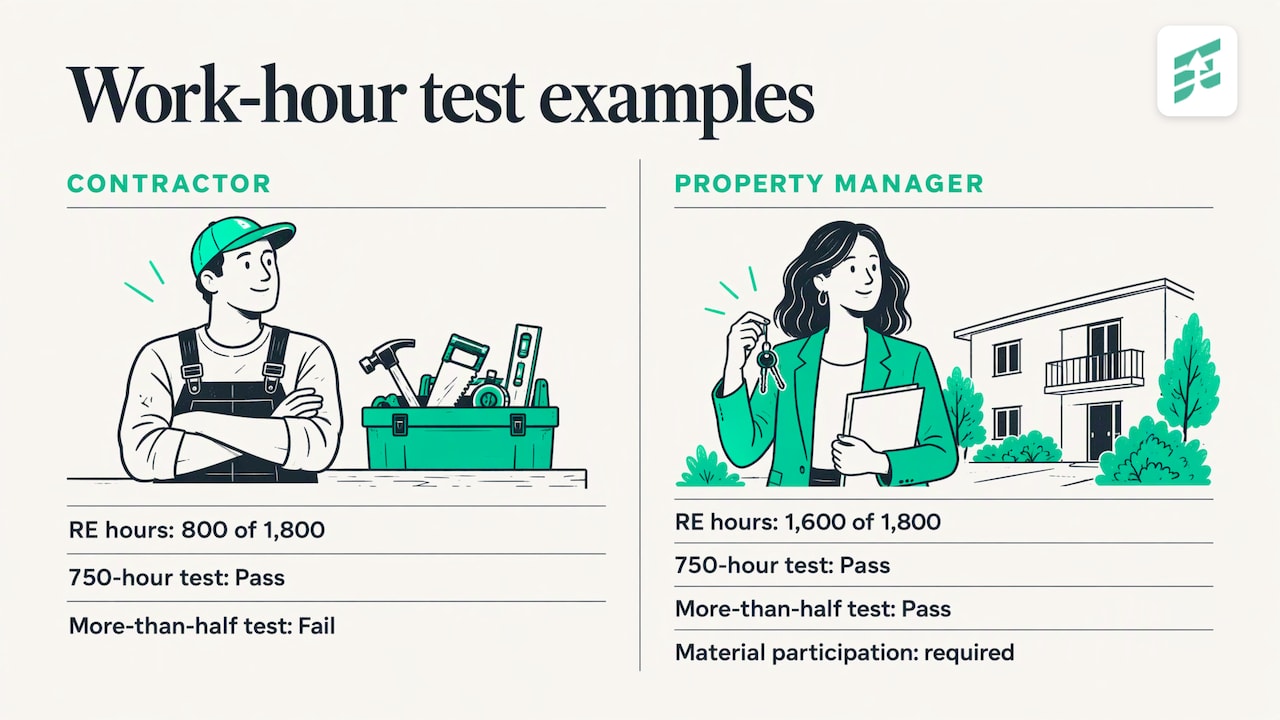
The point of the example: the tests compare your real estate time against everything else you do for pay, so a full-time job outside real estate usually rules the status out.
Which work counts as a real property trade or business
Publication 925 defines a real property trade or business as one that develops or redevelops, constructs or reconstructs, acquires, converts, rents or leases, operates or manages, or brokers real property. That covers a broad range of work:
- Developing or redeveloping properties
- Building or renovating
- Acquiring and converting properties
- Renting and leasing, including tenant screening and lease negotiation
- Operating and managing, including maintenance coordination and bookkeeping for the properties
- Brokering real property as an agent or broker
Hours count only when they are spent in a listed activity where you materially participate. Several common time-fillers generally do not count, including commuting, reading general investment books, conferences not tied to a specific activity, passive-investor hours in limited partnerships or syndications, and REIT activity.
Employee hours
This is the trap for salaried people. Publication 925 says personal services you perform as an employee in real property trades or businesses do not count toward qualification unless you were a 5% owner of the employer. Being a 5% owner means you owned, or are considered to own, more than 5% of the employer’s outstanding stock, voting stock, or capital or profits interest. A leasing manager at a company she does not own cannot count those hours. The same person running her own brokerage can.
Material participation: the part people skip
Qualifying as a real estate professional does not by itself make your rental losses nonpassive. Under 26 CFR § 1.469-9, a rental real estate activity of a qualifying taxpayer is still passive unless the taxpayer materially participates in it. Tony Nitti, CPA, writing in The Tax Adviser, puts it this way: a qualifying taxpayer has only overcome the presumption that rentals are passive, and must still establish material participation in each rental separately unless an aggregation election is made.
The statute sets the standard. 26 U.S.C. § 469(h)(1) treats you as materially participating only if you are involved in the operations of the activity on a basis that is regular, continuous and substantial. The regulations then provide specific tests for what meets that standard, and your CPA should map your facts to them each year.
Each property is its own activity unless you elect otherwise
Publication 527 explains that each interest in rental real estate is a separate activity unless you elect to treat all of your interests in rental real estate as one activity. For an investor with six rentals, that matters a great deal. Without the election, you would need to show material participation in each property. With it, your hours across all rentals are measured together. The election is made with your tax return and generally binds you in later years, so decide it with your CPA before you file, not after.
Real estate professional versus Realtor
The two terms sound alike and mean different things.
| Real estate professional (tax status) | Realtor | |
|---|---|---|
| What it is | A federal tax classification under Section 469 | A trademarked membership title |
| Who decides | You qualify by meeting the hour and participation tests | The National Association of Realtors, through membership |
| Requires a license | No | A state license, then membership |
| Purpose | Determines whether rental losses are passive | Signals membership and a code of ethics |
According to this explanation of Realtor versus real estate agent, REALTOR® is a membership designation for a licensed agent or broker who has joined the National Association of REALTORS® and agreed to its Code of Ethics. It is not a license level.
A Realtor does not automatically hold real estate professional status. A licensed agent with a part-time book of business and a full-time engineering job will fail the more-than-half test. Equally, an investor with no license who self-manages and renovates a large portfolio full time can qualify. The license is neither required nor sufficient. Hours and participation decide it.
One point is a quiet advantage for agents and brokers: brokering real property is on the list of real property trades or businesses, so hours spent on your own brokerage work can count toward the tests. The hours still have to be documented, and you still have to materially participate in your rentals to deduct their losses against other income.
What the status can do for your tax bill
The main benefit is the one already described: nonpassive treatment of rental losses. LegalClarity, in a December 2025 overview of Section 469, notes that for a real estate professional who materially participates, losses from those properties are treated as nonpassive and can be deducted against income such as wages or portfolio income.
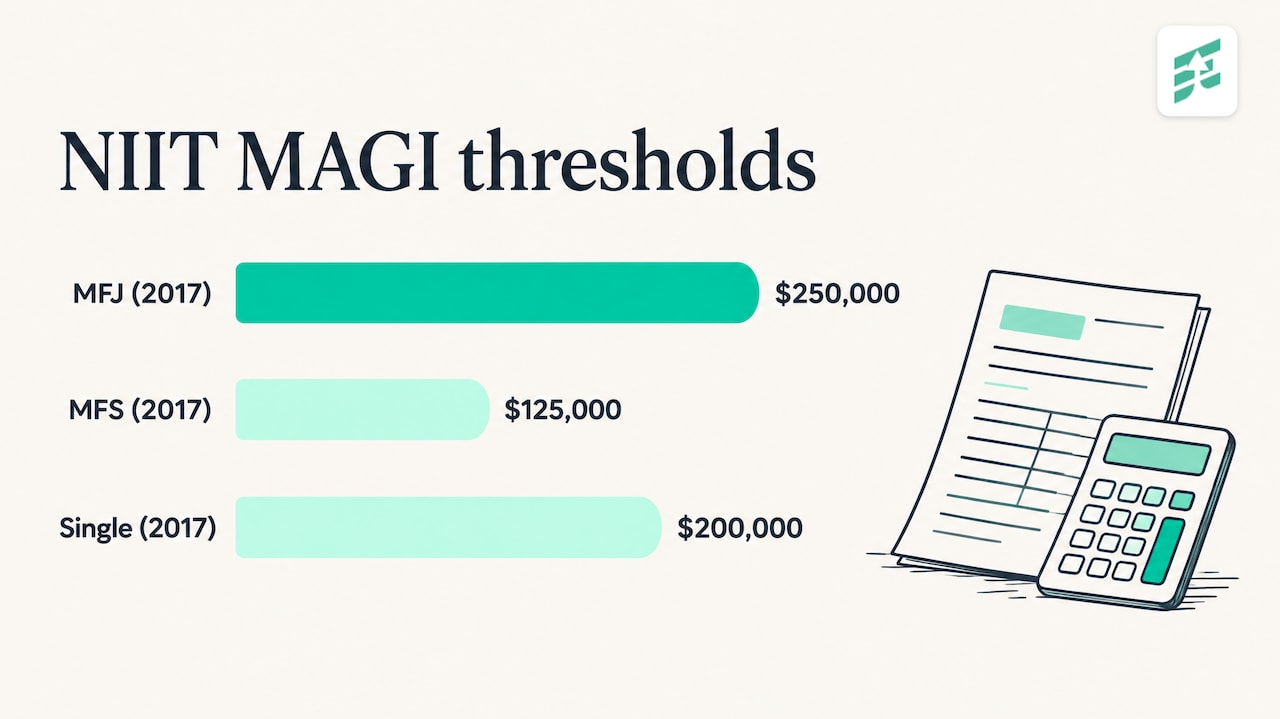
A second benefit involves the 3.8% net investment income tax (NIIT). Nitti explains in The Tax Adviser that passive rental income is generally subject to NIIT unless the taxpayer is a qualifying real estate professional and the income is derived in the ordinary course of a trade or business. A safe harbor treats 500 hours in the rental activity, either in the current year or in any five of the prior 10 years, as services in the ordinary course of a trade or business. NIIT applies to the lesser of net investment income or the excess of modified adjusted gross income over a threshold: $250,000 if married filing jointly, $125,000 if married filing separately, and $200,000 if single, per the same article.
That article is from 2017, so confirm current thresholds and rules with your CPA before planning around them. If you are weighing which properties are worth holding, it also helps to understand gross versus net yield, because the tax result and the cash result of a rental are two different numbers.
Suspended losses do not vanish
If you have carried passive losses from earlier years, qualifying later can still help. John Skarbnik, JD, CPA, writing in The Tax Adviser, states that a suspended passive loss can offset income from an activity in the following year even if the activity is no longer treated as passive, and that when you dispose of your entire interest in the passive activity, you can generally claim the disallowed loss.
Is it worth it?
It depends on three things: how large your rental losses are, how much other income they could shelter, and whether you can honestly meet the hours. A high earner with big depreciation from recent acquisitions and a flexible schedule is the typical candidate. Someone with modest losses, or who cannot reach the hours without a second full-time job, gains little from chasing the status. The deductions you can claim on rentals regardless of status are covered in our guide to tax deductions landlords should track.
How to prove your hours
The status is a question of fact. LegalClarity explains that taxpayers must keep sufficient documentation, such as logs or calendars, to substantiate the hours they claim. Ken Berry, JD, writing in CPA Practice Advisor in July 2026, makes the same point: even if you meet both parts of the test, you must be able to prove you put in the time.
A log that holds up is usually built the way a timesheet is built:
- Record as you go. Write entries the day the work happens, or within days. A spreadsheet reconstructed in March for the prior year looks like exactly what it is.
- Capture four details. Date, hours, property, and what you did.
- Back the log with other records. Emails, texts with contractors and tenants, mileage entries, invoices, calendar items and photos show the work took place.
- Log your other work too. Because the first test compares real estate time against all your time, your hours elsewhere matter.
- Be realistic. Entries like 8 hours on every property every day invite questions. Specific, varied entries are more credible.
- Separate investor-type activity. Reading, general research and passive syndication time do not belong in the count.
Accurate books help just as much. When your income, expenses and property records are in order, the log and the tax return tell the same story. That is a large part of what real estate accounting is for.
Common mistakes
- Counting employee hours at a company you do not own more than 5% of.
- Assuming a real estate license is enough. It is not, and it is not required.
- Forgetting the aggregation election and then failing material participation on individual properties.
- Treating short-term rentals as a shortcut. They follow their own classification path and are not a substitute for meeting the two tests.
- Rebuilding the log at filing time.
- Ignoring state rules. Federal classification does not settle how your state taxes the same income.
Our perspective
Most owners come to us after the year has ended, asking whether they “are” a real estate professional. By then the hours are already worked and either documented or not. That is the wrong time to find out.
We treat this status as a planning question, not a filing question. In the first quarter we look at your other income, your property list, how many hours you can realistically commit, and whether an aggregation election makes sense. During the year we check your log against your books so the two agree. At year end, you have a return that was built to be supportable, not rescued.
It also helps to connect the pieces. Your entity structure, your payroll if you pay yourself from a management company, your bookkeeping and your estimated payments all affect the same return. When one person sees all of it, the choices fit together. That is how we work with real estate investors: year-round, with your goals first.
Justin Ash, CPA
Getting help with real estate accounting
If you own rentals and think you might qualify, the work starts well before filing season: a clean set of books by property, a time log, and a plan for which elections to make. Our real estate accounting services are built around that kind of year-round structure, and our team can connect it with your tax planning, bookkeeping and payroll.
If you are ready to talk through your situation, start at Elevate Business Consulting and book a conversation. For the bigger picture of how planning fits across the year, see our quarter-by-quarter tax planning guide.
FAQ
What qualifies as a real estate professional in the IRS?
You must perform more than half of your personal services in real property trades or businesses in which you materially participate, and more than 750 hours in those businesses during the year. Both tests apply to each tax year. You must also materially participate in your rental activities to treat their losses as nonpassive.
Is real estate professional status worth it?
It can be when you have large rental losses, substantial other income to offset, and the time to meet the tests honestly. If your losses are small or your main job leaves little room for real estate hours, the benefit is limited. A CPA can model both scenarios against your actual numbers.
How do I prove real estate professional status?
Keep a contemporaneous log showing the date, hours, property and task for every entry, and support it with emails, invoices, calendars and mileage records. Participation is a question of fact, so your documentation is your evidence. Start it on January 1, not at filing time.
Can a W-2 employee be a real estate professional?
Only in limited cases. Employee hours in real property businesses do not count unless you own more than 5% of the employer. If you work full time as an employee outside real estate, passing the more-than-half test is generally not possible.
Sources
- IRS Publication 925 (2025), Passive Activity and At-Risk Rules
- IRS Publication 527 (2025), Residential Rental Property
- 26 U.S.C. § 469: Passive activity losses and credits limited
- 26 CFR § 1.469-9, Rules for certain rental real estate activities
- The Tax Adviser: Navigating the Real Estate Professional Rules (2017)
- The Tax Adviser: Real Estate Professionals: Avoiding the Passive Activity Loss Rules (2014)
- CPA Practice Advisor: Do You Make the Grade as a Real Estate Pro?
- LegalClarity: IRC Section 469, Passive Activity Loss Limitations
- Realtor vs Real Estate Agent: A Breakdown of the Differences