

Whether sales tax applies to your services depends on the state where the work is performed or delivered, and there is no federal rule to fall back on. In most states, services are taxed only if the law names them. In a handful, nearly every service is taxable unless the law carves it out. In five states, there is no general sales tax at all.
This guide explains how the pattern works, shows how four very different states handle it, and gives you a way to check your own situation before you send an invoice.
TL;DR
- There is no federal sales tax. Each state decides which services are taxable, so the same job can be taxed in one state and exempt in the next.
- Four states tax services by default: Hawaii, New Mexico, South Dakota and West Virginia. Most other sales tax states tax only the services they list.
- Professional services such as accounting and legal work are exempt in many states, while services to property (cleaning, repair, pest control) are commonly taxable.
- If your services are taxable, registering and collecting is your job as the provider. Not knowing the rule is not a defense.
- Check taxability by state, service type and customer location, then document your conclusion.
Table of Contents
- How states decide which services are taxable
- What types of services tend to be taxable
- Four states, four answers
- Are your services taxable? A five-step check
- Responsibilities and risks when you collect sales tax
- The hidden cost: tax on the services you buy
- Our perspective
- Where we can help
- FAQ
- Sources
How states decide which services are taxable
Sales tax began as a tax on goods. Services were added piece by piece, which is why the rules look patchy. According to Avalara’s state-by-state guide, five states (Alaska, Delaware, Montana, New Hampshire and Oregon) have no general statewide sales tax on goods or services. Of the remaining 45, four (Hawaii, New Mexico, South Dakota and West Virginia) tax services by default. The rest generally tax a service only when the state has enumerated it.
That gives you three buckets:
| Bucket | How it works | Examples |
|---|---|---|
| No general sales tax | Nothing to collect at the state level | Oregon, Montana, Delaware, Alaska, New Hampshire |
| Default taxable | Services are taxed unless exempted | Hawaii, New Mexico, South Dakota, West Virginia |
| Enumerated services | Only listed services are taxed | Texas, Florida, New York, Washington and most others |
The enumerated group is where most small businesses live, and where most mistakes happen, because the list is long and the wording is technical.
What types of services tend to be taxable
A few patterns repeat across states.
Services to tangible property or real property. Cleaning, repair, installation, landscaping, pest control and security services are the usual suspects. Florida, for example, taxes nonresidential cleaning services, and its guidance ties taxability to a federal industry classification code (NAICS 561720 for janitorial services).
Telecommunications, information and data services. New York lists items such as telephone services and certain information services among its taxable services.
Personal services. Parking, laundering and tailoring appear on New York’s taxable list. Other states reach salons, fitness and similar services.
Professional services. Accounting, legal, engineering and consulting are exempt in most states, but not all. Lawmakers keep floating the idea. The AICPA notes that state legislatures have explored expanding sales tax to professional services to close budget gaps, so a service that is exempt today may not stay that way.
Four states, four answers
Texas: 16 broad categories
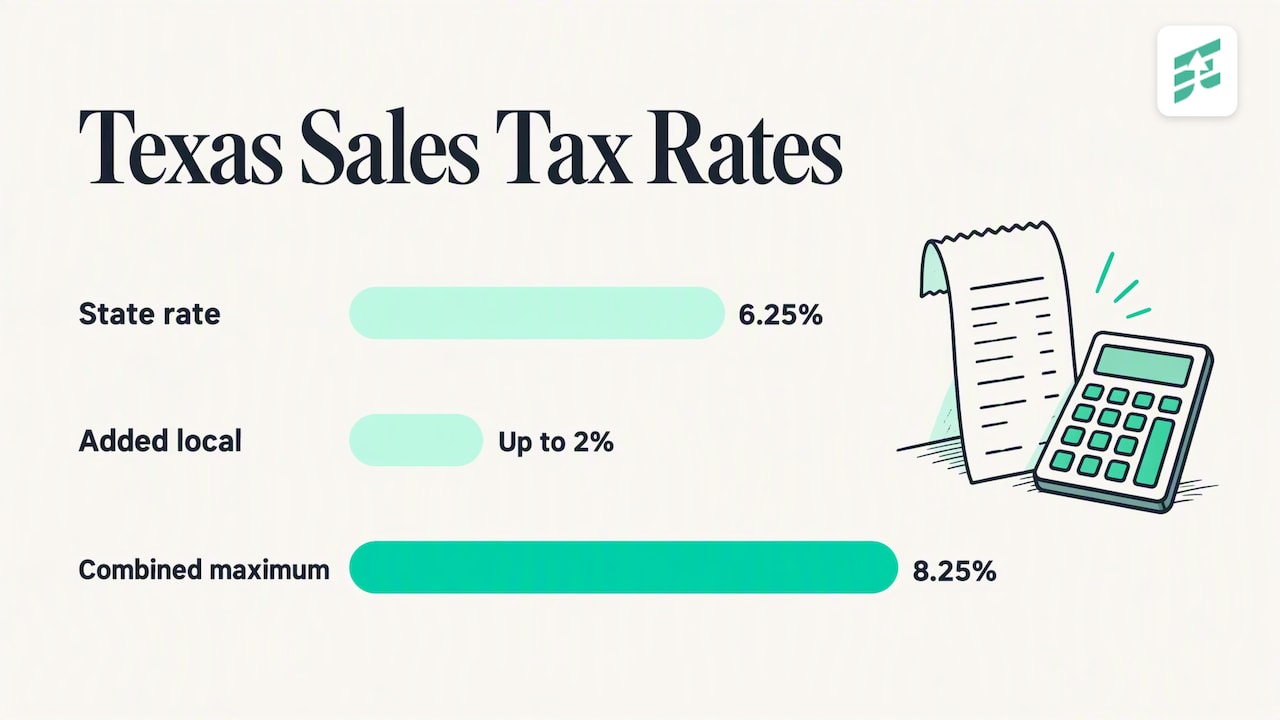
Texas defines taxable services in its tax code and groups them into 16 broad categories, each covering many specific services. The state rate is 6.25 percent, and local jurisdictions can add up to 2 percent, for a combined maximum of 8.25 percent. If you perform anything near the categories (data processing, repair, real property services), read the category text rather than guessing from your job title.
Florida: specific services, and a surtax trap
In Florida, sales tax applies to goods, admissions, transient rentals and only certain services. Nonresidential cleaning, pest control and some security services are on the list. One detail that surprises owners: the state’s cleaning-services guidance says the $5,000 discretionary sales surtax cap does not apply to services, so surtax is due on the full service charge. Local surtax rates vary by county, so the county where the service is performed matters.
New York: mostly retail goods, with a defined service list
New York’s sales tax applies primarily to retail sales of tangible personal property, and it extends to a defined set of services. Most professional services are not on that list. If you do a mix, such as installing a product and billing labor, how you structure and itemize the invoice can change the answer, so ask before you assume.
Oregon: no general sales tax
The Oregon Department of Revenue states plainly that Oregon has no general sales or use tax. That is good news for an Oregon service business selling to Oregon customers. It does not end the analysis. Oregon businesses that serve customers elsewhere, travel to work in another state, or sell into a state like Washington can run into that state’s rules. Washington publishes its own list of retail services subject to sales tax, and it is broader than many owners expect.
Are your services taxable? A five-step check
- Pin down where the service is performed and delivered. Taxability usually follows the customer’s location or where the work happens, not where your office is.
- Describe the service precisely. “Consulting” and “maintenance” mean different things to a tax auditor. Write what you actually do, step by step.
- Find the state’s list or default rule. Use the department of revenue’s own guidance for that state. Look for the section on taxable services, and for any classification codes it references.
- Check for mixed charges. If one invoice combines taxable and non-taxable items (labor, materials, software, delivery), find out whether the state requires separate itemization.
- Check exemptions and customer type. Resale, nonprofit and government customers may be exempt if they give you a valid certificate. Keep it on file.
Then write down the conclusion and the source. If an auditor asks in three years, that record is your best asset.
Responsibilities and risks when you collect sales tax
Once your service is taxable, the burden moves to you. State agencies are clear that the provider must register and collect tax from customers, and Florida’s guidance for new businesses makes the point that missing a statutory change is not a valid excuse. Penalties for late filing and underpayment can be steep in many states.
A few practical risks to plan for:
- Registering late. You generally need a permit before your first taxable sale, not after.
- Casual or occasional sales. Some states, Iowa among them, have rules for incidental sales outside your regular business. Do not assume a one-off sale is automatically tax-free; check the state’s threshold.
- Relying on payment reports. The IRS says all income is taxable unless the law says otherwise, whether or not you receive a Form 1099-K. The same logic applies to sales tax: the absence of a form from a payment platform does not mean you have no obligation.
- Weak records. Taxability decisions made informally by whoever sent the invoice are hard to defend. A written, repeatable process helps; a guide to the steps teams use to capture evidence for a compliance audit shows how to document why a decision was made, not just what it was.
The hidden cost: tax on the services you buy
Taxability also cuts the other way. In states that tax business-to-business services, you may pay sales tax on your own accounting, marketing or legal providers. The AICPA calls the effect tax pyramiding: tax stacks at each stage of the supply chain and inflates your costs. For a small firm it shows up in cash flow and in how you price. If you operate in a state that taxes business inputs, ask whether certain purchases qualify for a resale or other exemption, and whether how you structure the work or the entity matters.
Our perspective
Most sales tax problems we see are not exotic. They come from owners who treat sales tax as a separate, annoying task rather than part of how the business is priced, booked and planned. A service gets added, a new state gets a customer, and nobody asks whether the rule changed.
We approach it the way we approach everything: year-round and connected. Taxability should be settled when you launch an offer, not discovered in a notice. That means your pricing, your invoicing system, your bookkeeping and your tax planning all agree on what is taxable, where, and why. When your books are clean, QuickBooks can carry the tax setup. When they are not, a taxability rule is only as good as the person remembering to apply it.
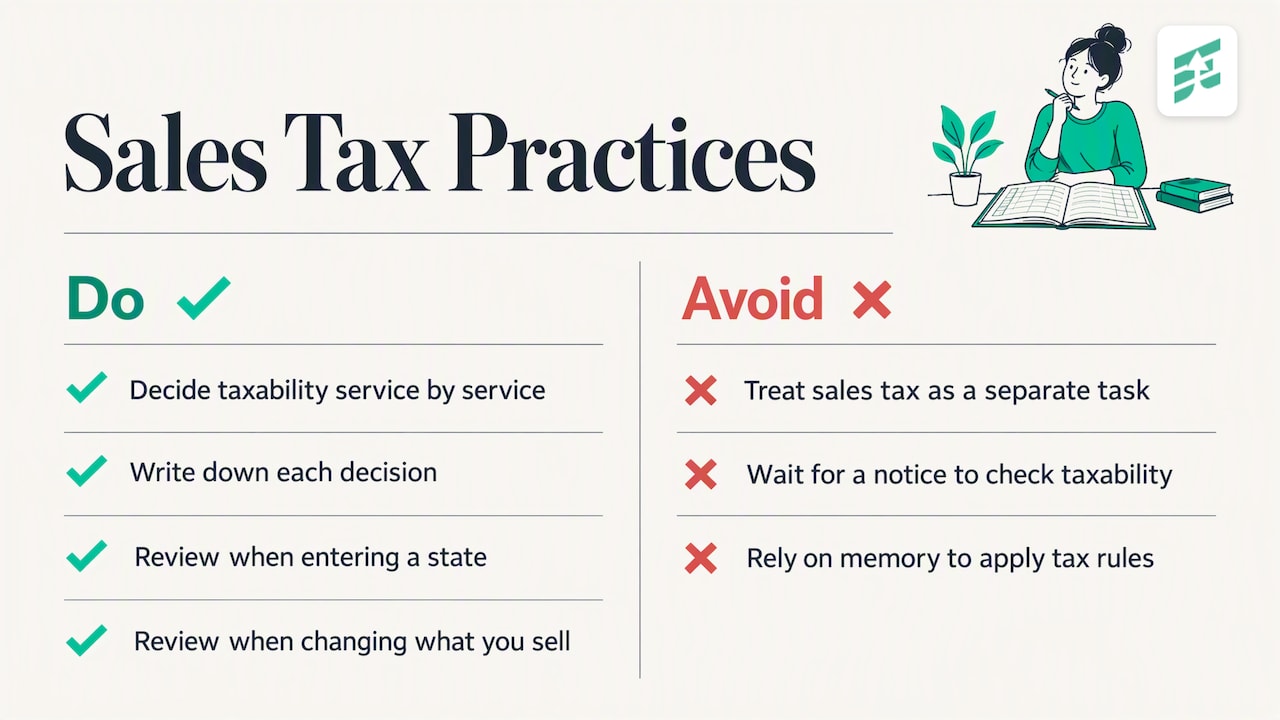
Our practical advice: decide taxability service by service, write it down, review it when you enter a new state or change what you sell, and treat a proposal to expand a state’s tax base as a planning signal rather than distant news. This is state-specific law, so confirm any conclusion for your own facts with the state’s revenue department or a CPA.
— Justin Ash, CPA
Where we can help
Elevate Business Consulting is a CPA firm based in Medford, Oregon, serving small businesses, startups, real estate investors and cannabis operators. We handle tax planning and preparation, accounting, payroll and business advisory as one connected service. If you are unsure whether your services are taxable, or you are about to expand into another state, we can work through it with your books in front of us. Tidy records make this easier, which is why many clients start with our bookkeeping services.
FAQ
Are services taxable in every state?
No. Five states have no general sales tax, and in most of the others only listed services are taxed. Hawaii, New Mexico, South Dakota and West Virginia are the exceptions that tax services by default. Always check the specific state and the specific service.
Do you charge sales tax on services in Florida?
Only on certain services. Florida taxes goods, admissions, transient rentals and specific services, such as nonresidential cleaning and pest control. Most professional services are not on the taxable list, but the rules depend on the exact service, so confirm with the Florida Department of Revenue.
Do you charge sales tax on services in New York?
Mostly no. New York taxes retail sales of goods and a defined list of services, including telephone services, certain information services and services to property such as parking and laundering. Professional services are generally not taxed.
Do I owe sales tax on services if my state has none?
Not to your own state, if it has no general sales tax, as in Oregon. But if you deliver services into or perform them in another state, that state’s rules may apply. Check each state where you have customers or do work.
Does a CPA need to be involved?
Not for every service business, but it helps when you sell in several states, mix goods and services on one invoice, or are unsure how a service is classified. A CPA can document the conclusion and align it with your books and tax plan.
Sources
- State-by-state guide to charging sales tax on services, Avalara
- Sales and Use Tax on Cleaning Services, Florida Department of Revenue
- Transactions that are not subject to sales tax, New York State
- Sales and use tax: tax expenditure estimates, New York State
- Taxable Services, Texas Comptroller
- Sales and Use Tax, Texas Comptroller
- Sales Tax in Oregon, Oregon Department of Revenue
- Services subject to sales tax, Washington Department of Revenue
- Taxes on professional services, AICPA & CIMA
- Considering Business Opportunities in Florida, Florida Department of Revenue
- Iowa Sales and Use Tax: Taxable Services, Iowa Department of Revenue
- IRS Form 1099-K FAQs