

Good startup bookkeeping comes down to five things you do in your first weeks. Open a separate business bank account. Pick cloud accounting software. Build a chart of accounts that fits how you earn money. Choose an accounting method. Then categorize and reconcile on a fixed schedule. Do these early and tax season is a review. Skip them and you will pay someone to rebuild months of history later.
This guide walks through each step in order, shows a 90-day checklist, and explains when a startup is better off handing the work to a CPA. We are a CPA firm in Medford, Oregon, and we see the same patterns in new businesses every year.
TL;DR
- Separate business and personal money on day one, with a dedicated bank account and card.
- Use cloud accounting software and categorize transactions weekly, not once a quarter.
- Decide between cash and accrual accounting before your first tax return, because changing later can need IRS approval.
- Treat your books as a dashboard for cash, runway and hiring decisions, not just a pile of receipts for tax time.
- Have your bookkeeping and tax work coordinated, ideally by the same firm, so categories are built for deductions from the start.
Table of Contents
- What startup bookkeeping actually covers
- Step 1: Separate your money first
- Step 2: Choose software and a chart of accounts
- Step 3: Pick cash or accrual before your first return
- Step 4: Build the weekly and monthly routine
- Your first 90 days: a bookkeeping checklist
- Use the books as a dashboard, not an archive
- Where startups lose money on bookkeeping
- Should you do it yourself, hire a bookkeeper, or use a CPA firm?
- Our perspective: bookkeeping is the first tax strategy
- Work with a CPA from the start
- FAQ
- Sources
What startup bookkeeping actually covers
Bookkeeping is the daily record of money moving through your business: income, expenses, purchases, payroll, loans, and owner contributions or draws. Accounting sits on top of it. It turns those records into financial statements, tax filings and advice.
The distinction matters for a startup because the two jobs need different skills. A bookkeeper keeps the ledger accurate. A CPA decides what the numbers mean for your taxes and your next move. NerdWallet’s startup bookkeeping guide recommends having both in your corner, and it also advises having the bookkeeper set up your chart of accounts.
Startups also have problems that a corner-shop bookkeeping setup does not cover:
- Money arrives in uneven lumps: a seed round, a grant, a few big invoices, then nothing for six weeks.
- Founders often pay early expenses personally and expect to be reimbursed.
- Contractors, software subscriptions and equipment all show up before revenue does.
- Outsiders such as lenders, investors and landlords may ask for statements before you feel ready.
Step 1: Separate your money first
Open a business checking account and a business credit card before the first real expense. It is the cheapest bookkeeping decision you will make and the hardest one to fix after the fact.
There is also a legal reason. The SBA notes in its financial tips for new business owners that mixing personal and business finances can put the liability protection of your entity at risk. If you formed an LLC or corporation, commingled funds make it easier for someone to argue the entity is not really separate from you.
A few rules we give every new client:
- Pay business expenses only from business accounts.
- If you slip and pay personally, record it as an owner contribution or a reimbursable expense, never as a mystery transaction.
- Move money to yourself through draws or payroll, in clean, labeled transfers.
- Keep one dedicated email address or inbox folder for receipts and vendor invoices.
If you have not formed your entity yet, do that first. Our business formation services and LLC formation help cover the paperwork, and the entity you pick shapes how you are taxed. Our comparison of LLC and S corporation taxes is a good place to start.
Step 2: Choose software and a chart of accounts
For most startups, cloud accounting software is the right default. It connects to your bank feeds, stores receipts, and gives you reports without a spreadsheet rebuild each month. QuickBooks Online is the tool we see most often, and we offer QuickBooks consulting for founders who want it set up properly rather than left on factory settings.
The software matters less than what you put in it. The chart of accounts is the list of categories every transaction lands in, and a generic template will not fit most businesses. Consider a software startup, a rental property and a cannabis retailer. Their revenue streams, cost of goods and compliance needs look nothing alike.
A workable chart of accounts for a startup usually has:
- Revenue accounts split by stream, such as subscriptions, services, product sales and grants, so you can see what is actually working.
- Cost of goods or cost of services, separate from overhead, so gross margin is real.
- Operating expenses in tax-friendly groups: software, contractors, marketing, travel, meals, professional fees, home office.
- Equity accounts for owner contributions, draws and any investor capital.
- Liability accounts for loans, credit cards, sales tax and payroll taxes payable.
Keep it short. Thirty to fifty well-chosen accounts beat two hundred overlapping ones. If you want a longer walk-through, see our guide to a startup accounting system that scales.
Step 3: Pick cash or accrual before your first return
Your accounting method decides when income and expenses count. Under the cash method, you record them when money changes hands. Under accrual, you record them when they are earned or incurred, whatever the payment timing. The IRS explains both in Publication 334, the tax guide for small business, and notes that you must use the same method to figure taxable income and to keep your books.
Here is how the two differ for a startup:
| Cash method | Accrual method | |
|---|---|---|
| Income counted | When you receive payment | When you earn it, such as when you invoice |
| Expenses counted | When you pay | When you incur the bill |
| Complexity | Low | Higher |
| Best fit | Very early service businesses with few invoices | Businesses with inventory, subscriptions, receivables or investors |
| Picture of performance | Can swing with payment timing | Matches revenue to the period it relates to |
Neither is automatically right. Some businesses have limits on which method they can use, and the rules depend on your entity type, inventory and size, so confirm yours with a CPA before you file. What we tell founders is simple: decide deliberately, not by default. Changing methods later generally requires filing with the IRS, so the first choice sticks longer than people expect.
Step 4: Build the weekly and monthly routine
Startup books fall apart for a boring reason: nobody has time. A short routine beats a heroic cleanup.
Weekly (30 minutes)
- Categorize new bank and card transactions.
- Match receipts to expenses, and chase any that are missing.
- Send invoices and check who is overdue.
Monthly (a few hours, or your bookkeeper’s job)
- Reconcile every bank, card and loan account to its statement.
- Review the profit and loss statement and balance sheet for oddities.
- Record payroll and payroll tax liabilities.
- Review cash position and a short forecast.
Quarterly
- Review estimated tax payments. Our explainer on quarterly estimated tax payments covers how they work.
- Check categories against your year-round tax plan.
Yearly
- Close the books, produce year-end reports and hand a clean file to your tax preparer.
How long to keep the records
The IRS says the general rule is three years for most business records, though it varies with the document, and employment tax records should be kept at least four years. Digital copies of receipts and statements save you a filing cabinet. Ask your CPA about longer retention for anything tied to assets, property or losses you carry forward.
Your first 90 days: a bookkeeping checklist
Use this as a working list. Dates are relative to the day you start spending money.
Week 1: foundation
- Form your entity and get your EIN.
- Choose your accounting method with your CPA.
- Decide who owns the books: you, a bookkeeper, or your CPA firm.
Weeks 2 to 4: accounts and tools
- Open the business bank account and credit card.
- Set up cloud accounting software and connect the bank feeds.
- Build the chart of accounts around your real revenue streams.
- Set up a receipt capture method and a vendor invoice inbox.
- If you will hire, decide on payroll. Our payroll processing services handle runs and tax deposits.
Weeks 5 to 8: routines
- Run your first weekly categorization, then the first monthly reconciliation.
- Fix mis-categorized items while they are still easy to remember.
- Record owner contributions and any pre-launch expenses you paid personally.
- Collect W-9s from contractors before you pay them.
Weeks 9 to 13: reporting
- Produce your first full month-end package: profit and loss, balance sheet, cash flow.
- Build a simple runway number: cash on hand divided by average monthly net burn.
- Set calendar dates for estimated taxes and payroll filings.
- Book a planning conversation with your CPA before year end, not after.
Use the books as a dashboard, not an archive
The biggest mistake we see is treating bookkeeping as passive record keeping. Financial advisers who work with venture-backed companies make the same point: providers should understand startup dynamics such as cap tables, burn rate and R&D credits rather than just code transactions.
That is the right standard for any early-stage company, venture-backed or not. Your books should answer a handful of questions at any time:
- How many months of cash do we have at the current burn rate?
- Which revenue stream has the best margin?
- Can we afford the next hire?
- What do we owe in taxes, and when?
Timeliness matters as much as accuracy. NerdWallet’s reporting on startup financial data points out that monthly-only reporting can leave founders learning their true cash position weeks after it started to matter. A weekly categorization habit closes that gap, and our cash flow forecasting guide shows how to project forward from clean data.
Clean books also widen your options when cash gets tight. A lender, whether a bank or an alternative provider, will ask for statements and proof of revenue. If you are weighing short-term financing, read up on title loans for business cash flow and run the numbers against your forecast first. Borrowing against a vehicle is a serious decision, so compare the full cost with what a CPA can model for you.
Where startups lose money on bookkeeping
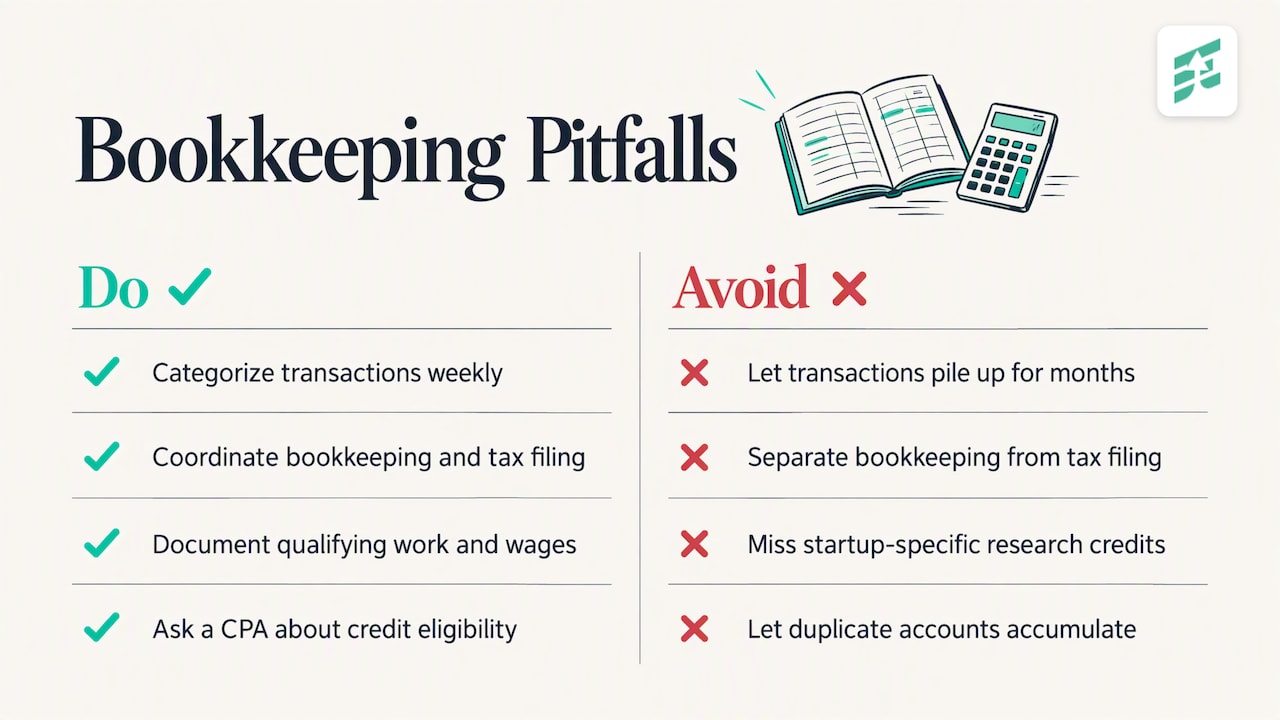
Reconstructing history. Letting three months of transactions pile up before you categorize them means you are guessing at what each charge was. Rebuilding is slower and more expensive than a weekly routine.
Splitting bookkeeping and tax. When the person coding expenses never talks to the person filing the return, deductions slip through and categories need rework. Practitioners cited by NerdWallet note that having both handled by one firm, or closely coordinated, produces a cleaner audit trail. This is why we pair bookkeeping with tax planning instead of selling them as separate silos.
Missing startup-specific credits. Some young companies with little or no income tax liability can use research activity to offset payroll taxes. The IRS explains that qualified small businesses can apply part of their research credit against payroll tax, with a limit of $500,000 per year for tax years beginning after December 31, 2022. The election is made on Form 6765 and claimed with Form 8974. Eligibility is technical, so documentation of qualifying work and wages from the start makes a real difference. Ask a CPA whether you qualify.
Letting the software sprawl. Duplicate accounts, uncategorized transactions and old test entries pile up. If that has already happened, our QuickBooks cleanup checklist shows how to fix it step by step.
Should you do it yourself, hire a bookkeeper, or use a CPA firm?
The right answer changes as the business grows.
| Stage | What usually works |
|---|---|
| Pre-revenue, a handful of transactions | You, in cloud software, with a CPA reviewing setup and method |
| First customers, first contractors | A part-time bookkeeper or a firm, with monthly reconciliation |
| Employees, inventory, or outside investors | A firm that handles bookkeeping, payroll and tax together |
| Regulated or specialized industry | A CPA who knows the industry rules |
The industry piece is easy to overlook. Real estate investors need to track property-level income, depreciation and loans. Our real estate accounting services and guide to deductions landlords should track cover that ground. Cannabis businesses face their own tax and cost-tracking issues, which we address in our cannabis accounting services.
Our perspective: bookkeeping is the first tax strategy
We work with small businesses, startups, real estate investors and cannabis operators, and the pattern holds across all of them. The clients who save the most on taxes are rarely the ones with the cleverest tactic. They are the ones whose records are current enough that we can make decisions in June instead of discovering problems in March.
That is why we do not treat bookkeeping, payroll, tax and advice as separate jobs. A category choice in January becomes a deduction in April. A payroll setup in week three becomes a clean quarterly filing. A cash forecast in the spring tells you whether to buy equipment before year end.
Our advice to a founder starting from zero is short. Separate the money, pick a method on purpose, keep a weekly habit, and talk to a CPA before big decisions rather than after them. Good books should make the next decision easier. If they only record the last one, they are not doing their job.
— Justin Ash, CPA
Work with a CPA from the start
If you want the setup done right the first time, Elevate Business Consulting handles bookkeeping that helps you plan ahead, alongside tax planning, payroll and advisory for small businesses. We are based in Medford, Oregon, and we work with founders who want year-round guidance rather than a once-a-year tax return. You can see everything we offer on our main site and reach out to book a consultation.
FAQ
When should a startup start bookkeeping?
From the first dollar you spend or earn, including pre-launch costs. Early records support deductions, show lenders and investors where the money went, and avoid the expensive cleanup that comes from reconstructing months later.
Do I need a bookkeeper if I am a solo founder?
Not always. If you have only a few transactions a month, cloud software and a weekly routine may be enough, as long as a CPA reviews your setup and accounting method. Once you add contractors, employees, inventory or investors, outside help usually pays for itself in saved time and fewer errors.
Should a startup use cash or accrual accounting?
It depends on your entity, size, inventory and goals. Cash is simpler, while accrual gives a truer picture of performance when you invoice customers or sell subscriptions. Choose before your first tax return, because changing methods later generally needs IRS involvement, as Publication 334 explains.
How long do I have to keep my business records?
The IRS general rule is three years, but it depends on the record, and employment tax records should be kept at least four years. Keep digital copies organized by year and ask your CPA about anything tied to assets or carryforward losses.
What is the difference between bookkeeping and accounting?
Bookkeeping records and organizes your transactions. Accounting interprets them: financial statements, tax planning, filings and strategy. Startups benefit from both, and having them coordinated keeps your expense categories aligned with your tax return.
Sources
- IRS Publication 334, Tax Guide for Small Business
- IRS: Common questions about recordkeeping for small businesses
- IRS: Qualified small business payroll tax credit for increasing research activities
- SBA: 5 key financial tips when starting a business
- NerdWallet: Bookkeeping for startups, 9 best practices
- Digits: Essential bookkeeping services for startups